Posts Tagged ‘Baptistery’

Why We Keep Asking “Was Machiavelli an Atheist?”
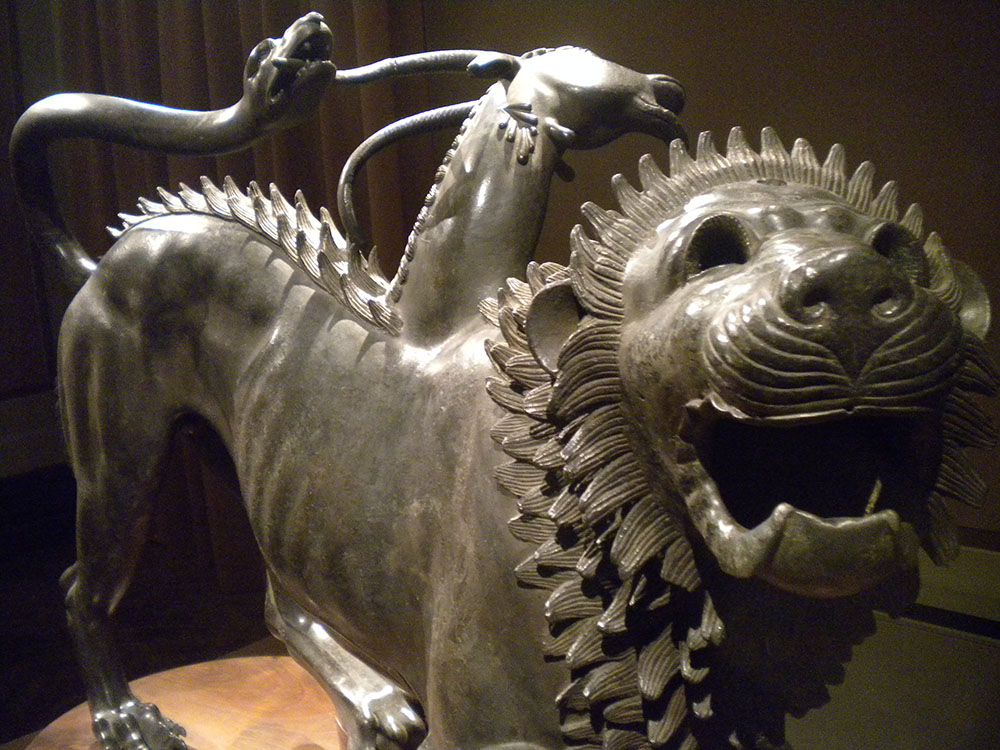
I can't come up with any really appropriate illustrations for this entry, so am including random pictures of cool objects from Florence, since Machiavelli likes Florence. This is the Chimera, the most impressive Etruscan bronze ever excavated in Tuscany, now in the Florentine Archaeological Museum. (The Etruscans were contemporaries and rivals of the early Romans).

Was Machiavelli an atheist?  We don’t know and never will, but we can learn much about our society’s attitudes toward atheism by examining the persistence of the question, and the different reasons we have asked it over and over for centuries even though we know we have no proof.

(This is the last entry in my Machaivelli series.  See also Machiavelli Part IPart I.5Part IIPart III and Part IV)

No historical discipline can be honestly called “neutral”, but the study of atheism (and of its cousins skepticism, deism, and more general freethought, heterodoxy and radical religion) has always been particularly charged because it is so impossible to be detached from the central question.  Setting aside the elaborate and bloody history of religious violence, oppression and entanglement in politics, whether you answer “No,” “Yes,” “Maybe,” or “Sort-of,” the question of whether or not there is a divine force and/or being(s) ordering or governing the cosmos, your answer has an enormous impact on your everyday actions, decision-making, ethics, attitudes toward law and government, and every other corner of the human condition.  Even if religion and government had never mixed in the history of the Earth, if tomorrow you encountered irrefutable proof that the answer to the question was the opposite of what you had hitherto believed, your life and actions thenceforth would be radically different.  The stakes are high, and personal.  This makes it hard for historians to be calm about it.

Historians did not try to be calm about it in the early, juicy days when atheism was first presented as having a history.  In the late sixteenth and seventeenth centuries, pamphlets and books discussing famous atheists were a thriller genre, scandalous tales of tyrants and madmen which occupied largely the same niche as biographies of serial killers, or penny museums displaying the death masks of executed murderers.  Treatises on “Infamous Atheists” served a slightly more learned audience than wax heads and the numerous early versions of the Sweeny Todd legend, but only slightly, and as they proliferated in printing shops tales of the scandalous excesses of Tiberius and Caligula under the label “atheist” were part morality play, part voyeurism, and part slander as each particular collection targeted its audience’s enemies.  French collections accused Italians and Englishmen of atheism while Italian collections accused Frenchmen; Catholic collections accused Martin Luther and John Calvin of atheism, while Protestant collections accused popes and papists, and almost all European collections accused Muslims and Jews of atheism in a spirit of general racism and lack of accountability and lexical clarity.
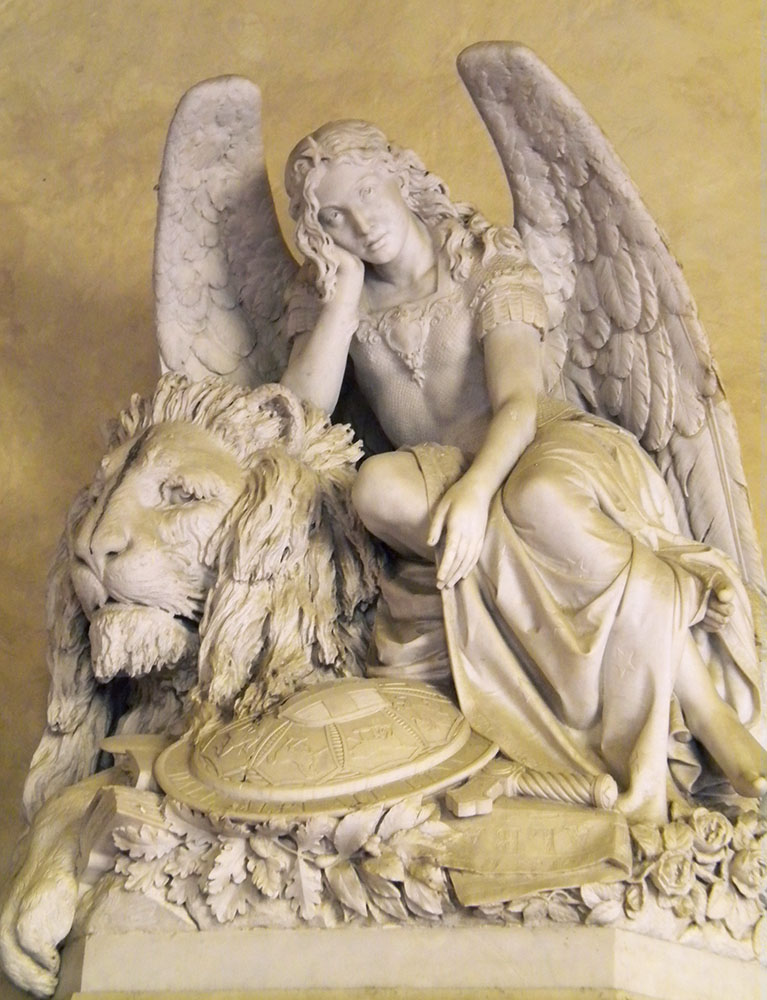
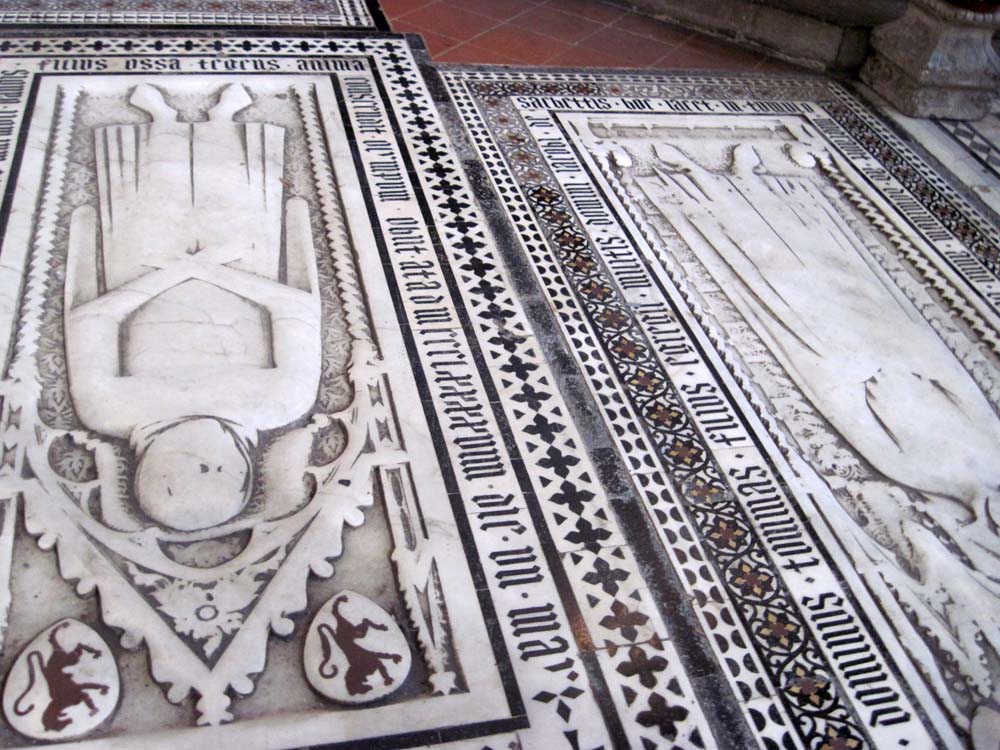
An awesome Baroque tomb, in the Santa Croce cloister.

You may note that neither Martin Luther nor Caligula is on record as ever having philosophically attacked the existence of God, but the logic chain of these collections is, from our perspective, backwards: (1) Fear of Hell drives men to good behavior.  (2) These men were bad.  (3) These men did not fear Hell.  (4) These men were atheists.  In the Renaissance, sinful living in overt defiance of divine law was considered evidence of atheism, to the degree that we have records of many atheism trials from the fourteenth through sixteenth centuries in which the evidence brought by the prosecution involves no statement of unbelief on the part of the accused.  Rather the evidence will be sinful living, promiscuity, homosexuality, gluttony, irreverence of civic and religious authority, anything from a monk taking in a mistress to a drunkard running around in public with no pants on (See Nicholas Davidson, “Atheism in Italy 1500-1700,” in Atheism from the Reformation to the Enlightenment, ed. Michael Hunter & David Wootton (Oxford, 1992), 55-86, esp. 56-7).

Serious attempts to write a history of atheism began in the later nineteenth century, when secularization had progressed enough that an atheist was no longer a thrilling exotic creature, but was instead a black sheep in a land with many, many sheep of which some were even more alarming colors than black.  It was also at this point that histories of atheism bifurcated.  Some presented pessimistic accounts (by theist authors) of the modern decay of morals as atheism proliferated, while others presented optimistic accounts (by guess who) of the progress of secularization.  Even in their more objective accounts, when dealing with earlier periods when atheism was rare and its traces elusive, these historians were, or rather we historians are, still prone to hyperenthusiasm when we think we have found what we are looking for, as whale watchers may mistake any dark shape for a humped back.

Everyone (whether theist or atheist) who studies pre-modern atheism is excited when we find evidence of it.  This is because secularization, this brave new world in which atheism is both commonplace and legal, is an essential characteristic of the modern Western world, one of its unique features, differentiating us, here, now, from all earlier times and all other places.  When I say the modern world is secularized I do not mean that atheism is a majority or even a plurality—it remains a small minority.  What I mean is that atheism is universally present in Western discourse as a coequal interlocutor in theological debate, and all contemporary Western theists have lived their whole lives in contact with atheism, debating with atheists or at least expecting they might have to do so, and generally knowing that atheism is a commonplace alternative to their own views.  This is radically different from the pre-modern situation, in which people saw atheists as elusive and invisible enemies (rather like vampires), and most books on the subject described atheism as a form of mental illness (often thought to be inborn), or as a moral perversion (compared in the period to homosexuality), while the genuine philosophical atheist was expected to be so extraordinarily rare that we might see only a couple in a century (such categories are employed by David Derodon in his treatise L’atheism Convaincu (1659), see Alan Kors, Atheism in France (1990), p. 28).
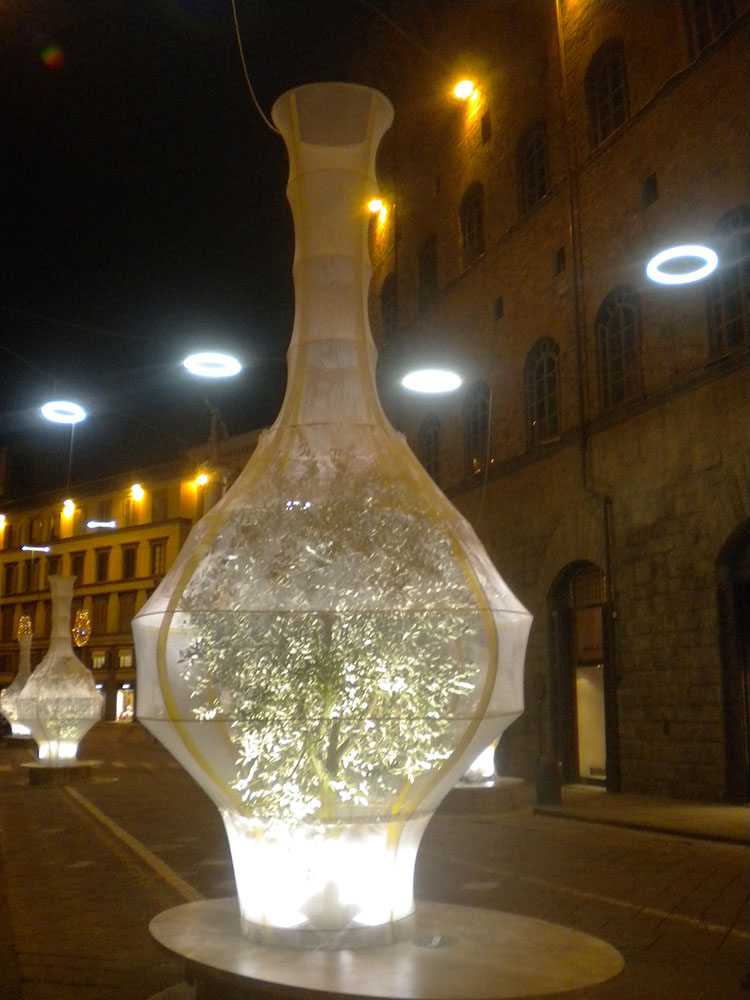
In Florence's $1,000 Purse District, holiday decorations last year consisted of live olive trees inside huge gauze vases with floating neon halos above. Why not?

If the study of history is more than mere delight in exciting stories of past exploits, it is an attempt to understand our origins and ourselves.  When we comb the past and spot something characteristically modern—be it the scientific method, hygiene, feminism or atheism—we are excited because we have found an early trace of home.  Religious tolerance and the presence of atheism as a coequal participant in religious discourse in our own day is part of what makes us radically different from our predecessors.  The following claim may seem counter-intuitive, but if I were to send an average modern American theist back in time to the seventeenth century, I think that person would debate more comfortably with an early atheist than with a theist of the same era, because the atheist, while disagreeing with our time traveler, would be disagreeing with somewhat familiar vocabulary and justifications, while the seventeenth-century theist would be going on about Aristotle, and teleology, and angels pushing the Moon around, and other fruits of an alien religious conversation that has no experience of 90% of the theological issues which our modern time traveler is used to considering.  The seventeenth-century atheist probably knows what “natural selection” is (he read about it in Lucretius) but the corresponding theist probably hasn’t read such a rare and stigmatized text, so when our time traveler says “I want a proof of the existence of God that stands up against natural selection,” the atheist can have that conversation, while the theist is much less prepared.  For most Renaissance theists Thomas Aquinas’ Proof of the Existence of God from Design is unassailable; for us, it’s been assailed every minute of every day of our lives; for the early atheist, it has an assailant, and it’s a similar assailant to the one we moderns are used to, so we can talk about it with the atheist and feel more at home than if we tried to talk to a theist who had never experienced any such attack.  A pre-modern theist is, of course, well prepared for attacks from heresies we no longer worry much about: Arianism, Averroism, Antinomianism, but Darwin is a bolt from the blue.  Not so much so for the early atheist, who, whether right or wrong, is more prepared for modern conversations than the average theist of his day.  Thus, for atheists and believers alike, the history of atheism is the history of theology coming to be shaped more like what we’re used to in the modern era.  Hence why even a theist historian thinks it’s super special awesome when we spot a bona fide atheist before the Enlightenment.

The study of what was going on with atheism before the mid-seventeenth century is not, and cannot be, the study of actual atheists.  There are none for us to study.  There may have been some, there may not, but in a period when saying “I think there is no God” led pretty directly to arrest and execution, no one said it.  No one wrote it.  If anyone thought it, not even private letters can confirm.  Knowing that an atheist won’t fess up in documents, we historians naturally read between the lines, seeking hints of heterodoxy in the subtext of a treatise or the double meaning of a couplet.  This is the only place we can realistically expect to find evidence, but it is also prone to giving us false positives.  As Lucien Febvre put it in his enormously influential The Problem of Unbelief in the Sixteenth Century: the Religion of Rabelais, we moderns are bound to see that rare beast the atheist around every dark corner.  We see him because we want to.
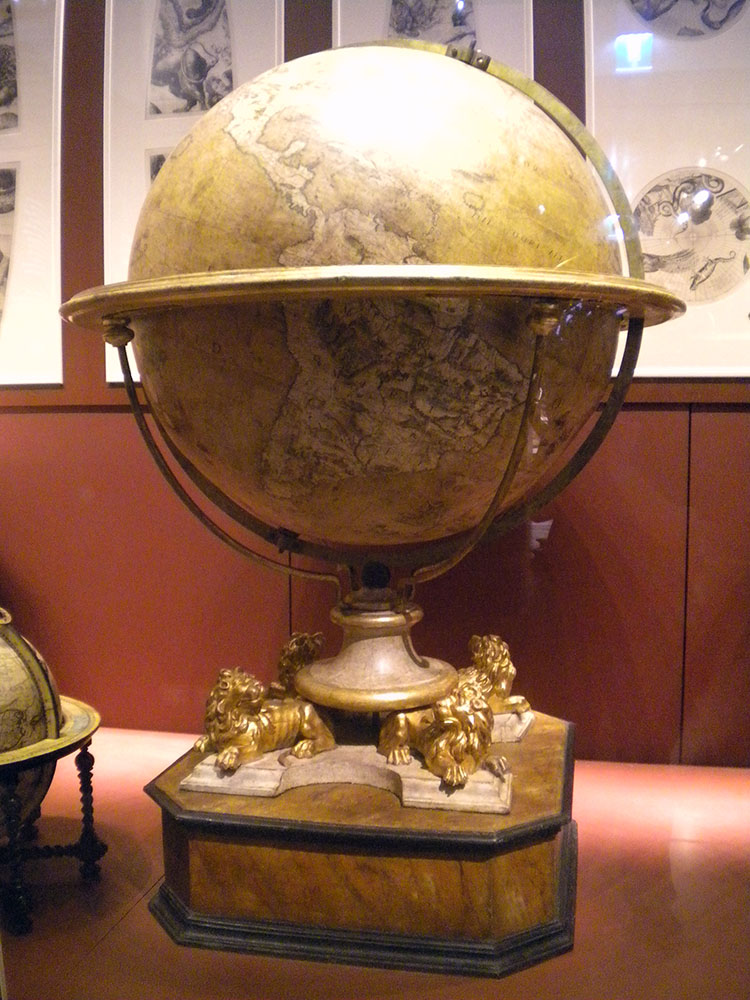
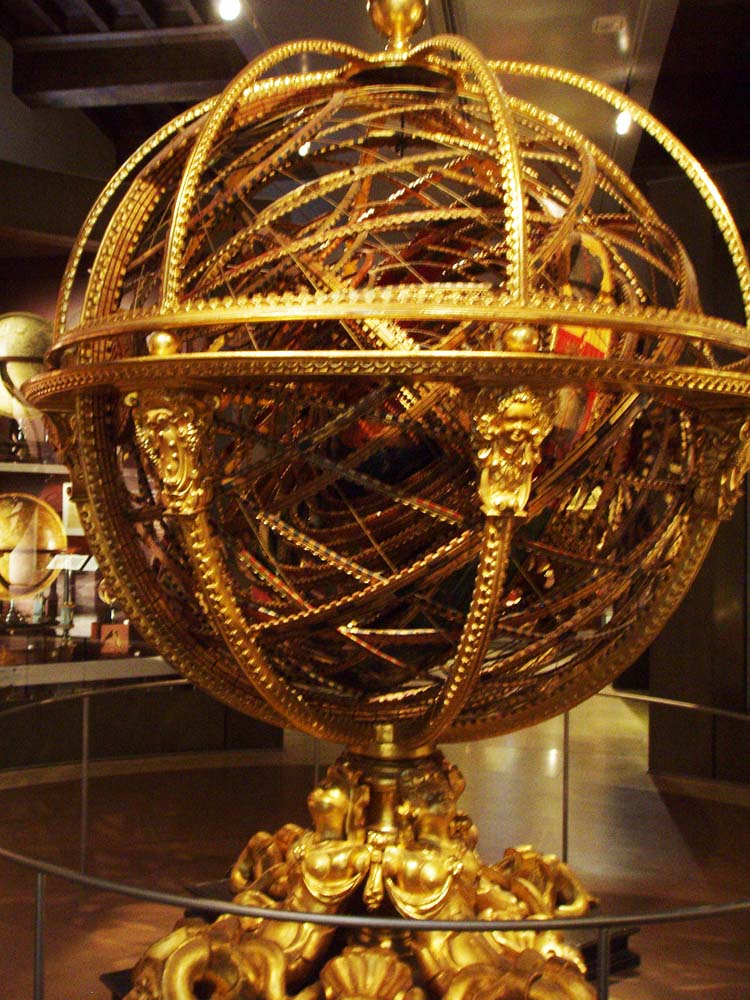
Why have an enormous awesome globe when you can have an enormous awesome globe sitting on gold lions?

The first really real for sure definite actual atheists who, by golly, said they were atheists (OMG!) date to the mid-seventeenth century, the Libertine movement, when a push toward religious tolerance (largely in the name of stopping the Reformation wars of religion before they wiped out all homo sapiens on the European continent) meant that wealth and power were enough to armor figures like the Earl of Rochester and his circle (including the bone-chilling Charles Blount) sufficiently that they could be known to be atheists and survive so long as they denied it in public.  This trend strengthened in the Enlightenment.  I often compare late seventeenth- and eighteenth-century atheism to late nineteenth- and early twentieth-century homosexuality: there were circles in which one could let it be an open secret that one was an [atheist/homosexual] and it would be okay so long as one didn’t ruffle too many feathers or say anything in public or in front of civic authorities.  One was always at risk of prosecution, and if one wanted to be safe and respected one kept it carefully hidden (as Diderot hid his atheist works), but there was enough sympathy within the apparatus of power that one could write of one’s [atheism/homosexuality] in private letters, and even hint at it in public works, and more often than not be safe.  The pre-seventeenth-century atheist enjoyed no such safety, so not even in Renaissance private correspondence (where talk of homosexuality is quite commonplace) do we see even the most timid hand raised when the historian calls back: “Is anybody there an atheist?  Anybody?  Machiavelli?”

Why is Machiavelli our favorite candidate?  Many reasons.  First, he is in other ways so very modern.  Having spotted someone who thinks about history as we do, and thinks about ethics as we do, and definitely, provably thinks in a very much more modern way than others of his century, he is a natural candidate for other modern twists including atheism.

Second, he was called an atheist by so many people for so long.  The mystique of vague, beard-stroking villainy invoked by the term “Machiavellian” (Note: Machiavelli did not have a beard) falls nicely into the pre-modern logic chain: (1) Fear of Hell drives men to good behavior.  (2) Machiavelli advocates sinful behavior including lies, betrayal, murder and reign by terror.  (3) Machiavelli does not fear Hell.  (4) Machiavelli was an atheist.

But there are more focused reasons than that.  If we return to Febvre’s warning that we are prone to spot atheists in every shadow, Febvre argues that, instead of seeking the rare beast of our desiring, we should instead confine ourselves to searching for a habitat capable of supporting him; only then can we safely say that we have found him, not his shadow.  By “habitat” Febvre means the apparatus of other ideas related to atheism which make atheism easier and more likely.

Imagine that you are a biologist studying a particular fungus.  This fungus is hard to find, but often grows around the roots of a particular tree species, with which it has an unexplained but well-documented symbiosis.  You thus survey mainly regions where this tree is common.  And if you hope to trace your fungus back to before material records survive, you might trace the history of that tree species, through fossils or early human artifacts made of its wood, and conclude that, while you can’t be sure the fungus was there too, the odds are certainly better than the odds of it having been in places where its tree friend was unknown.  You have not provably found your fungus, but what you have is certainly enough to talk about, and enough to get people excited if your fungus is a truffle and may yield millions in delicious profit if your information leads to improved cultivation.
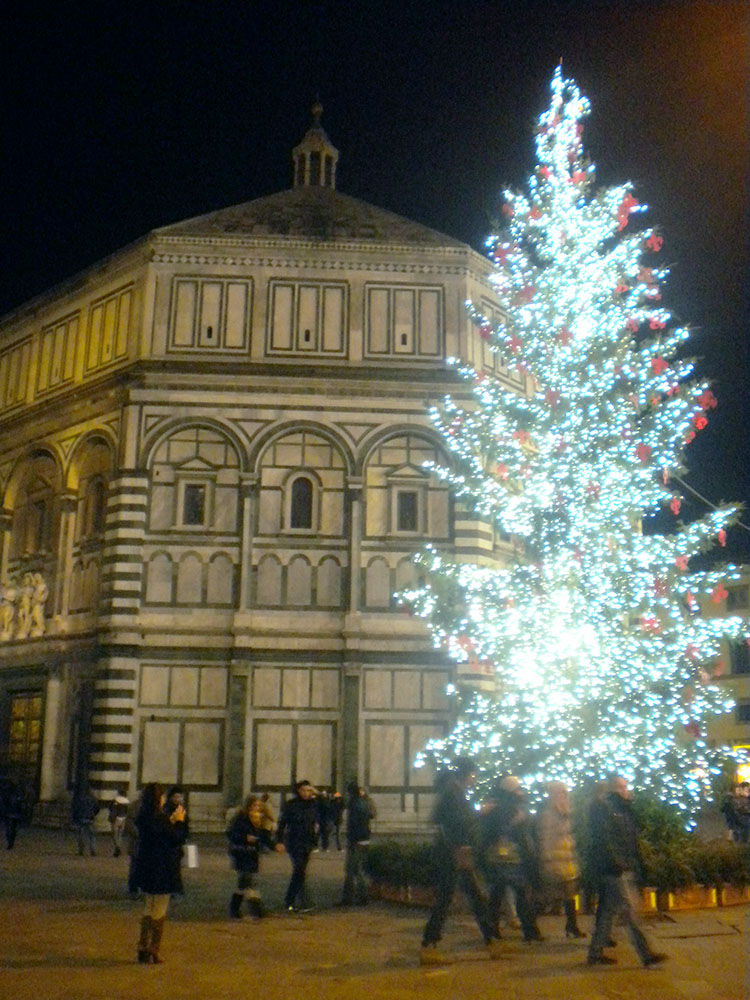
Florence struggles to find a Christmas tree that can manage to look big against its architecture.

Now, for the truffle substitute the elusive pre-1650 atheist, and for the tree substitute the ancient Greek theory that matter is made of atoms.  The two are unrelated, and the atomic theory does not attack theism in any way, but it is certainly easier for atheism to flourish when “How was the world made if God didn’t do it?” can be answered with “Atoms interacting chaotically in the void clumped together to form substances… bla bla… planets… bla bla… natural selection… bla bla… people etc.” instead of “I don’t know.”

“I don’t know,” is the centerpiece here.  Medieval and Renaissance Europe had perfectly respectable answers to all scientific and sociological questions, they just all depended on God all the time.  Take gravity, for example.  Celestial bodies are moved by angels.  As for why some earthly objects fall and others rise, morally inferior objects fall down toward Satan and morally superior ones rise up toward God, sorting themselves out into natural layers like oil and water.  Stones sink in water because Water is superior to Earth, hot air rises because Fire is superior to Air, and virtuous men go to Heaven because good souls are light and wicked souls are heavy with sins which make them fall to the circle of Hell corresponding to the weight of their sins: nine circles separated out in layers, again like oil and water.  God established the first societies, handed down the first laws, created the first languages, and directed the rise and fall of empires to communicate His Will.  If one wanted to be an atheist in the Middle Ages one had to throw away 90% of all science and social theory, and when asked “Why do rocks sink?” or “How do planets move?” or “Where did the world come from?” one had to answer, “I have no idea.”  Turning one’s back on social answers in that way is very difficult, and is part of why the study of atheism is so closely tied to the study of philosophical skepticism—only very recently have atheists had the leisure of both denying God and still having a functional model of the universe.  Early atheists had to be, largely, skeptics.  They also had to embrace a not-particularly-functional partial worldview which made rest of the world (which had a much more complete one) think they were completely crazy.  I thus sometimes compare Medieval atheists with modern creationists, since both are individuals willing to say, “I believe this one thing so fiercely that I will throw away all the other things to keep it, even if it makes everyone think I’m nuts.”  Doing this is very hard.  Doing it when other ideas are around to satisfy the gaps left by removing God from science becomes much easier.
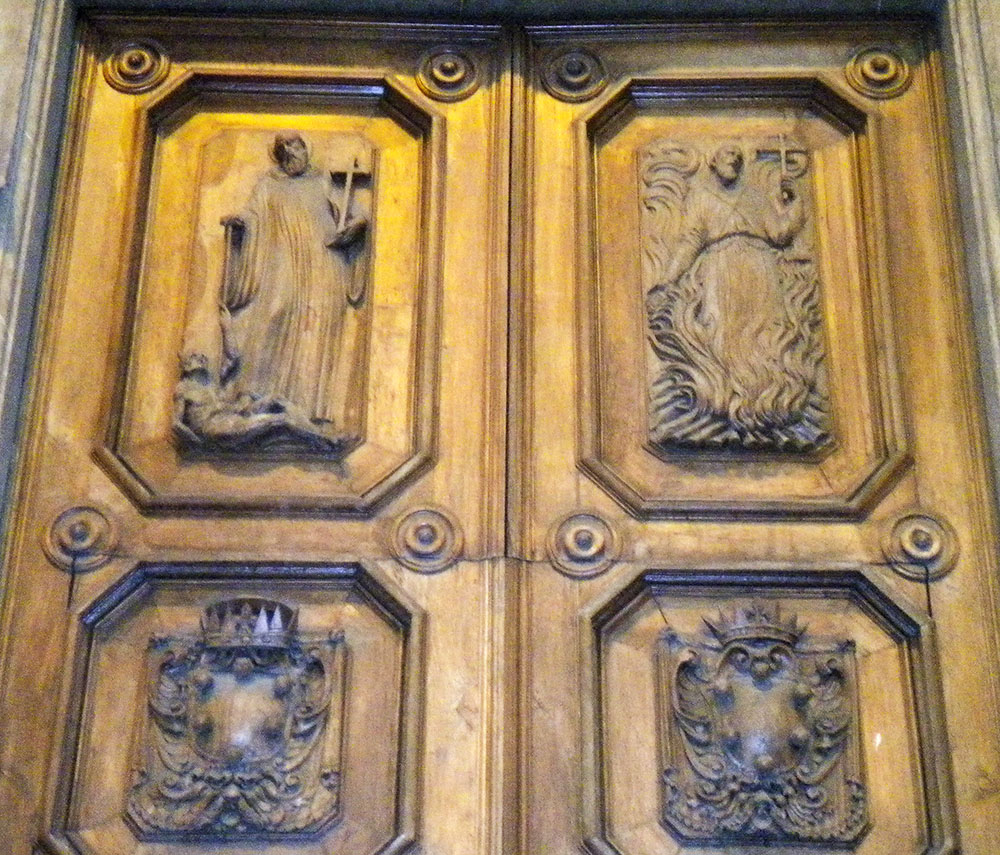
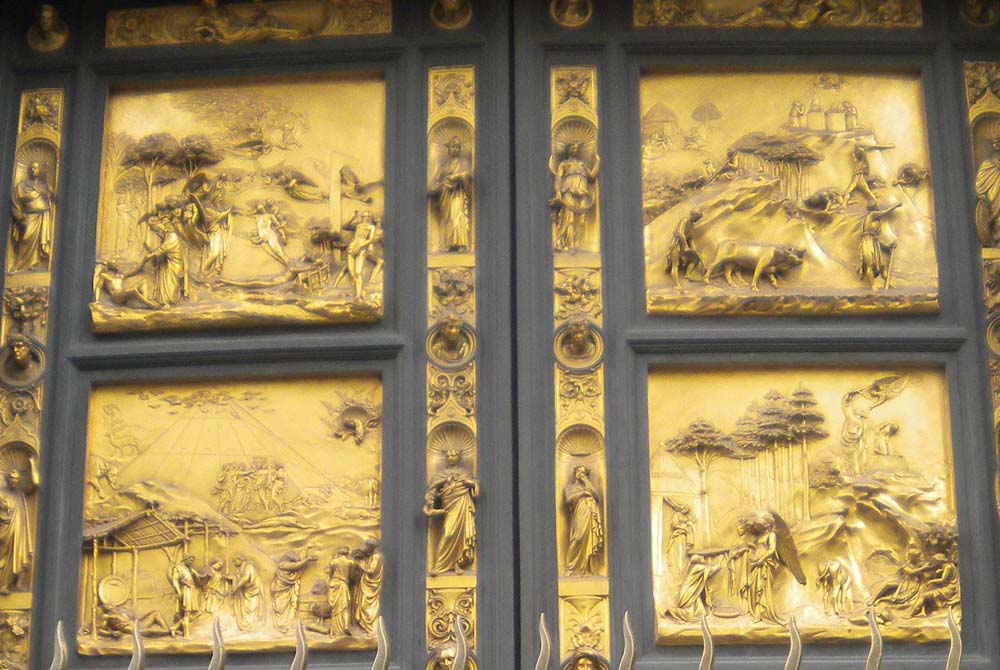
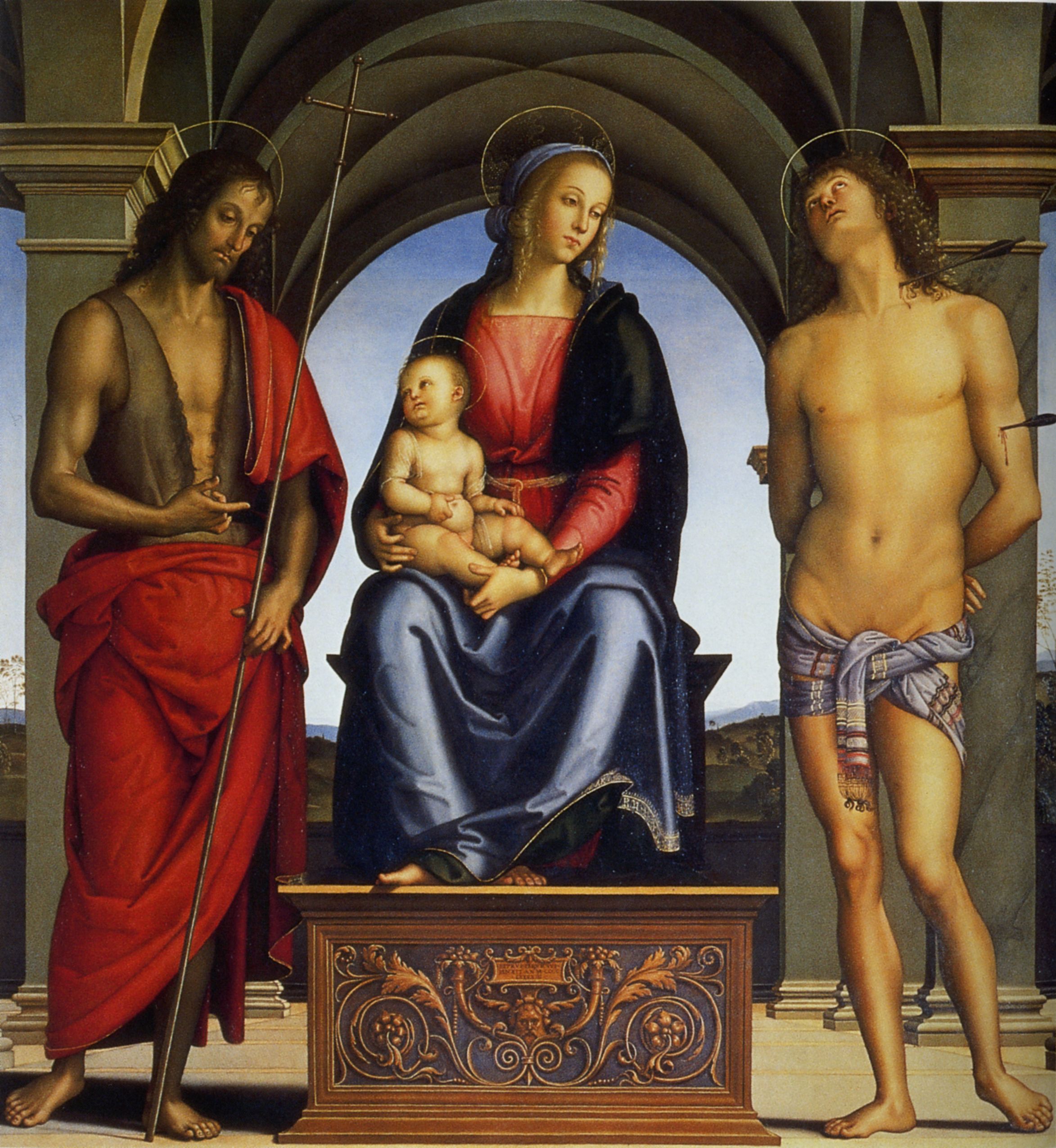
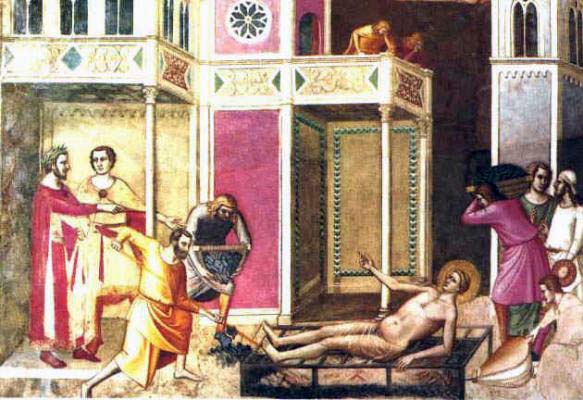
One of my favorite Florentine doors, featuring a saint crushing a devil (top left), a saint on fire (top right) and Medici balls (below).

How then do we seek the habitat capable of supporting the invisible pre-1650 atheist?  We look for radical scientific theories: atomism, vacuum, heliocentrism, anything which makes Nature more self-sufficient and less dependent on divine participation.  We look for related theological challenges: attacks on the immortality of the soul, on miraculous intervention, on Providence, on angelology, anything which diminishes how often God is part of the answer to some basic question.  We look for who is reading ancient texts which offer alternate explanations to Christian theological ones: Epicurus, Lucretius, Plato, Pythagorean cult writings, Cicero’s skeptical dialogs, Seneca.  Who is reading all this?  Machiavelli.

In the pre-modern world, a firestorm of accusations of atheism and wickedness awaited anyone who raised a powerful and persuasive alternate answer to some question whose traditional answer depended on God.  This firestorm fell even if the author in question never made any atheist arguments, which, generally, they didn’t.  It happened often, and fiercely.

Thomas Hobbes awoke one such firestorm when his Leviathan suggested that savage man, living in a state of terror and war in his caves and trees, might through reason and self-interest alone come together and develop society and government.  Until that time, Europe had no explanation for how government came to be other than that God instituted it; no explanation for kings other than that God raised them to glory; no explanation for what glue should hold men together, loyal to the law, other than fear of divine punishment.  Hobbes’ alternative does not say “There is no God,” but it says, “Government and society arose without God’s participation,” a political theory which an atheist and a theist might equally use.  It gives the atheist an answer, and thereby so terrified England that she passed law after law against “atheism” specifically and personally targeting Hobbes and banning him from publishing in genre after genre, until he spent his final years producing bad translations of Homer and filling them with not-so-subtle Hobbesian political notions one can spot between the lines.
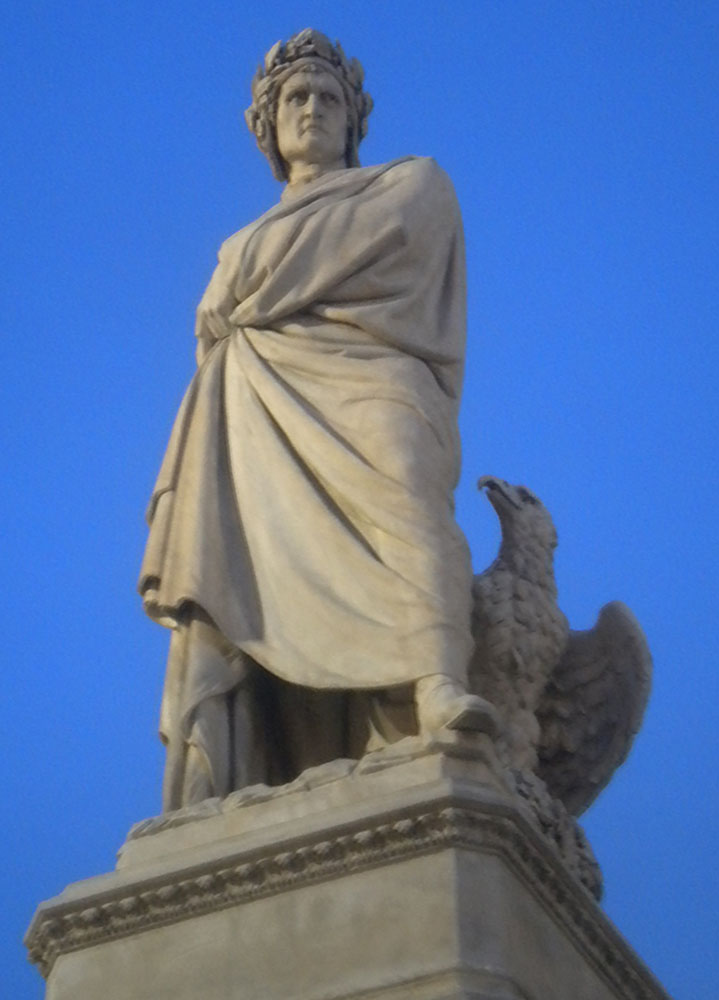
Dante knows where the author of "The Prince," goes - straight to circle 8 section 10, for those who advise others to do sinful things. Machiavelli knew his Dante well, so one must wonder if he found it comforting to be so sure that, "Well, if there is a Hell, there's me."

Machiavelli awoke such a firestorm by creating an ethics which works without God.  Utilitarianism depends entirely on evaluating the earthly consequences of an act, and can be used as a functional system for decision-making whether or not there exists any external divine force or absolute code of Truth.  He also painted a world of politics in which he recommends actions which are the same that one might take if there is no God watching.  In order for people to be virtuous they must first be alive—doesn’t that sound like the sentiment of someone who isn’t thinking about Heaven?  It is justified and necessary to kill and lie in order to protect the stability of the state and the lives of the people—doesn’t that sound like there isn’t a separate Judgment waiting?  The man who will do so much—even serve the Medici who tortured him—in order to guard and protect Earthly Florence seems to have an Earthly mistress, and not to be thinking of a Higher One.  He certainly talks like an atheist, and he certainly created the first system of politics and ethics which an atheist could coherently employ.

In addition to all this, there is what we can glean about religious attitudes from Machiavelli’s personal sentiments and behavior.  We know that he was a military commander, and fought, and killed people.  We know that he was what I think of as “averagely promiscuous” for a Renaissance man based on my experience of letters and autobiographies, which is to say that (while married) he had both male and female lovers, and wrote comfortably and playfully about friends doing the same.  We know friends wrote to him for advice about their love-affairs, which he freely gave, though warning against getting too caught up in them.  We know he helped his family in a push for a profitable priestly position for his brother, and was thus involved in minor acts of simony.  We know he owned many pagan classics and loved to read them, including a fascinating little volume in his own handwriting (now at the Vatican) which contains his complete transcriptions of two texts, first Lucretius’ De Rerum Natura (On the Nature of Things, containing antiquity’s best account of god-free atomistic physics and denial of the soul, afterlife, Providence and prayer), and second Terrence’s Eunuch (containing one of the most uncomfortable scenes in all of ancient comedy which the young hero boasts triumphantly about having just committed rape).  Machiavelli himself wrote the infamous comedy The Mandrake, which does not contain rape, but in which the twist is that in the end all the deception and adultery goes just dandy and in the end no comeuppance is had and everyone carries on committing deception and adultery and lives happily ever after, including those being deceived.  We know he had a sense of humor, and we know he often directed it against the antics of priests and monks.  I will include one sample of this edge of him, taken from a letter from late in his life, when he was sent on behalf of the Florentine wool guild to recruit a preacher for Lent (an extremely high-profile public performance, rather like picking who will play at superbowl half-time), Machiavelli wrote to his high-ranking political friend Guicciardini, from Carpi, May 17th 1521 (Note the playful way he juxtaposes the mandatory obsequious Renaissance opening address with the base setting of the second sentence.)
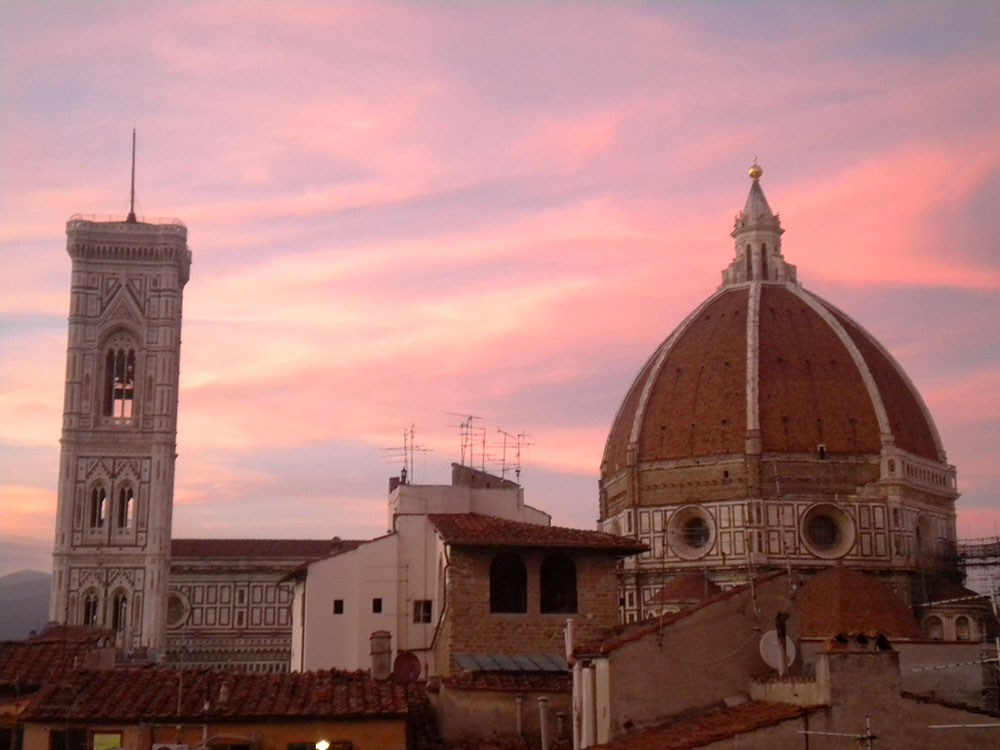
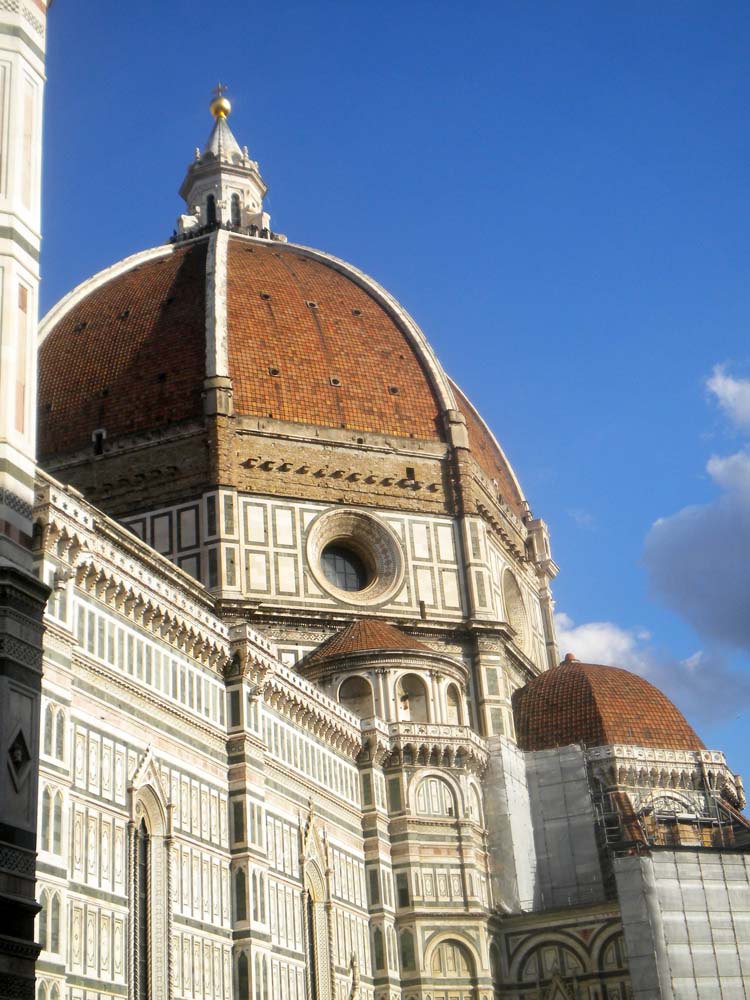
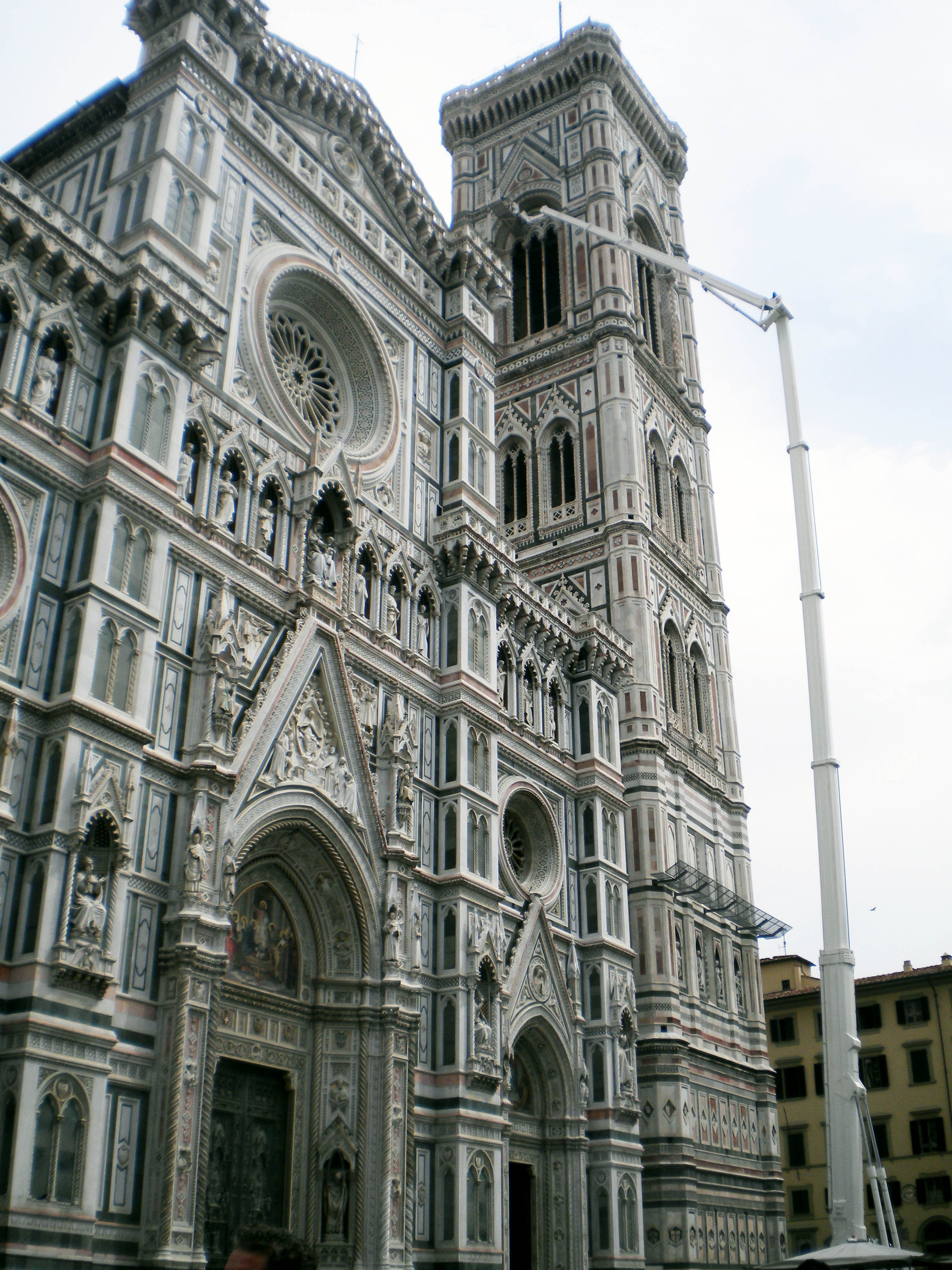
The Florentine cathedral, paid for by the wool guild. It was a great honor to be called there to be the Lent preacher, and they worked hard to pick a real celebrity to come.

Magnificent one, my most respected superior.  I was sitting on the toilet when your messenger arrived, and just at that moment I was mulling over the absurdities of this world; I was completely absorbed in imagining my style of preacher for Florence: he should be just what would please me, because I am going to be as pigheaded about this idea as I am about my other ideas.  And because never did I disappoint that republic whenever I was able to help her out – if not with deeds, then with words; if not with words than with signs – I have no intention of disappointing her now.  In truth, I know that I am at variance with the ideas of her citizens, as I am in many other matters.  They would like a preacher who would teach them the way to paradise, and I should like to find one who would teach them the way to go to the Devil.  Furthermore, they would like their man to be prudent, honest and genuine, and I should like to find one who would be madder than Ponzo (who at first followed Savonarola, then switched), wilier than Fra Girolamo (Savonarola), and more hypocritical than Frater Alberto (either a Boccaccio character or someone whom Alexander VI sent to Florence and who recommended summoning Savonarola to Rome so they could seize him under false pretenses), because I think it would be a fine thing – something worthy of the goodness of these times – should everything we have experienced in many friars be experienced in one of them.  For I believe that the following would be the true way to go to Paradise: learn the way to Hell in order to steer clear of it.  Moreover, since I am aware how much belief there is in an evil man who hides under the cloak of religion, I can readily conjure up how much belief there would be in a good man who walks in truth, and not in pretense, tramping through the muddy footprints of Saint Francis.  So, since my imaginative creation strikes me as a good one, I intend to choose Rovaio (Riovanni Gualberto, “the north wind” or “the hangman”), and I think if he is like his brothers and sisters he will be just the right man.”  (Translation from Machiavelli and His Friends, Their Personal Correspondence, James B. Atkinsons and David Sices eds. (DeKalb: Northern Illinois University Press) 1996, p, 336).

Later in the letter Machiavelli says that he is trying to come up with ways to actively stir up trouble among the monks he’s staying with just to entertain himself.  This sparks a hilarious sequence in which Guicciardini starts sending Machiavelli letters with increasing frequency, and stuffing them with random papers to make the packages fat, to get the monks to think that some important political thing is going on.  At one point a letter arrives saying that Guicciardini instructed the messenger to jog the last quarter mile so he would be sweaty and out-of-breath when he arrives, and Machaivelli describes with glee the increasing hubbub and attention he receives in the monastery as people become convinced that something of European import must be stirring.  Unfortunately a later letter hints that Machiavelli thinks they are on to the prank, and the correspondence ends there.
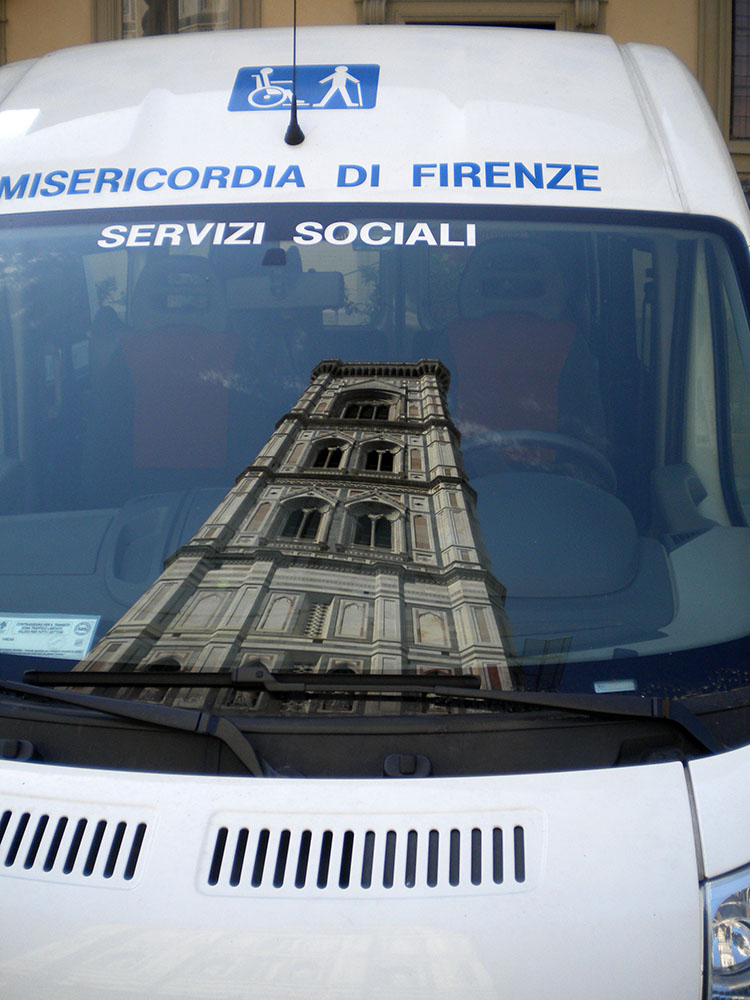
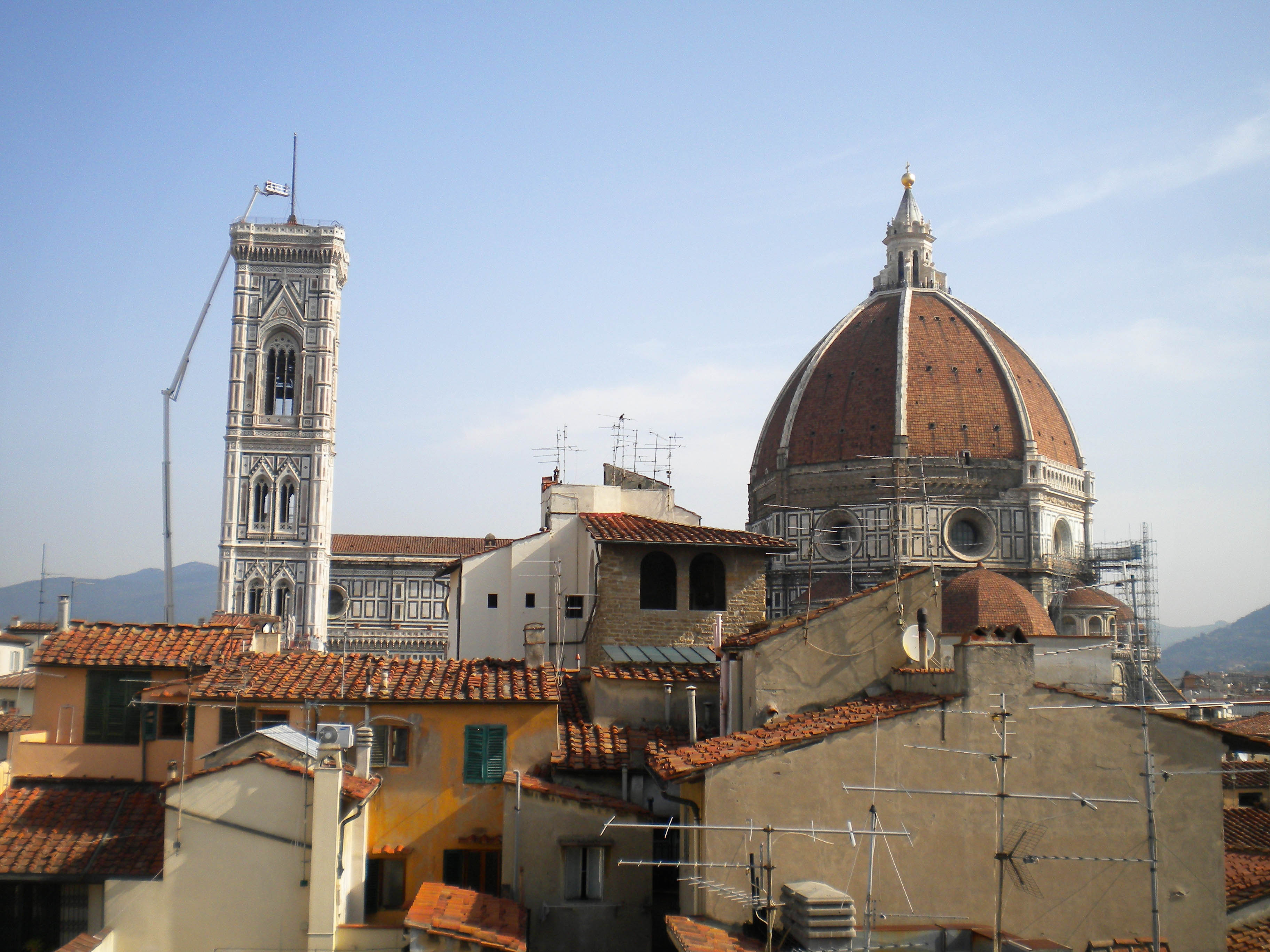
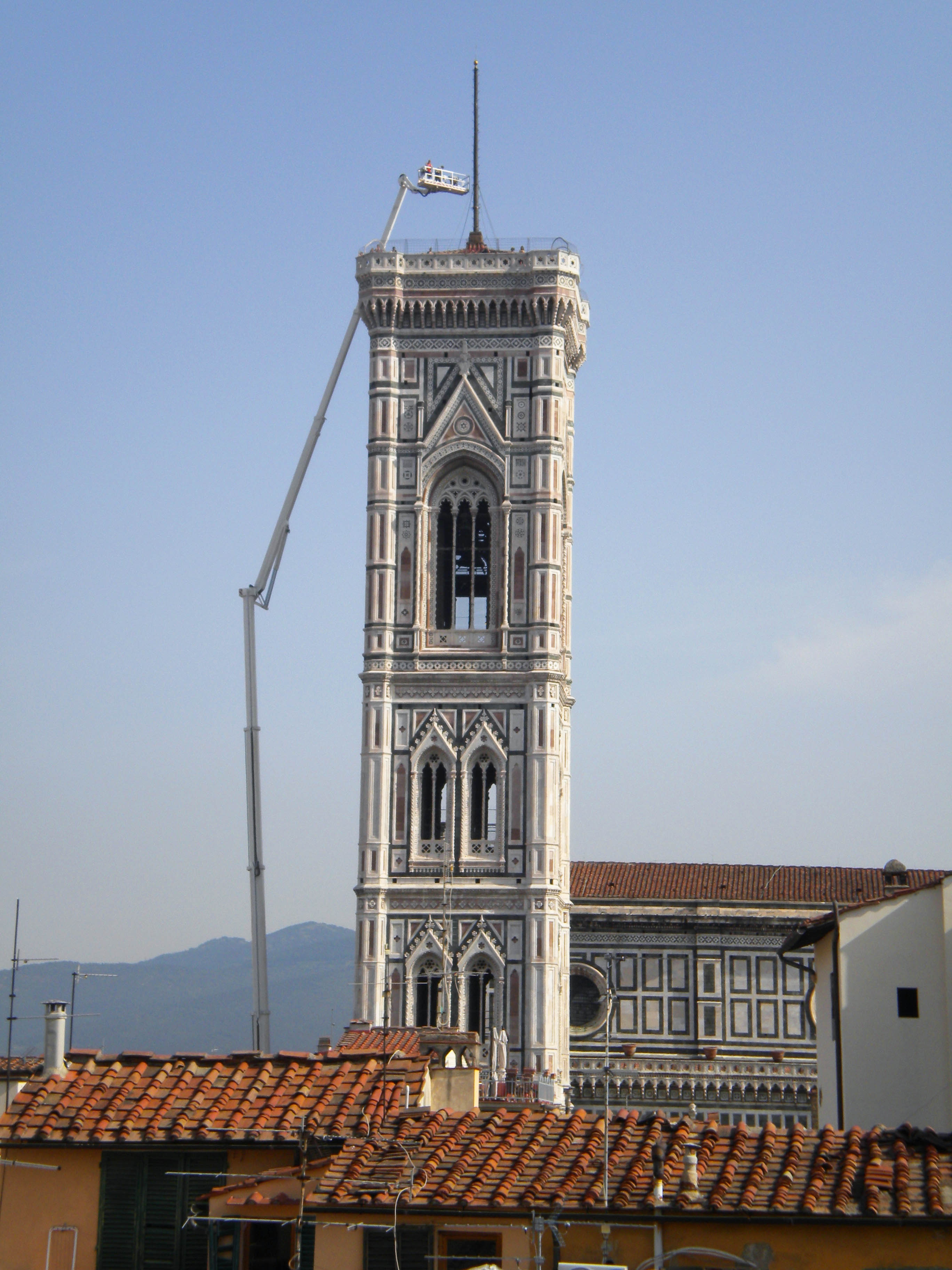
An ambulance parked by Giotto's bell tower, ready to spring into action to protect Machiavelli's dear Florentines.

You now have pretty-much as much evidence as anyone does about Machiavelli’s religious beliefs.  Smells like an atheist, doesn’t he?  His manifest unorthodoxy, the unique modernity of his ethics and political attitudes, and his playful anticlericalism, not to mention his charisma as an historical figure, inevitably tempt us into wondering whether we have found here a beautiful specimen of the rare beast we seek.  But until we develop a time-traveling telepathy ray to let us read the thoughts of the dead, we must remain very wary.  Is Machiavelli religiously unorthodox?  Absolutely.  Does he deny the existence of the divine?  Perhaps, perhaps not.  1520 is very early, and there are many genres of heterodoxy besides denial of God which we may be smelling here.  Thinking forward two hundred years, Enlightenment deism with its Clockmaker God denies divine intervention in Nature, removes the Hand of God from politics and lessens theology’s role in ethics without removing God.  If Machiavelli is an early deist, rather than an early atheist, that is certainly enough to fit comfortably his model of politics without God as a central factor, his ethics which segregates Earthly activities and consequences from broader divine concerns, and his interest in Lucretius and pagan scientific models for how Nature can function without constant divine maintenance.  If Machiavelli thinks these monks are corrupt and hypocritical, so would Voltaire, Rousseau, and even Martin Luther, without any of them being atheists.  Radicals yes, atheists no.  We may, in fact, ascribe any number of heterodoxies to Machiavelli, and as we review the history of writings about him we in a sense review the history of what radical religious veins we are most worried about, since whatever is most scary tends to be ascribed to him in any given decade.  These days it is often atheism, nihilism, skepticism, rarely deism, since we are at present as a society very comfortable with the Clockmaker model and associate it more with the bright and kind Enlightenment than with he-who-advocates-fear-over-love.

Is Machiavelli an atheist?  We have no idea, but by looking at why we want him to be, or don’t want him to be, or think he was, or think he wasn’t, and why new historians keep trying to answer this literally unanswerable question, we can watch the evolution of our own societal anxieties about the origins of unbelief, and how we understand how we got to this modern situation in which theism must stand constantly prepared to face its thousand enemies and is not (like Baldur) so secure in the presumption that no one will aim for the heart that it doesn’t realize it might have to dodge.  This is a slight exaggeration, as Medieval Christianity did prepare itself for onslaughts of atheism, and we have numerous practice debates written by theologians showing how they would argue with imaginary atheists since they had no real ones about to spar with.  (Alan Kors in his meticulous history Atheism in France has argued that these practice debates against pretend atheists were actually critical in introducing atheist arguments to broad audiences and thus themselves responsible for propagating atheism, even though they were written by theists for theists in a world populated probably only by theists.)  But it is not much of an exaggeration, since such preparation was much more an academic exercise than real sharpening of mental blades.  Since Machiavelli is the first of the great, famous possible-atheists—before Hobbes, before Spinoza, before Bayle, and before the real beast Rochester—Machiavelli is where we turn to test our anxieties about how our world came to be so secularized.
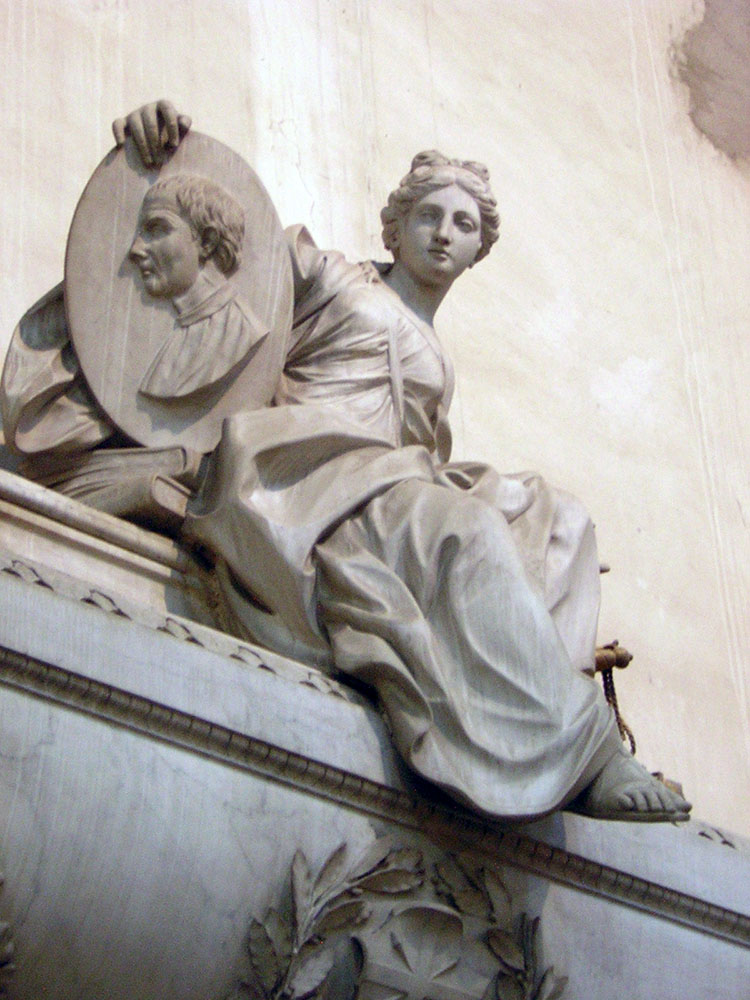
Machiavelli's honorary tomb in Santa Croce, with the epitaph: "Tanto nomini nullum par elogium," (For such a name no praise is enough.)

In the small talk phase of a party, I often answer “What do you do?” with “I study the history of atheism.”  The response usually takes the general form of, “Tell me more!” but as discussion unfolds I often feel one of two undercurrents shaping my new acquaintance’s replies: either “I’m an atheist and, since I presume you’ll agree with me, I now want to vent at you about how much I hate organized religion and my parents,” or “I’m a theist but pride myself on being rational about it, and I’m scared that if I tell you I’m a believer I’ll sound like the kind of religious nut that gives theism a bad name.”  I sympathize with the anxieties behind both these reactions, but both sadden me.  They are symptoms of the debate done badly: an atheist motivated more by rebellion than by Reason, a theist shamed into buying into rhetoric in the worst sense.  They are what happens when people grow up surrounded by others who care more about propagating their own beliefs than about helping young people meet and explore great questions for themselves (see comment thread).  I love this debate.  I love all of the people on all the sides.  I love the passion, and earnestness, and urgency of writings on atheism, by both sides.  It is the essence of the examined life and the exercise of Human Reason at its most intense.  I love everyone involved: Plato, Aquinas, Ockham, Ficino, Sade, Nietzsche.  I love when a student comes to my office hours and asks me directly, “I want you to be a Socratic gadfly for me and help me test my position,” whichever position it is.  I do it.  I love it.  When I wonder whether Machiavelli was an atheist, it’s not because I want to know, but because I want to talk to him about it, at length, and we would stay up all night, and eat all the cheese and olives, and drink all the wine, and Voltaire would come, and Hobbes, and Locke, and Rochester and Rousseau would get plastered and piss themselves, and Diderot would help me mop it up while we talked about Leibnitz and the imperfection of Creation, and Machiavelli would keep pace with us even though most of the ideas in question would be two hundred years younger than him.  They would be new to him, but he would understand them easily and join in comfortably to the debate.  He should be there.  There isn’t anybody else we know of from Machiavelli’s century who really should be there in the imaginary salon where we revisit the Enlightenment debates that made this modern era secular the way it is.  Just Machiavelli.  That’s why we can’t stop asking.

(Here ends my Machiavelli series.  I hope you have enjoyed it, and thank you for being patient.  Also, I have now added a substantial discussion of atheism in the classical world in the comment thread on this post, for those interested.)

If you’re interested in reading more about the history of atheism, skepticism, heterodoxy, deism and freethought, I recommend these sources:

  • Allen, Don Cameron.  Doubt’s Boundless Sea; Skepticism and Faith in the Renaissance.  Baltimore, Johns Hopkins.  1964.
  • Hunter, Michael and David Wootton ed.  Atheism from the Reformation to the Enlightenment.  Oxford: Clarendon.  1992.
  • Kors, Alan Charles.  Atheism in France, 1650-1729.  Vol. 1, Princeton: 1990.  (The long-awaited second volume is forthcoming.)
  • Popkin, R. H.  History of Scepticism from Savonarola to Bayle.  Oxford: 2003.  (Earlier editions of the book have titles, “History of Scepticism from X-other-dude to Y-other-other-dude.  All editions are good, but the most recent is the most comprehensive.)

Also recommended:

  • Betts, C. J.  Early Deism in France, From the so-called ‘déistes’ of Lyon (1564) to Voltaire’s ‘Lettres philosophiques’ (1734).  The Hague: Martinus Nijhogg Publishers. 1984.
  • Buckley, Michael J.  At the Origins of Modern Atheism.  New Haven: Yale University Press.  1987.
  • Febvre, Lucien.  The Problem of Unbelief in the Sixteenth Century: the Religion of Rabelais.  Cambridge MA: Harvard University Press.  1982.
  • Ginsburg, Carlo.  The Cheese and the Worms.  New York: Penguin Publishers. 1992.
  • Jacob, Margaret. The Radical Enlightenment: Pantheists, Freemasons and Republicans.  London, Boston: Allen & Unwin.  1981.
  • Kristeller, P. O. ‘The Myth of Renaissance Atheism and the French Tradition of Free Thought’. Journal of the History of Philosophy, 6 (1968), pp. 233-443.
  • Lemay, J. A. Leo ex.  Deism, Masonry and the Enlightenment.  Newark: University of Delaware Press.  1987.
  • Wagar, Warren W. ed.  The Secular Mind: Transformations of Faith in Modern Europe.  New York: Holmes & Meier Publishers inc.  1982.
  • Wilson, Catherine.  Epicureanism at the Origins of Modernity.  Oxford: 2008
  • Wootton, David.  ‘Lucien Febvre and the Problem of Unbelief in the Early Modern Period’  The Journal of Modern History, Vol. 60, No. 4. (Dec., 1988), pp. 695-730.
Share

Florence: Overview of Churches and Monuments

A quick review of the architectural centerpieces of Florence.  Prices and hours may change arbitrarily (this is Italy, after all).

Palazzo Vecchio (Palazzo della Signoria):

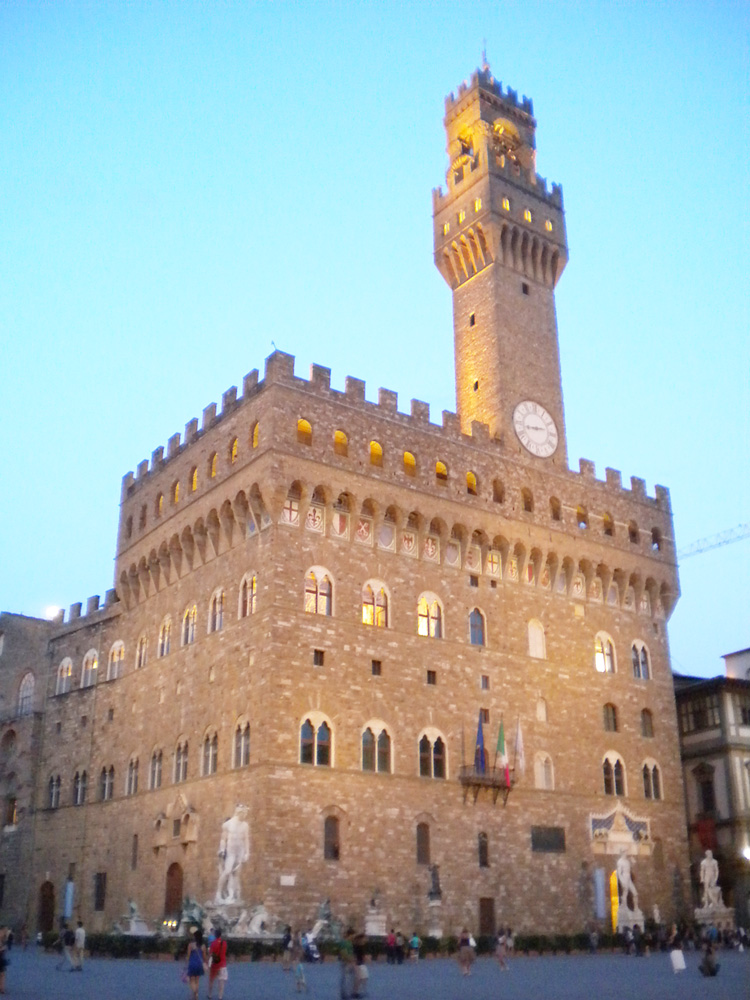
  • The old seat of government of the Florentine Republic, later taken over as the seat of the Medici Dukes.  The different parts of the building are a micro-history of Renaissance Florence right before your eyes.  Going to see the outside is a must.  You can pay to go inside, to see the ducal decorations, the offices where all the great humanists used to work, and Dante’s death mask, which is kept there because why not.  Among the decorations are some beautiful intarsia (inlaid wood) doors with portraits of Dante and Petrarch, plus the original of Donatello’s Judith.  You can also see the enormous Hall of the 500, which Savonarola had built, and its over-the-top decorations.  You can’t go up the tall tower where the prison was.
  • Cost: Seeing it from the outside, and entering the lower story, is free.
  • Time required: 20 minutes to just look at, 2 hours for the museum.
  • Hours:  Changing all the time, but usually 9 am to 7 pm, but sometimes 2 pm to 7 pm, and sometimes open super late, often on Thurs or Tues.
  • Website:  http://www.museicivicifiorentini.it/en/palazzovecchio/ 
  • Notes:  See my discussion of it: http://exurbe.com/?p=37

Baptistery:

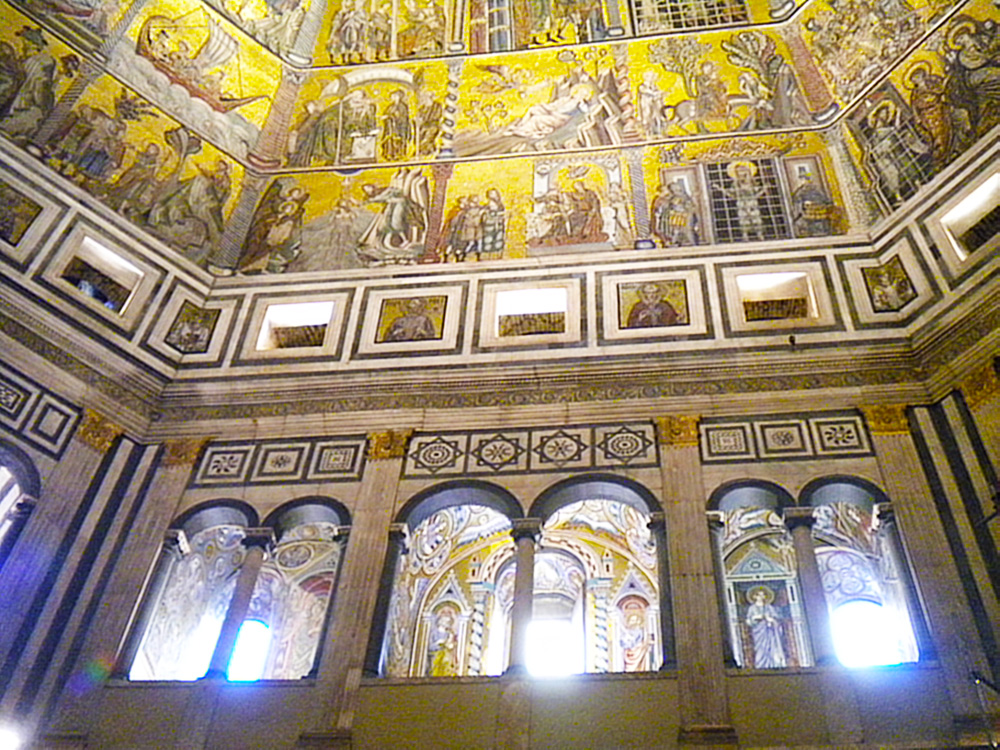
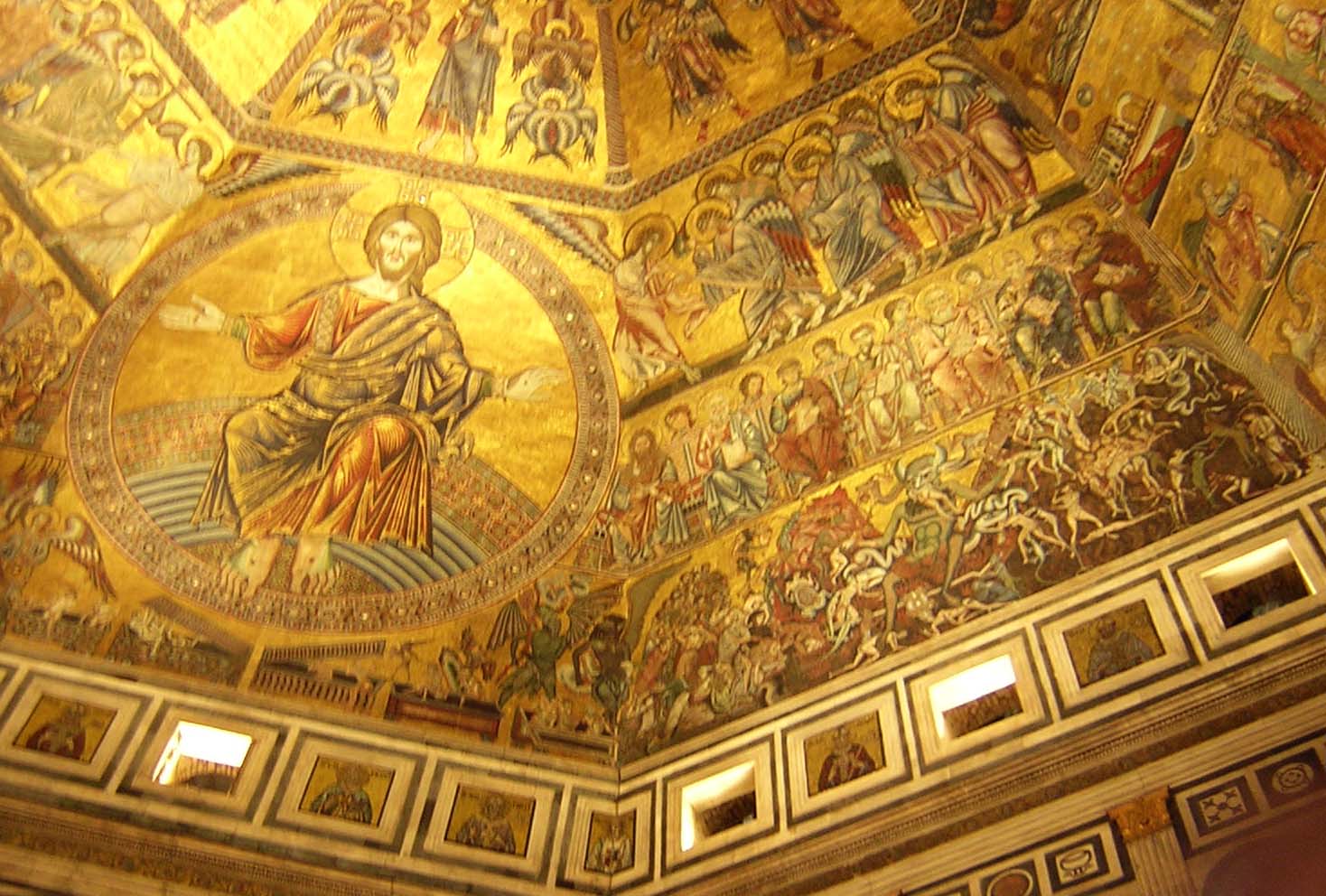
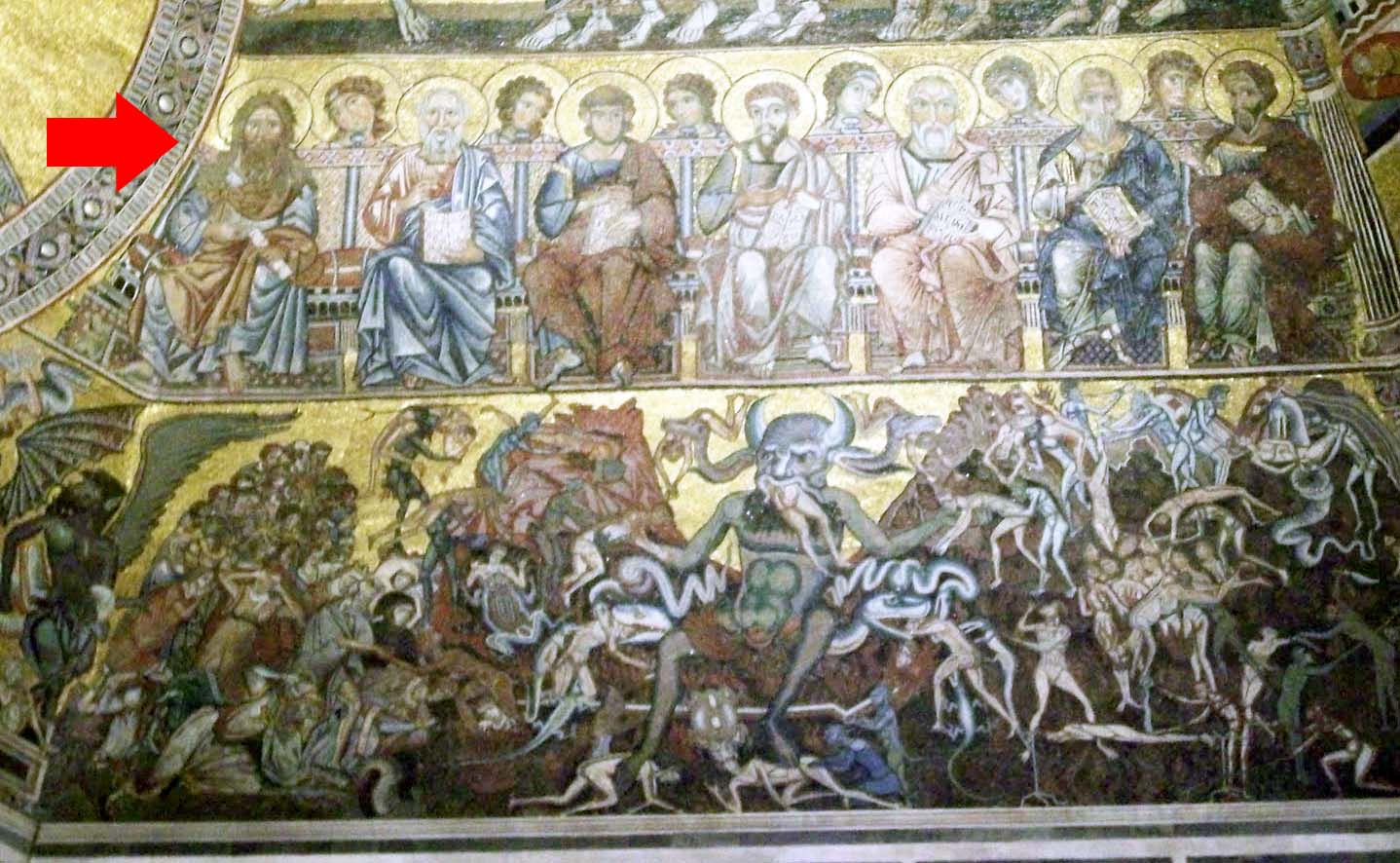
  • The old heart and symbol of the city, sacred to its patron saint John the Baptist.  The baptistery is right in front of the cathedral, and the oldest of the grand buildings erected to show off Florence’s affluence.  The outside features the Gates of Paradise, with Ghiberti’s gilded bronze relief sculptures, one of the greatest moments in Renaissance sculpture.  Seeing the outside is free, but it is worth paying to go in, because the entire interior is covered with gorgeous gold mosaics in stunning condition, including a fabulous depiction of Hell.  Also Florence’s antipope is buried inside (closest thing they had to a pope before the Medici), and outside keep an eye out for the Column of St. Zenobius nearby.
  • Cost: 4 or 5 euros to go inside.
  • Time required: half an hour
  • Hours: 12 pm to 7 pm weekdays, open 8:30 am to 2 pm on the first Saturday of the month.
  • Notes:  The tickets are sometimes sold at the entrance of the baptistery, but sometimes in a confusing archway to the right of it (if you stand facing the gates of paradise).  People will usually point you the right way.  You get a slight discount if you get the baptistery ticket along with a ticket to climb the Duomo and go to the Museo del Opera del Duomo.

Duomo (cathedral) and Belltower:

  • The grandest church in Christendom when it was built, and still so beautiful that, when you’re standing in front of it, it’s hard to believe it’s real.  The outside is a must-see.  The dome was the greatest engineering marvel of its day, and still astoundingly humongous.  The inside is also worth seeing, with colored marble floors, high clean vaults, and the dome frescoed with a particularly excellent last judgment, with a great Hell-scape.  On the right hand wall look for the tomb of Marsilio Ficino (who restored Plato the the world) and on the left the painting of Dante standing in front of Florence, Purgatory, Heaven and the gates of Hell.
  • You can, separately, pay to climb the dome.  It is taaaaaaaaaaaaall.  Climbing it lets you see the inside between the two layers of the double dome (which is how a dome that big stays up), and lets you see the fresco on the inside of the dome up close.  The view on top is spectacular but a lot of people get major height fear and vertigo up there, even people who don’t usually, due to the dome’s dizzying slant.  Also the cramped area between the domes is rather claustrophobic, giving you the world-class claustrophobia-acraphobia combo!
  • You can also pay to climb the belltower but it’s not hugely worth-it, unless you want to see the bells bells bells bells bells bells bells bells.  In general, though, if you want to climb something, go for the Duomo.
  • Cost: Free to enter the cathedral.  You have to pay to climb the dome.
  • Time required: Half an hour for seeing the cathedral, a couple hours for climbing the dome.
  • Hours: 10:00 am to 5:00 pm, with some complicated exceptions. Check the website with an Italian friend.
  • Website: http://www.operaduomo.firenze.it/monumenti/duomo.asp
  • Notes:  Climbing the dome has a long line a lot of the year, as does the cathedral itself even though you don’t pay; they only let a certain number of people in at a time. (Ex Urbe’s humble assistant Athan can confirm that the line is long and the climb cramped even in January.)

I stole this photo, but there is no other way to show you. Mea culpa.

San Marco:

  • No photography allowed in the monastery, so I can’t offer decent photos.  This is the major Dominican monastery and church (in contrast with the Franciscans at Santa Croce).  The church itself is free, while you have to pay to go to the monastery museum, but it’s only 5 euros and very worth-it.
  • The church is mostly baroque at this point, but contains the tombs of the Renaissance scholars Giovanni Pico della Mirandola and Poliziano.  Also a byzantine mosaic Madonna, a nice annunciation, the tomb of St. Antoninus, and an angry bronze statue of Savonarola.
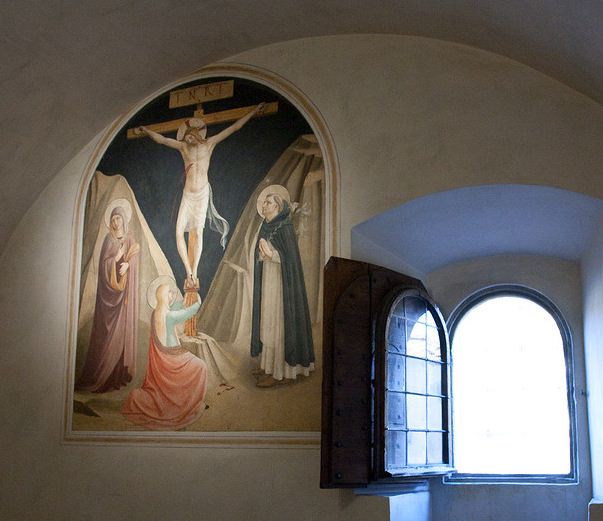
  • The monastery section is the real centerpiece.  Every cell in the monks’ living area was frescoed by Fra Angelico, as were the refectory and other important spaces.  This rare chance to see Renaissance paintings still in their original context lets you understand how they were used and interacted with in daily life.  While almost every room has a crucifixion scene, each one is unique, highlighting some different emotional or theological aspect of the crucifixion, in a perfect example of how Renaissance artists moved on from the repetition of icon making to make each piece offer the viewer a unique new angle on the subject.  You can also see Savonarola’s room and relics, and the room Cosimo de Medici had made for himself when he paid for the renovation of the monastery, so he could come there to have a break from public life sometimes.
  • Cost: Free for the church, 4 euros for the monastery section.  It is on the Friends of the Uffizi pass.
  • Time required: 2+ hours
  • Hours: 8:15 to 1:20 pm weekdays, 6:15 to 4:50 weekends.  Closed odd numbered Sundays and even numbered Mondays.
  • Website: http://www.uffizi.firenze.it/musei/?m=sanmarco
  • Notes:  The priest will usually glare at anyone who comes into the church and makes straight for Pico’s tomb.

Santa Croce:

  • On the East end of town, Florence’s major Franciscan monastery church came to be the major burial place for famous Florentines.  Includes the tombs of Machiavelli, Galileo, Michelangelo, Fermi, Marconi (who invented the radio), Bruni (who invented the Middle Ages), the cenotaph of Dante, and dozens and dozens of other tombs crammed into every surface.  Also excellent Giotto and Giotesque frescoes, and other exciting art.  The orphanage it used to house taught orphans leather working, and it still contains a leather working school.  Also contains one of the surviving tunics of St. Francis of Assisi.
  • Cost: 5 euros!  Expensive!
  • Time required: 2 hours
  • Hours: 9:30 AM to 5 PM except Sundays, when it opens at 2
  • Website: http://www.operadisantacroce.it/
  • Notes:  It tends to be quite cold inside.

Ponte Vecchio:

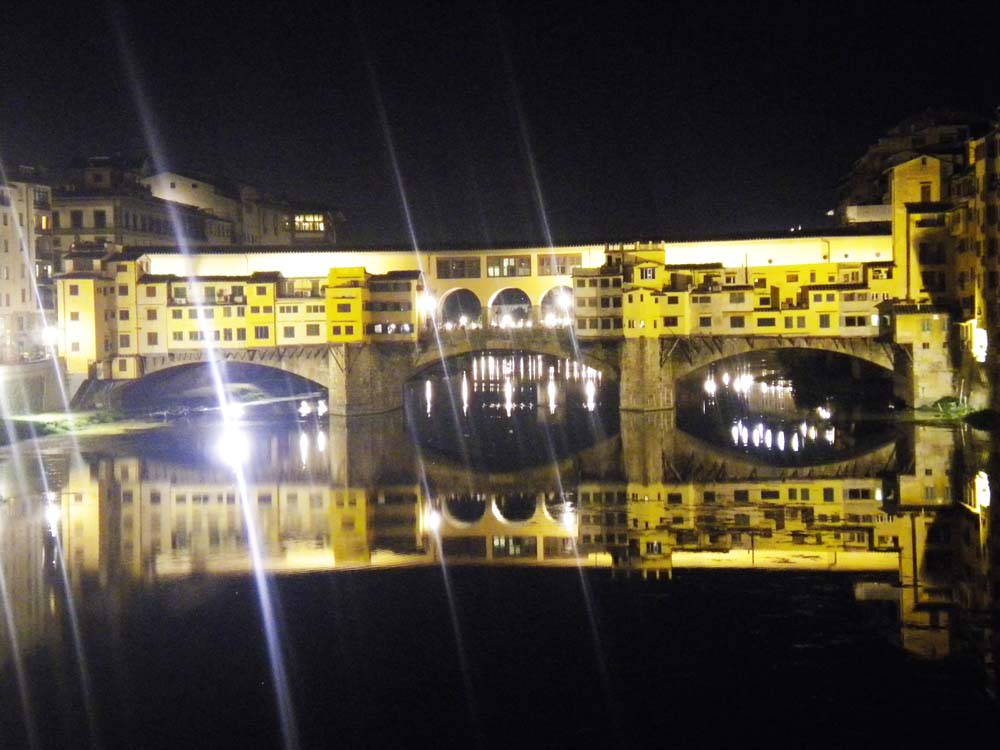
  • The old bridge, covered with tiny jewelry shops.  This has been the heart of Florence’s gold trade for a long time, and is incidentally one of the most valuable shopping strips on Earth.  At night the tiny little shops lock themselves up in wooden shutters and look like giant treasure chests, which is really what they are.  The view of this bridge from the next bridge down (Ponte Santa Trinita) is also worth seeing.  Be sure, while on the bridge, to greet the statue monument of the incomparable Benvenuto Cellini, Florence’s great master goldsmith/ sculptor/ duelist/ engineer/ necromancer/ multiple-murderer, who wrote one of humanity’s truly great autobiographies.
  • Cost: Free.
  • Time required: half an hour, more if you want to shop
  • Hours:  Shops shut around sunset.

San Lorenzo:

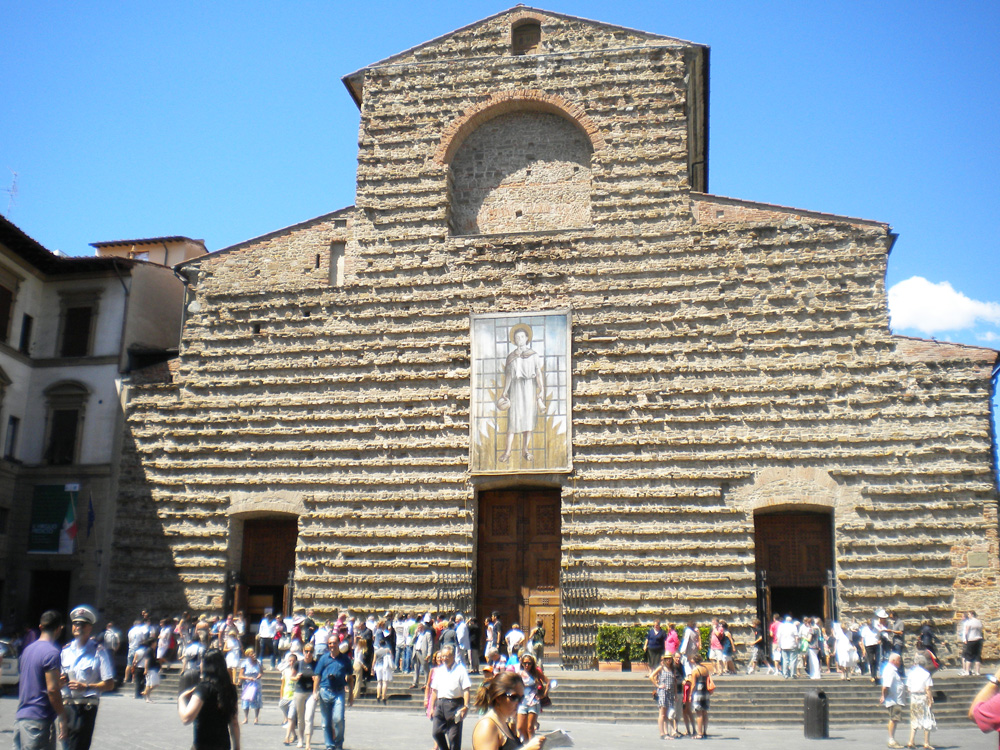
  • My photos do not do this church justice, but they don’t let you take pictures inside.  San Lorenzo is a little complicated because you have to pay separately to go in the different areas:
  • The main part of the church (which costs 3.5o euros) is a mathematically-harmonious, high Renaissance neoclassical church full of geometry and hints of neoPlatonism.  I recommend going in it after Santa Croce and Orsanmichele, since the contrast of its lofty, light-filled spaces and rounded arches gives you a vivid sense of how much architecture has changed in so little time.  Here you can see the excellent tomb of Cosimo de Medici (il vecchio), and some other early Medici tombs, as well as some Donatello reliefs and the remains of Saint Caesonius (no one knows who he is or how he got there, but he’s clearly labeled as a saint, so no one’s willing to move him).  This ticket also gets you into the crypt below the church, where you can see the bottom of Cosimo’s tomb, and a collection of really gaudy reliquaries.
  • Separately, the library attached to the cloister courtyard at the left of the church (which also costs 3.50 euros, but you can get a combined ticket to it and the church for 6) contains the reading room with the desks where the great Laurenziana library was housed.  It is very much a scholarly pilgrimage spot to see one of the first great houses of the return of ancient learning.  The old reading desks are still there where the books were chained, and still labeled with the individual manuscripts.  To get in you also get to (or rather have to) go up Michelangelo’s scary scary staircase.  The library periodically has small exhibits of exciting manuscripts, most recently on surgery, and on the oldest surviving copy of Virgil.  The library is only open in the morning!  Its gift shop sells some fun things including a lenscloth decorated with a reproduction of the illuminated frontispiece of the Medici dedication copy of Ficino’s translation of Plato – ultimate history/philosophy nerd collectable.
  • Separately, the Medici Chapels in the back of San Lorenzo (under its big dome; costs 5 euros, but is on the Friends of the Uffizi card, unlike the other two [why?!]) contain the later Medici tombs, those of Lorenzo de Medici, his brother, the next generation of Medici, and the Medici dukes.  The earlier Medici tombs here have some Michelangelo sculptures on them, while the later ones are in a ridiculously over-the-top baroque colored marble chapel which knocks you breathless with its unbridled and rather tasteless opulence.  One friend I visited with subtitled the chapel: “Baroque: UR doin’ it WRONG!”  An excellent excercise in trying to grapple with the evolution of taste, and why certain eras’ taste matches our own while others don’t.  Also you get to see more over-the-top sparkly reliquaries.
  • Hours:  Different for each bit.

Orsanmichele:

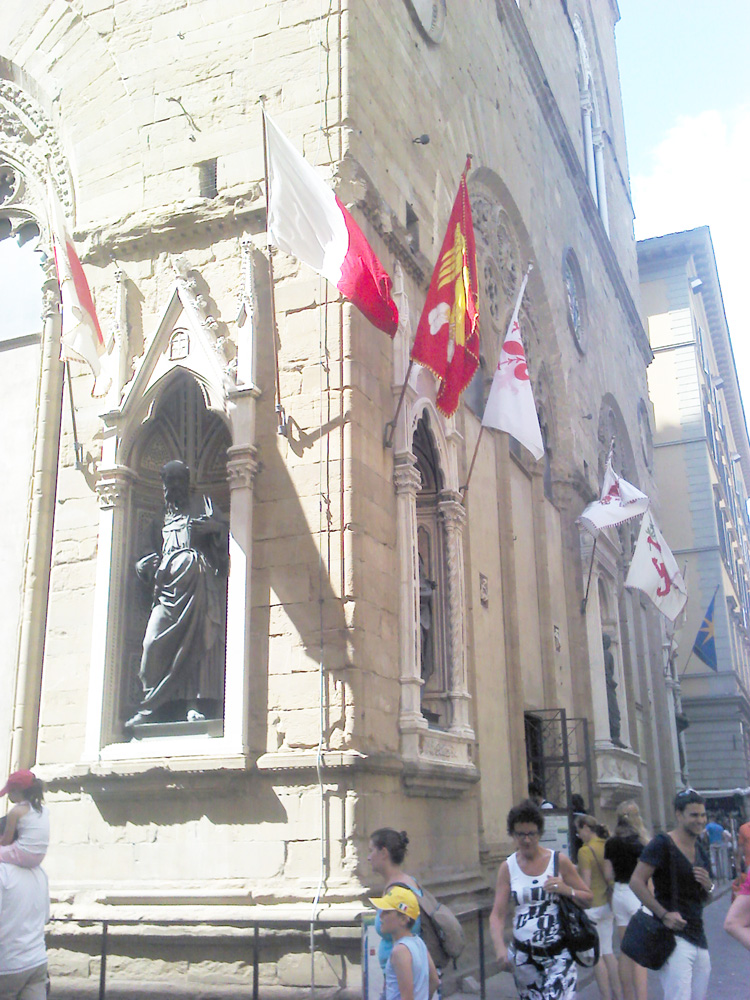
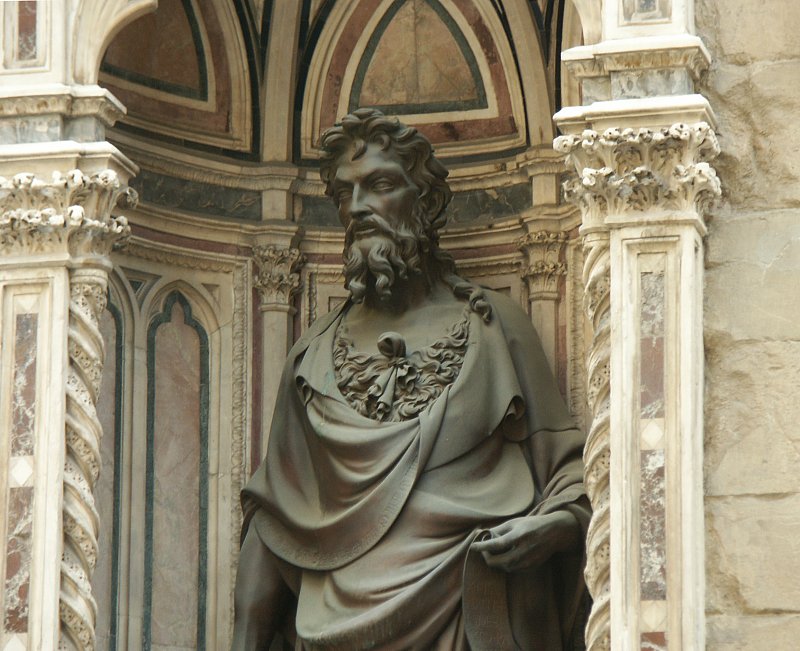
  • The former grain market and grain storage building at the heart of the city was turned into a church when an icon of the Madonna there started working miracles.  Because it was the official church of the merchant guilds of Florence, the different guilds competed to supply the most expensive decoration for it, so the outside is covered with fabulous statues, each with the symbols of its guild above and below.  Seeing the outside is quick and easy.  Seeing the inside is trickier and not always worth cramming into your schedule, but the inside is also beautiful, a very medieval feeling, with saints painted on every surface.  A museum above (open rarely, mainly Mondays) holds the original sculptures, which have been replaced on the outside with copies for their own safety.  But since the sculptures were designed to be seen in their niches, the copies in situ look better than the displaced originals in my opinion.
  • Cost: Free
  • Time required: half an hour
  • Hours: 10 am to 5 pm. Closed on Monday.
  • Notes:  Occasionally hosts concerts.  On the outside is a booth where you can get tickets to the Uffizi without waiting in the Uffizi line.

Mercato Centrale & Mercato San Ambrosio:

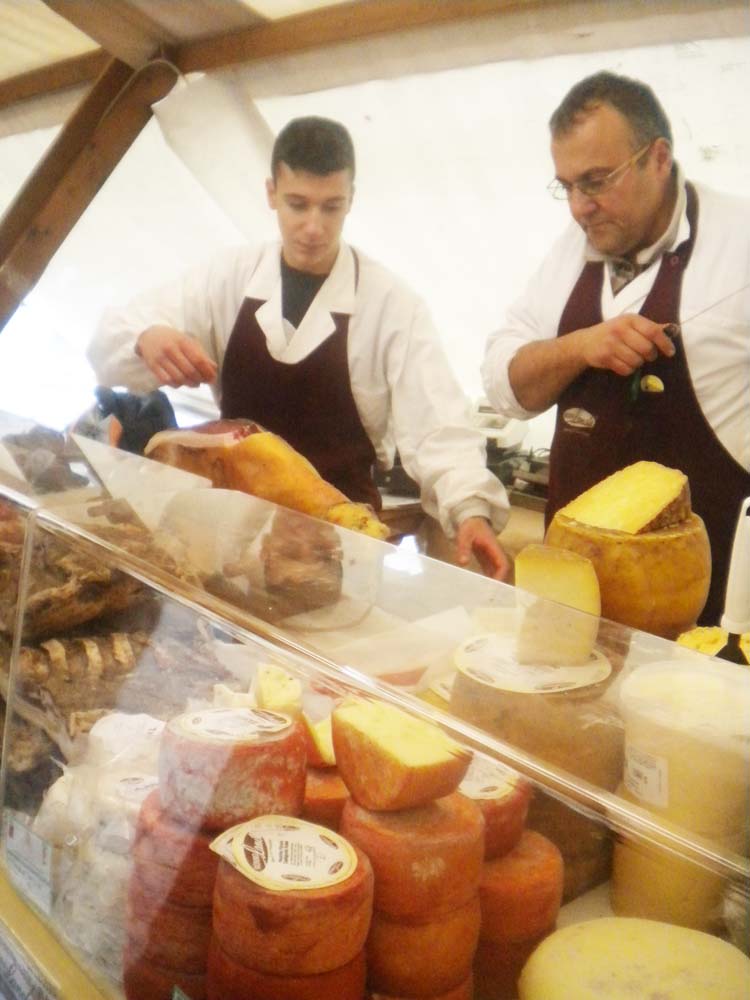
  • Not historic, but the two great farmer’s markets of the city are definitely worth visiting, and great for both lunch and souvenir shopping.  Cheese, salumi, spices, sauces, fruits, veggies, oil, vinegar, truffle products…  The Mercato Centrale (near San Lorenzo) has more touristy things and things to take home, while San Ambrosio has more things to eat right now or cook at home, but both have both.  At the Mercato Centrale I particularly recommend eating fresh pasta at Pork’s (order tagliatelle with asparagus, or all’ Amatriciana (with tomato, onion and bacon) or tortellini with cream and ham (prosciutto e panna)), and/or having a porchetta sandwich.  You can also try tripe or lampredotto if you’re brave.
  • Cost: Free
  • Time required: 1+ hours
  • Hours: Morning through early afternoon.
Share

Florence: Overview of Major Museums

Kicking off my new Travel Reviews section, a quick review of some centerpieces among the many, many, many attractions Florence offers her visitors.  Please keep in mind that times and prices change constantly, so always check before you plan:

Uffizi Gallery:

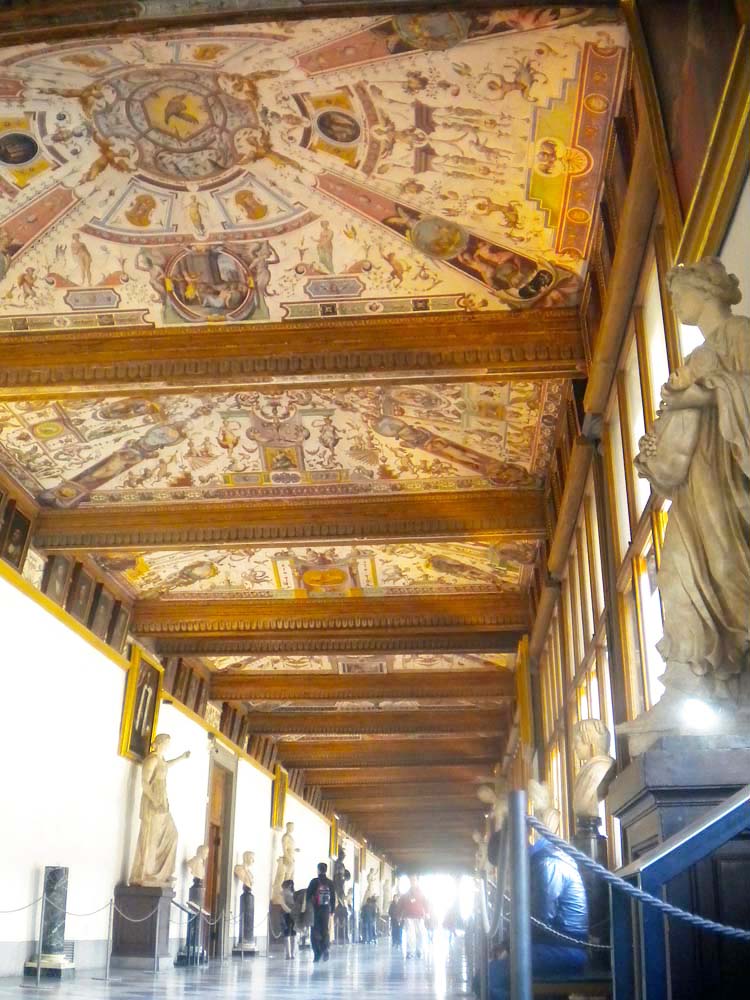
  • The city’s great painting collection, housed in the offices built by Vasari for the Medici dukes.  Arranged in mainly chronological order, the collection chronicles the progression of art out of the middle ages through the Renaissance.  This is where you find the big names: Giotto, Filippo Lippi, Botticelli, Raphael, Titian, Michelangelo, all in halls decorated with Romanesque grotesque ceilings, covered with portraits of everyone who was anyone in the Renaissance, and crammed with classical sculpture, including the Medici copy of the Laocoon.  Highlights include the three big Madonnas, the Botticelli room featuring the Madonna della Magnificat and the Birth of Venus, Raphael’s portraits of popes Leo X and Julius II, and Michelangelo’s Holy Family With Gratuitous Naked Men.  Endless gift shop including a huge room of academic books.  Fantastic venue for Spot the Saint.
  • Cost:  11 euros plus 3 or so extra for making a reservation.
  • Time required: 6+ hours if you can stand up that long.
  • Hours: 8:15 am to 6:50 pm Tuesday through Sunday.  Closed Monday.  Sometimes open late Tuesdays.
  • Website:  http://www.uffizi.firenze.it/en/index.php
  • Notes: The Uffizi has an infinite (3+ hour) line during peak season, so it’s a very good idea to make a reservation.  It also has very few places to sit, no water fountains (they scan your bag as you go in so you can’t bring water), and a very inconveniently-located bathroom.  So enormous and exhausting is it that it’s very difficult to go through in one day.  If you’re in Florence for a week, I highly recommend getting a Friends of the Uffizi pass, which costs 60 euros at present (40 for student-age) and gives you unlimited access plus line skipping at the Uffizi, Academia, Bargello, Pitti Palace and San Marco, plus some other secondary places.  The card, which can be purchased at an office at the Uffizi, gives you the leisure to go to the Uffizi for half a day, then go do something else, then return.  In my experience a typical visitor does not quite get 60 euros out of the pass in a single week, but it comes close, and the convenience makes up the difference.  No photos.

Academia:

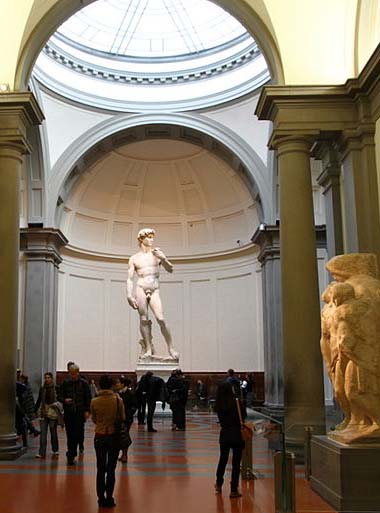
  • The other most famous and frequently-visited museum in the city.  The Academia hosts the original Michelangelo David and Michelangelo Prisoners, plus a great collection of Renaissance paintings, and, in the upper floor, a great Saint Spotting area including a huge collection of icons of Saint Zenobius.  Michelangelo’s fame means the Academia is always extremely crowded, and there are always mobs around the David.
  • Cost: also 11-ish, 14-ish with an appointment.
  • Time required: 5+ hours
  • Hours: 8:15 am to 6:50 pm, Tuesday through Sunday.
  • Website: http://www.polomuseale.firenze.it/musei/?m=accademia
  • Notes:  The Academia is great, but it’s also a lot of hassle and chaos, especially during peak season, and it’s not actually that much better than most of Florence’s other, less popular great museums.  As with the Uffizi, make an appointment or get the Friends of the Uffizi card, but honestly, if you are only in Florence briefly and need to choose carefully, there are other things you can see that are just as fabulous and a lot less difficult.  No photos.

Bargello:

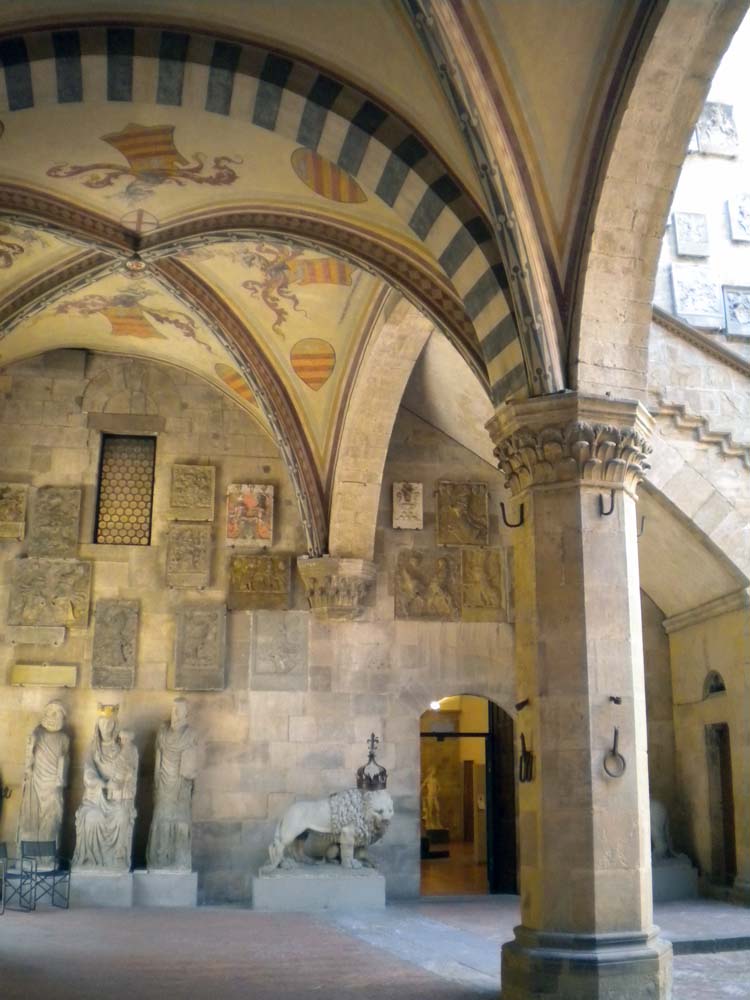
  • Formerly the prison and seat of the city’s chief of police, the Bargello is a fabulous fortress, with battlements and hundreds of coats of arms of knights who served in it.   Now it houses the city’s Renaissance sculpture collection, including Donatello’s David and Cellini’s Ganymede.  Easy to reach and inexpensive, this little museum takes a comfortable half-day to see thoroughly, but is crammed with  world-class pieces.   Also contains collections of ceramics, a chapel whose fresco includes the oldest surviving portrait of Dante, and assorted “stuff” ranging from Roman cameos to an ivory and ebony medieval portable backgammon set.
  • Cost: 5 euros
  • Time required: 3-4 hours.
  • Hours:  (sigh) 8:15 AM to 1:50 PM, closed the 2nd & 4th Monday and 1st, 3rd & 5th Sunday of each month and randomly selected holidays.
  • Website: (the official one seems to be down) http://en.wikipedia.org/wiki/Bargello
  • Notes:  No photography is permitted in the sculpture rooms, but they do let you take photos in the courtyard.

Palazzo Pitti:

  • This enormous palace in the across-the-river (Altrarno) area is where the Medici dukes moved once the Palazzo Vecchio proved too cramped for their royal style.  It contains seven museums in one, which are confusingly grouped into two separate tickets.  They are constantly rearranging what is on what ticket, so this info may be out of date:
  • Ticket 1 is for the Palatine Gallery, which includes yet another collection of extraordinary paintings, including a lovely Raphael holy family, a great Filippino Lippi madonna, Titian’s extremely sensual Mary Magdalene, and elaborate baroque frescoed walls and ceilings.  It also contains some of the finest examples of Pietra Dura, the Florentine art of making elaborate images out of inlaid semi-precious stone.  It also includes the Royal Apartments, with all the fancy furniture.
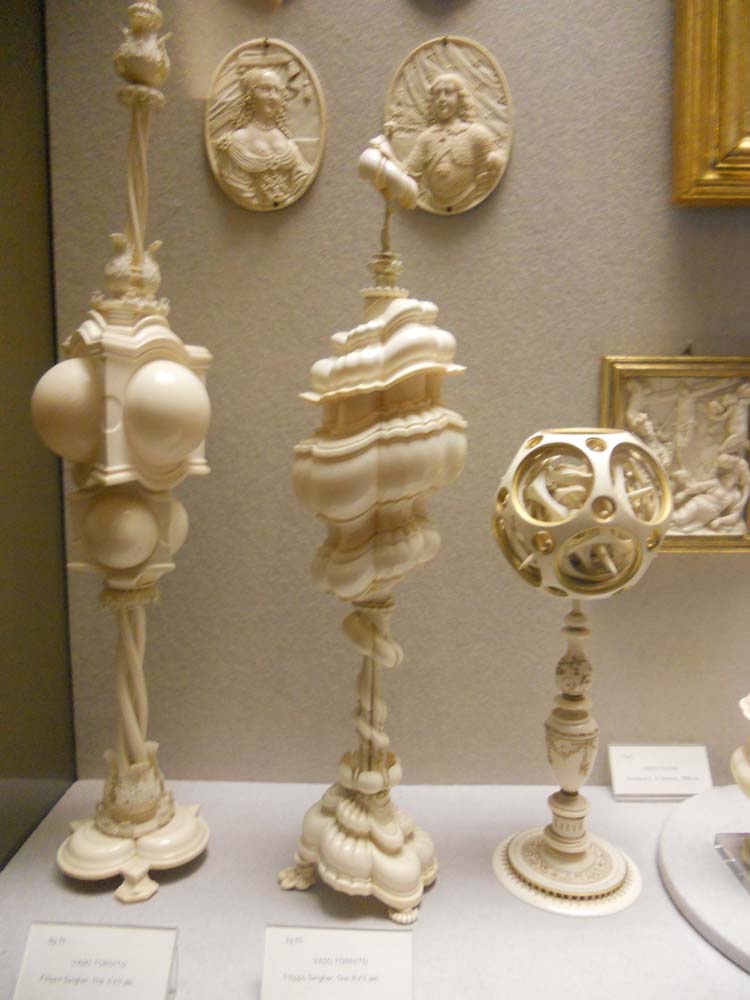
  • Ticket 2 is for the Argenti Museum, or silver museum, which houses the ridiculous treasures which belonged to the Medici family.  When I say ridiculous I mean it, and the endless cases of ivory vases, gilded cups, huge amber reliquaries and elaborate hand-carved rock crystal dishes leaves one completely overwhelmed by the opulence of wealth.  Prepare to be stupefied by the sheer genius of human opulence.  This collection is very different from anything you meet at a typical museum, and I recommend it highly as a break from too much art.  The first few rooms also feature truly astounding fake-perspective frescoes, and one of my favorite fresco cycles of all time, depicting Lorenzo de Medici inventing the Renaissance.  There are also frequently interesting temporary exhibits in the initial rooms.
  • Also on Ticket 2 are the Boboli Gardens, the large, meandering Italian gardens behind the palace.  These are great for a quick stroll, or for getting really winded on the endless slopes and stairs.  At the river end of the gardens is the grotto, an elaborate Renaissance fantasy of a fake excavated ancient Roman villa, covered with fake mud and fake ruins and rustic mosaics made of seashells.  It is only open for brief intervals at unpredictable times of day, so if you go, ask an employee when it will be open that day, to make sure you don’t miss it.
  • Minor museums included in one ticket or another are the Modern Art gallery, the Costume Museum (disappointingly small and modern), the Porcelain Museum, and the Carriage Museum.
  • Cost: 8.5 euros for the Palatine, 7 for the Argenti.
  • Time required: 3-4 hours for the Argenti, another 3-4 for the Palatine, 1-2 each for the others.
  • Hours: 8:15 to 6:50, closed Mondays.
  • Website: For the Argenti: http://www.polomuseale.firenze.it/en/musei/?m=argenti, For the Palatine: http://www.polomuseale.firenze.it/en/musei/?m=palatina
  • Notes:  No photography except in the gardens.

Museum of the History of Science (Museo Galileo):

  • A phenomenal collection of scientific instruments from the Renaissance through 19th century, though mostly 17th and 18th.  Astrolabes, sextants, orreries, clocks, barometers, telescopes, electrostatic generators… These are pieces from the period when scientific demonstration models were designed to impress aristocratic patrons, so gold and engraving are the norm.  Highlights include Galileo’s telescopes (and finger and thumb in a reliquary), apothecary’s work table, the Military Compass (dagger with built-in compass and other mathematical tools), and a gruesome collection of 18th century full color obstetric models showing dissected female torsos and the various ways babies can be laid wrong in them.
  • Cost: 8 euros.
  • Time required: 3-4 hours.
  • Hours: 9:30 AM – 6:00 PM, except on Tuesdays, when it closes at 1:00 PM.
  • Website: http://www.museogalileo.it/en/index.html
  • Notes: Private museum, not included on the Friends of the Uffizi ticket.

Museo del Opera del Duomo (Museum of the Cathedral Corporation):

  • The construction of Florence’s massive cathedral, which was, at the time, the most spectacular church in Christendom, was an incredibly expensive undertaking, and the Renaissance corporation created to oversee it survives to this day.  This museum showcases the art and artifacts which belong to that corporation, including numerous sculptures from the old early Renaissance facade which was later torn down in favor of a more modern one, the wooden models of different designs for the church, and many of the tools used for it.  Highlights include Donatello’s stunning wooden sculpture if Mary Magdalene, the reliquary from the Baptistery containing the right index finger of John the Baptist, and the original Baptistery sculptures and (once they’re done cleaning them) the real Gates of Paradise.
  • Cost: 6 euros
  • Time required: 2-3 hours.
  • Hours: 9:00 AM – 7:00 PM, except on Sundays, when it closes at 1:45 PM.
  • Website: http://www.operaduomo.firenze.it/ There does not seem to be an English version of this website.
  • Notes: Not included on the Friends of the Uffizi ticket.

Palazzo Strozzi:

  • An enormous city palace built by one of Florence’s leading merchant families, the Palazzo Strozzi hosts a circuit of temporary exhibits, usually pretty good, but each is unique, so check it each time you consider coming. The Strozzi family were never the most powerful, but generally the biggest wealthy merchant family, with the most individual households, so widely feared (and often exiled) by the Medici and other rivals. This palace was built after a return from exile, and celebrates their presence in the city.
  • Cost: Variable by exhibition and greed.
  • Time required: 2-4 hours depending on exhibit.
  • Hours: 9:00 AM – 8:00 PM, Thursdays 9:00 AM – 11:00 PM.
  • Website: http://www.palazzostrozzi.org/index.jsp?idProgetto=2&idLinguaSito=2
  • Notes: Private museum, not included on the Friends of the Uffizi ticket.


La Specola (Museo di Storia Naturale):

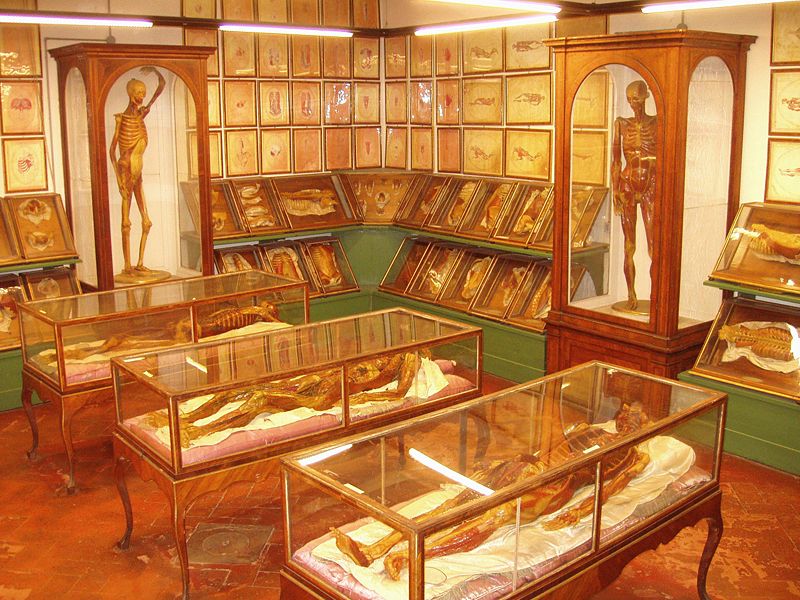
  • All major cities have natural history museums, but not ones founded by the Medici.  La Specola hosts eighteenth-century specimen collections, including skeletons and dissection models, many many more elaborate wax surgical models than the science museum, and the Medici’s pet hippo (stuffed).  Not for those with weak stomachs.
  • Cost: 6 euros, 10 euros for museum and exhibition.
  • Time required: 2-4 hours.
  • Hours: 9:30 AM – 4:30 PM, closed Mondays.
  • Website: http://www.msn.unifi.it/mdswitch.html
  • Notes: Some ticketing connection with Pitti Palace which I don’t quite understand. (Quoth the website in two contiguous lines: disabled access: YES / disabled access: NO)


Share

A Passion for Porphyry

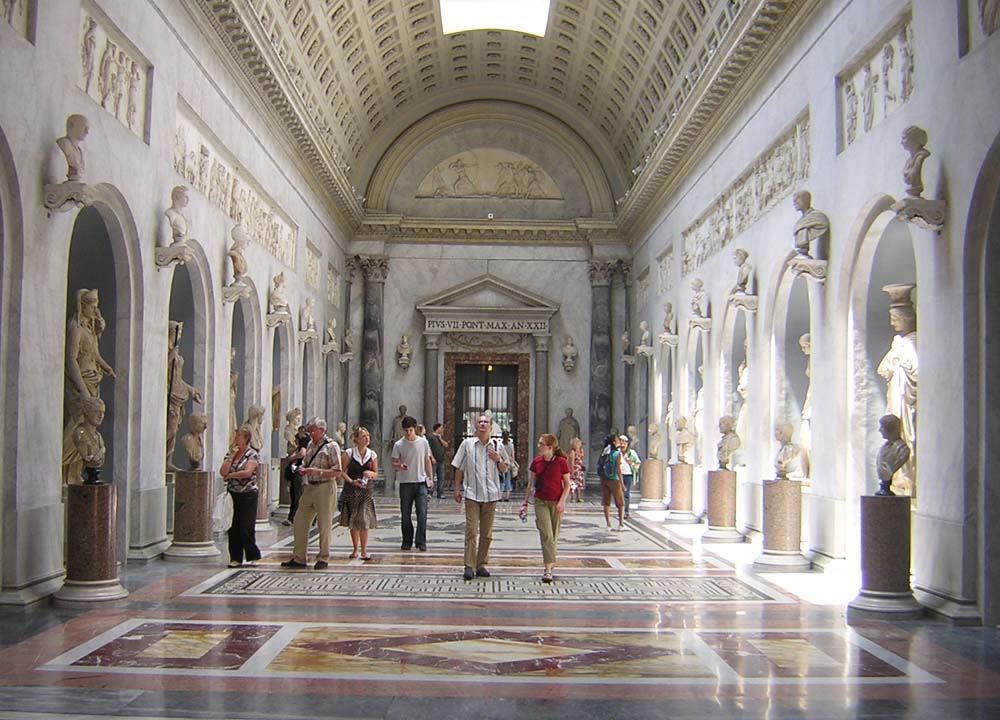
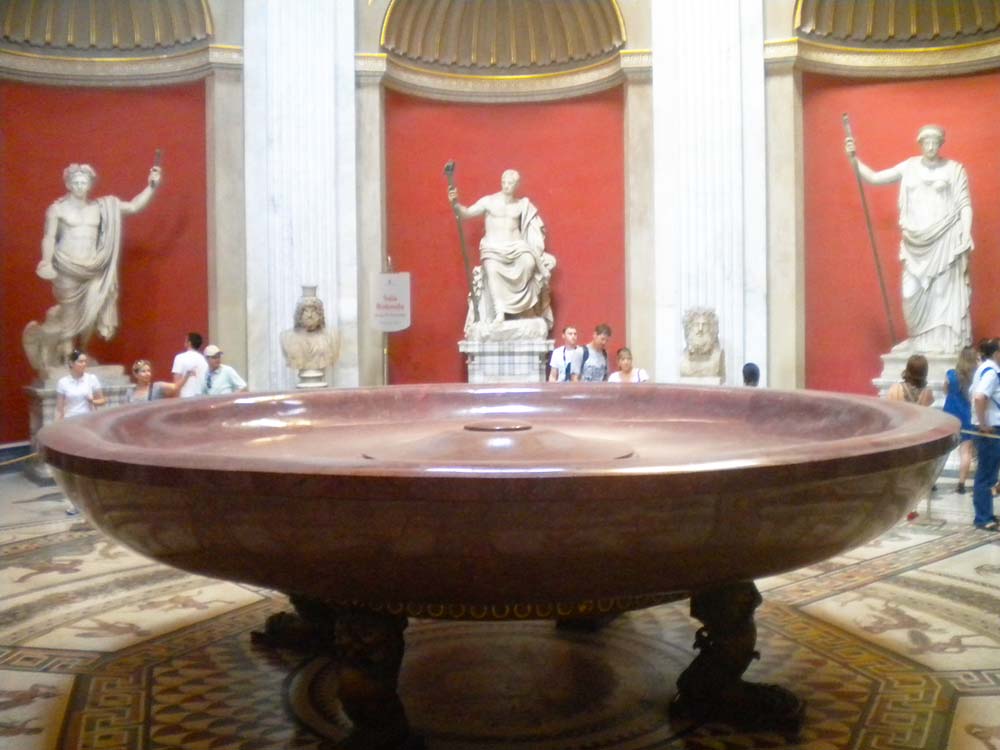
The Vatican museum: hall after hall of ancient Rome.  Shelves crowd the corridors with busts of Caesar, of Cicero, of a hundred obscure Senators, of still more-obscure Romans, anonymous but vivid with two-thousand-year expressions of resolve or grit or whimsy crowded shelf on shelf.  Here sits Penelope still patient, Diana hunting, Bacchus laughing merry, while somewhere in the distance the Sistine Chapel lurks, complacent in its celebrity.  In the Hall of Animals, Roman hounds sniff at Roman horses, rabbits, crabs, crocodiles, camel heads with their enormous, gummy lips, all stone.  The Belvedere Courtyard stunned you with its circle of masterpieces every one of which transformed the history of sculpture: the Belvedere Apollo, the Belvedere Torso that so fascinated Michelangelo, and, as matchless when the Renaissance unearthed it as it was when Pliny called it the best of sculptures 1500 years before, the real Laocoön.  The walls and ceilings of the patchwork labyrinth-palace are such an ocean of gilded cornices and marble tracework that it becomes impossible to tell north from south or ground from upper floors, so all sense of grounded space is long gone as you turn the corner into a grand scarlet rotunda, floored with vivid Roman mosaics.  Statues of gods and emperors loom, more than twice life-height: grim-faced Athena, tired Claudius, the massive gilded Hercules; while the friend beside you stops dead and, slack-jawed, points at a big stone tub in the middle of the room: “Look at the size of that hunk of porphyry!”

Yes, it’s porphyry, a dark, reddish-purple speckly stone, and this room, for the many who enter and ooh and aah and glittering Hercules, is another moment of material illiteracy.  Just as a Catholic spots John the Baptist by his hairshirt, and a fashionista a Gucci handbag by whatever alien cues its curves contain, so from the Roman Republic to Napolean a European knew what porphyry implies: Wealth, Technology, Empire, Rome.

Porphyry has become a generic term for igneous rock containing large spots (crystals), but the source of the name is the Greek word for purple, and the purple form is the true original.  This is referred to as Red Porphry, Purple Porphyry, or, most aptly, Imperial Porphyry.


The Imperial Porphyry found in Italy came from a single mine in Egypt, the Mons Porphyrites.  It was imported by the Romans as a decorative accent stone, for use in tiled floors, as colored columns, or occasionally carved into a vase or sculpture.  Its color invokes Royal Purple, but is also very close to the color of the fabulously expensive shellfish-based purple dye which produced the purple stripe which marked the tunics and togas of the Senatorial class.  This also dyed the completely purple toga worn by those who occupied the rare and severely powerful office of Censor, a special official created only on occasions, whose task was to examine the state of the Senatorial families and judge which were still worthy of office and who should be removed or added to the roster of Rome’s leading citizens.

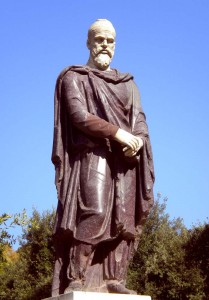
A Roman statue with a purple toga rendered in porphyry, from the Boboli gardens behind the Medici's Pitti Palace.

Several Caesars held this special office, so purple, and porphyry, and as their palaces became more opulent it became increasingly an imperial symbol.  In Constantinople, once the capitol moved in the late empire, the imperial palace contained an entire room covered in porphyry, and this was traditionally where empresses gave birth, giving imperial princes and princesses the title Porphyrogenos, “born to the purple”.

Porphyry is extremely hard, also dense and heavy.  Even lifting a substantial hunk of porphyry is a great feat, let alone transporting it by ship from Egypt.  It is also so hard that it takes very strong, well-tempered steel to cut it, and even then, achieving any great degree of precision is very challenging.  The Romans had steel good enough, but it too was lost in the Middle Ages, making Roman porphyry artifacts not only symbols of the Caesars but of the impossible godlike skills of the ancients, which their weak successors could only marvel at.  It was physical, recognizable proof that the Romans could do the impossible.  In addition, the location of the mine in Egypt was lost around the fourth century AD, and not successfully rediscovered until 1823.

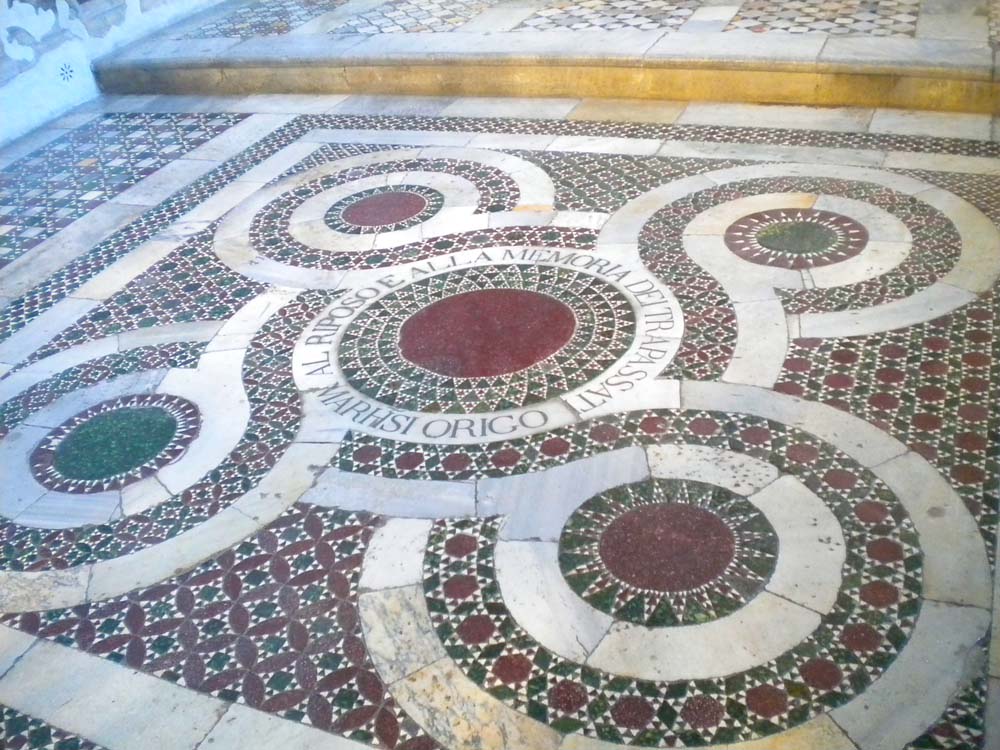
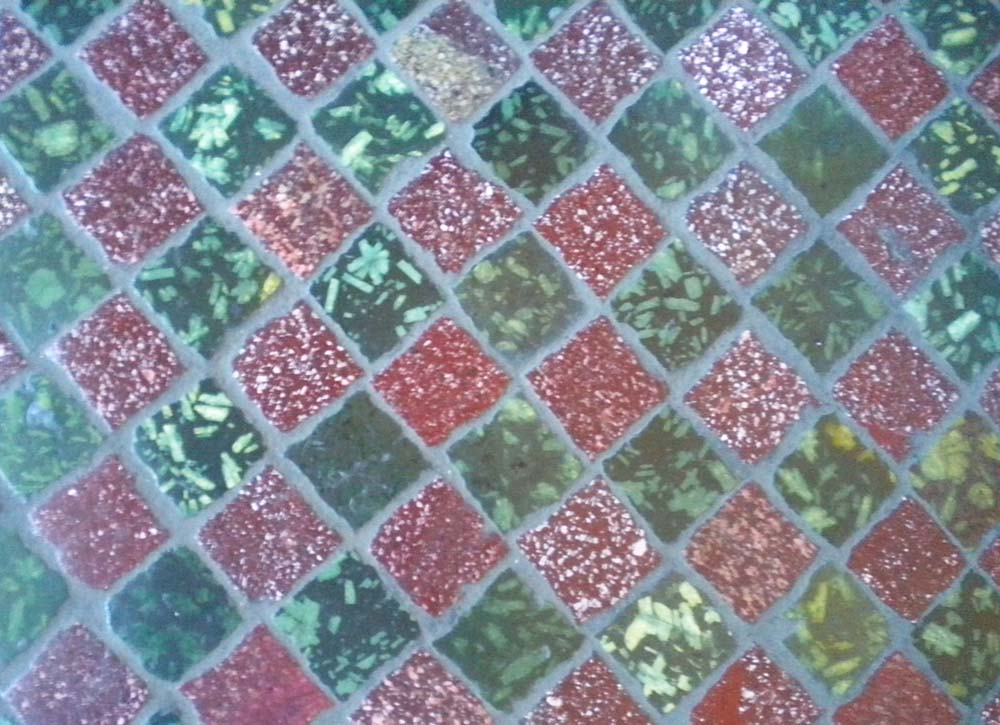
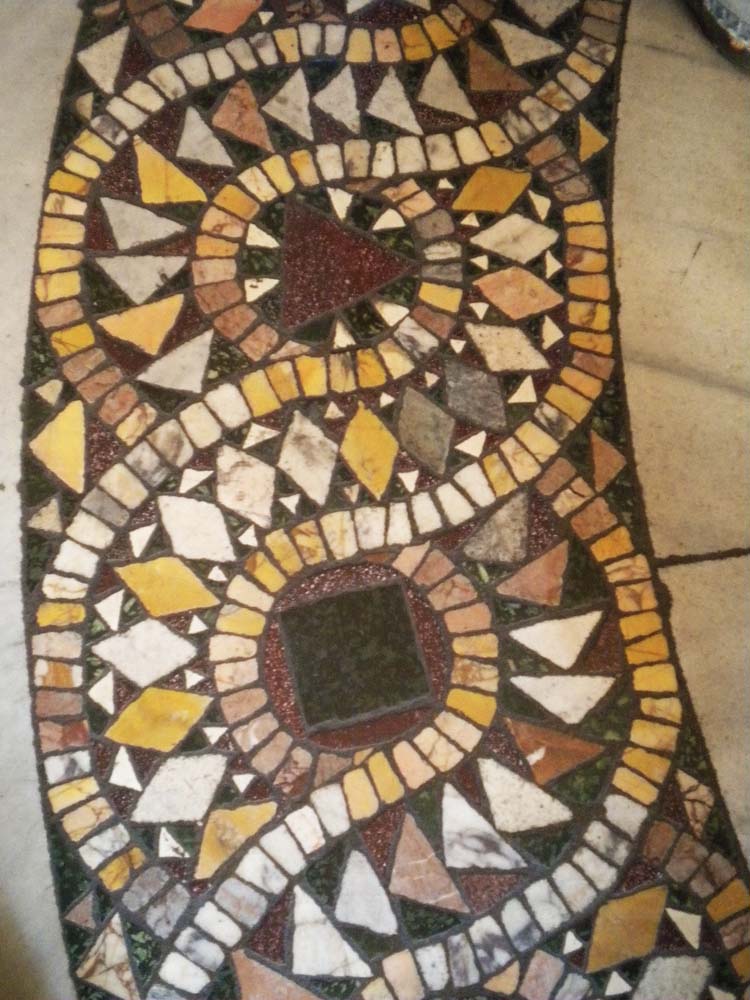
Imperial Porphyry has a cousin, green porphyry, commonly called Serpentine.  It is just as hard, also Egyptian in origin, speckled too though often with larger speckles, many somewhat rectangular or X-shaped.  The combination of rich green and purple, usually set in a white Italian marble background, was an extremely popular decorative element seen all over Rome, in the houses of Rome’s imitators, and especially in palaces and churches which re-used floor tiles looted from Roman sites.  Porphyry ornaments the floors of Rome’s greatest churches, with the size and density of porphyry among the framing stones increasing toward the altar.  The header at the top of this very blog shows a porphyry section from the floor of the Sala della Disputa, the frescoed room in the Vatican which hosts Raphael’s incomparable School of Athens, while the Sistine Chapel Floor (not a phrase you hear often enough) completes the opulence of the other decoration with a dense decoration more purple than white.

In the Middle Ages, then, porphyry meant Rome, specifically the lost power of the Caesars who could reach across oceans and achieve impossible feats.  Anywhere porphyry appeared it was a Roman relic, and anyone who had it could claim thereby to be an inheritor, in some small way, of that lost Imperium.  Porphyry also came, over the middle ages, to symbolize Christ (reddish purple = blood), but in the Middle Ages everything came to represent Christ, from griffins and unicorns to pelicans and pomegranates (no, it’s totally not a co-opted pagan symbol, why do you ask?), so what distinguished porphyry from the zillion other things that represented Christ was still its imperial connection and its technological unachievability.

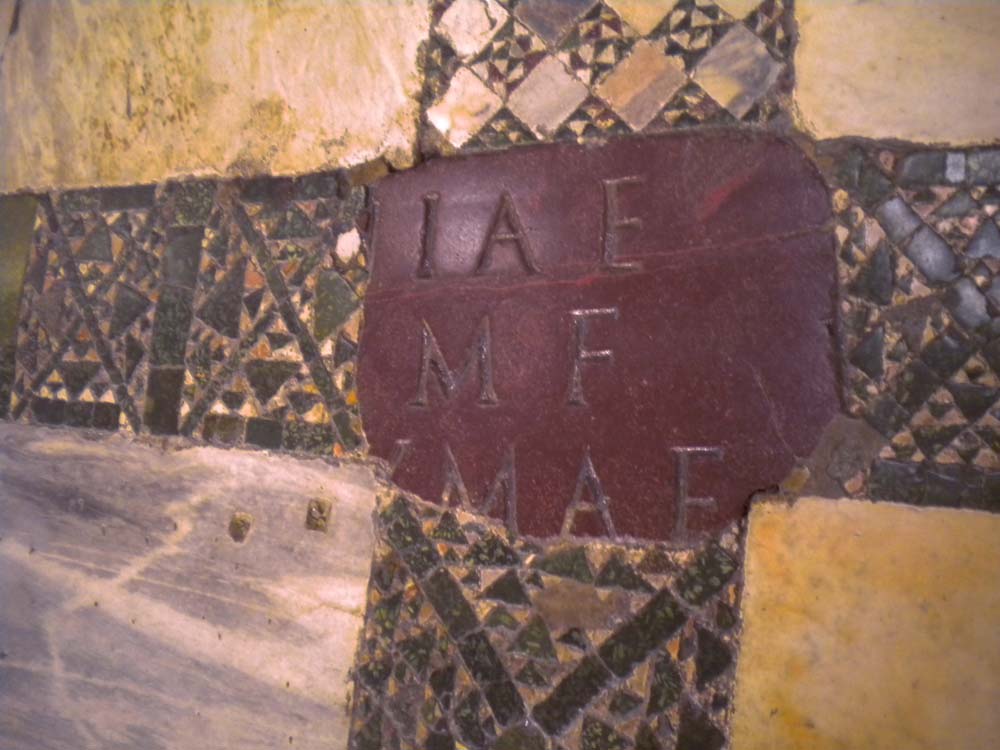
Re-purposed porphyry in a Church floor, with remnants of its Roman inscription.

Thus everyone who’s everyone wanted porphyry, and if you wanted it, you had to steal it.  The only porphyry in Europe lay in things the Romans built, so every prince and republic and sculptor who wanted this symbol of Roman power had to steal it from the source.  Want to put in a nice porphyry floor for a Church?  Loot it from a Roman temple.  Want to advertise the imperial majesty of Mary Queen of Heaven?  Make the altar out of an old, repurposed porphyry sarcophagus.  If a pope wanted porphyry columns for his tomb, he had no better source than to go to some surviving Roman temple (say, the Pantheon…) and rip out the porphyry, perhaps if he’s polite substituting some less valuable stone to keep the looted edifice from falling down.

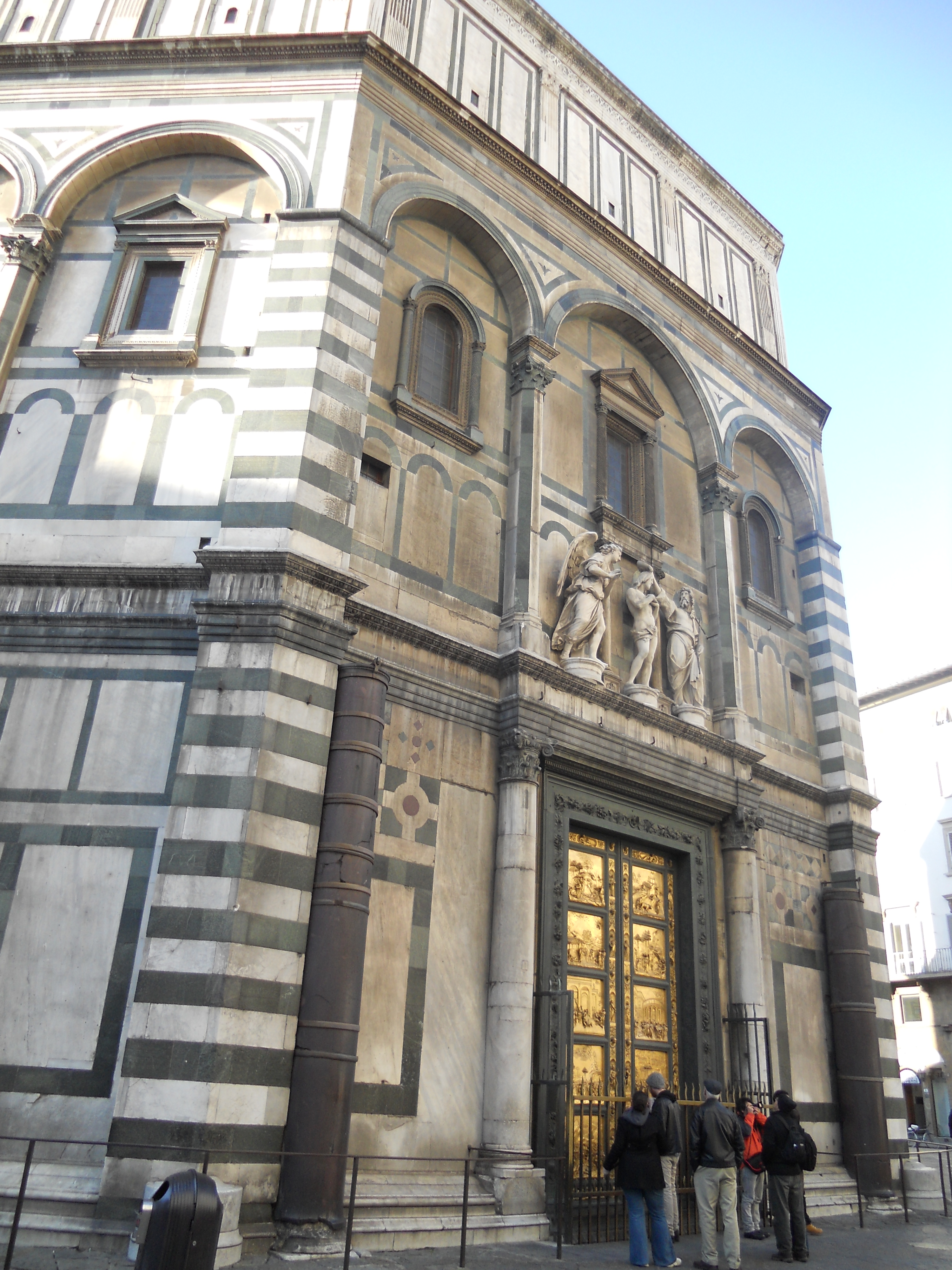
Some places already had porphyry brought there by the Romans, and in these cases it was proudly displayed as proof of the noble Roman origins of a town or province.  Even in Florence, on the baptistery which is the literal heart and center of the city, the gilded Gates of Paradise are still flanked by two old, cracked and mended, asymmetrical dark reddish columns, built into green and white facade despite a complete chromatic mismatch.  So old and dull are they that many don’t even notice them upon first or even third visit, but these are porphyry, relics of the Roman-era Church of Santa Reparata, or its predecessor, preserved and re-used here as proud proof of Florence’s Roman roots.

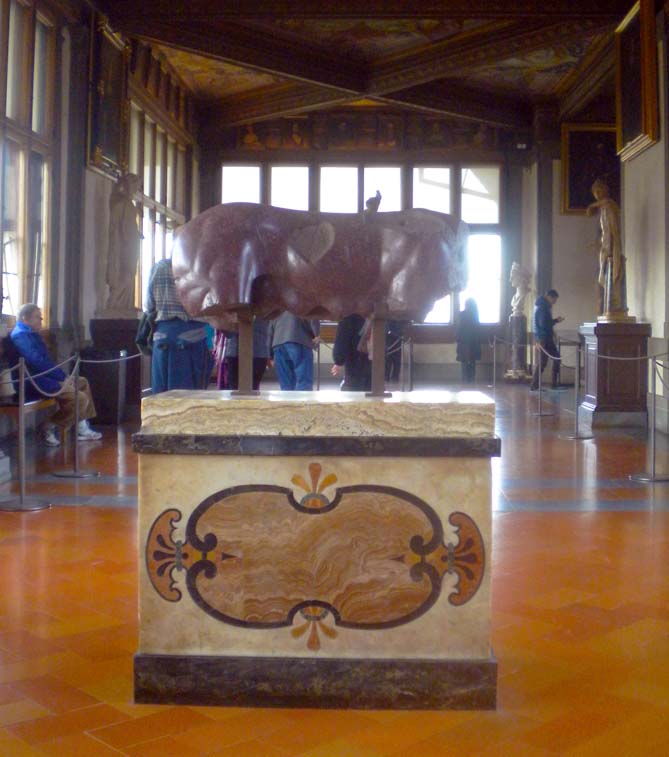
The Uffizi "lupa" i.e. she-wolf

Porphyry sculpture was even more impressive than a tile or column, since working such an adamantine substance into complex shapes required immense time and skill.  Diamond was rare and valuable and not a practical tool for trying to make a large chisel to work large stone, but short of diamond the only means to shape porphyry was to rub it against another piece of porphyry for a very long time, grinding both down, a clumsy, labor-intensive and imprecise technique.  Many, especially the Medici family, poured funds and efforts into researching ways to make a metal sharp enough to carve porphyry, or a solvent capable of weakening it, in hopes of adding this to their list of resurrected Roman achievements.  Even before they succeeded, however, possessing a Roman porphyry sculpture was an even grander boast than possessing simple tiles, and at last now we can understand why, in the Uffizi Gallery, where the great Roman sculpture treasures of the Medici are still housed, one comes around the corner to the very center of the U-shaped gallery, expecting to see in the center some exceptional masterpiece, an Emperor or bold Athena, one sees instead the mangled, limbless torso of an animal.  Look again: those hips, those hanging teats.  This is the mangled, limbless torso of a porphyry she-wolf, the symbol of Rome herself.

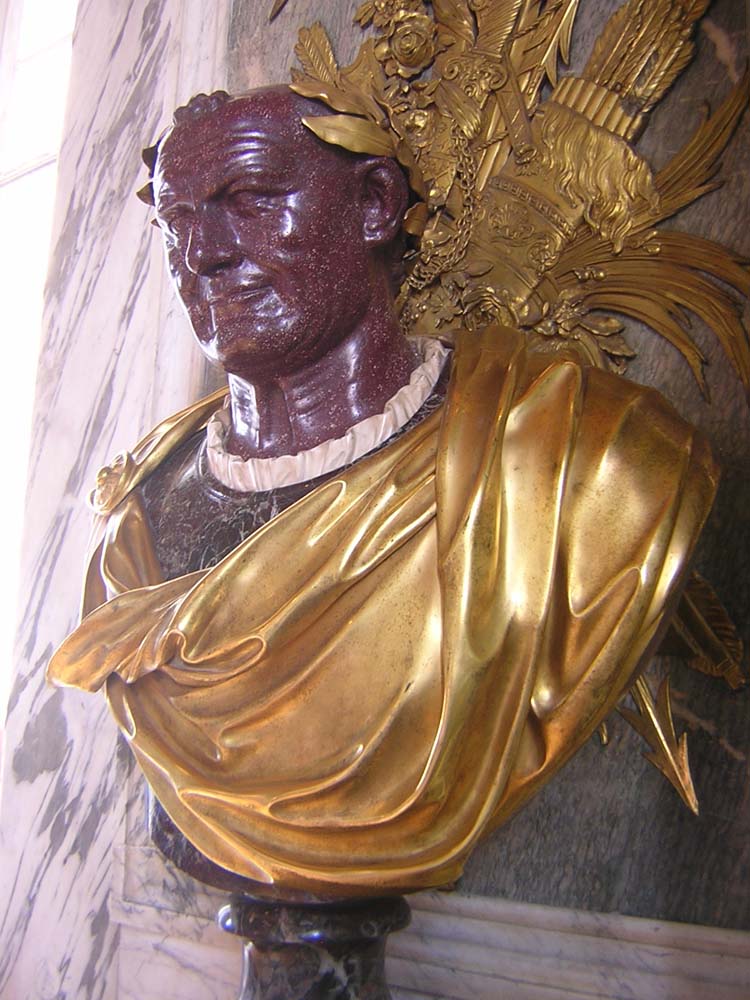
A porphyry bust at Versailles.

Naturally, the greatest concentration of porphyry lay (and lies) in and around Rome itself.  The farther you are from Rome, the scarcer (and more impressive) porphyry becomes.  Florence had a couple columns and the odd basin, but for more porphyry they had to buy or steal from Rome, or elsewhere.  The Venetians carried off large pieces of porphyry from Constantinople when they looted it, and still display them proudly as pulpits on either side of the main alter in San Marco.  Porphyry in northern Italy is comparatively scarce, so a Venetian palace with a few roundels in its facade makes a real statement.  Even as far as France, when Louis was decorating Versailles, porphyry was scarce indeed, but what few busts and vases he got hold of went straight into the best places: the throne room, and the Hall of Mirrors where every visitor would see, and understand, Louis = Caesar.

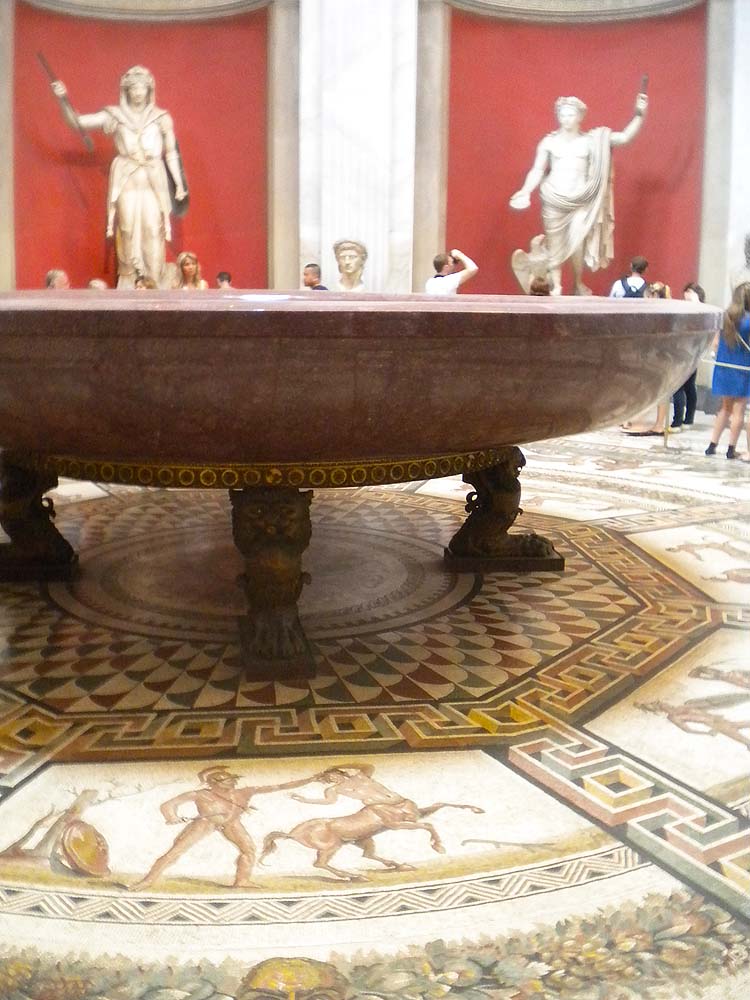
The pope always wins the Who-Has-The-Most-Porphyry Competition, and the Vatican is its grand display case.  The staggeringly enormous porphyry basin in the round sculpture room in the Vatican palace is referred to as Nero’s bathtub, and is the largest piece of porphyry I have ever seen; I would not be surprised to discover it is the largest in the world.

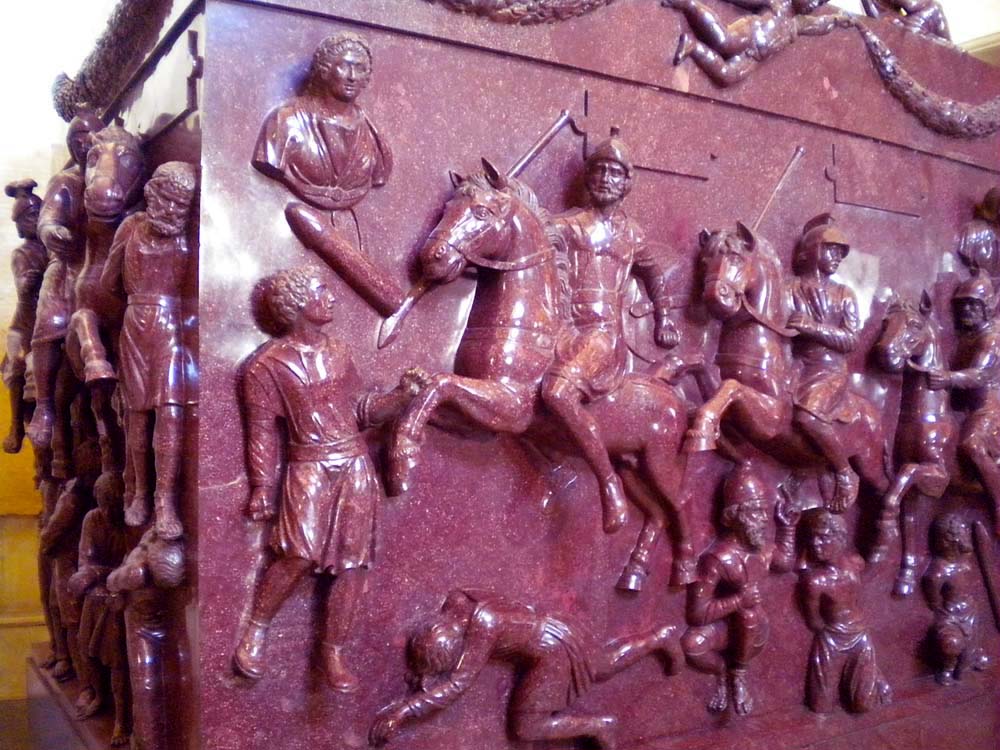
The sarcophagus of St. Helen

One is generally still reeling from trying to imagine the staggering cost and difficulty of creating and moving such an object, when in the next room one encounters an even more impossible vision: two enormous solid porphyry sarcophagi, both taller than a standing person, and covered in deep relief carvings of horsemen, prisoners and acanthus leaves.  This is Rome indeed.  Specifically, these are the sarcophagi of the women of Constantine’s family, including the tomb of his mother, Helen, or more specifically Saint Helen, who traveled to the holy land and brought back the True Cross and the Lance of Longinus and… at least one other major relic, but I can’t right now remember whether it was a nail or part of the Crown of Thorns, or perhaps that piece of the Holy Sponge they have in Rome…  (Spot the Saint moment: Helen’s attribute in art is that she carries the cross.)  Regardless, the two tombs have no Christian imagery, just the most Roman of Roman decorations, horsemen leading vanquished prisoners for Helen, and for the other fertility images.  In deep, impossible relief.  In an era when it was a substantial feat to scrape two looted pieces of porphyry into sufficiently matching shapes to make them seem symmetrical in a floor pattern, there is no purer proof of the godlike power of the ancients.  After that, there is just too much, and every further encounter with porphyry in the Vatican labyrinth feels like one, two, three, five, ten too many.

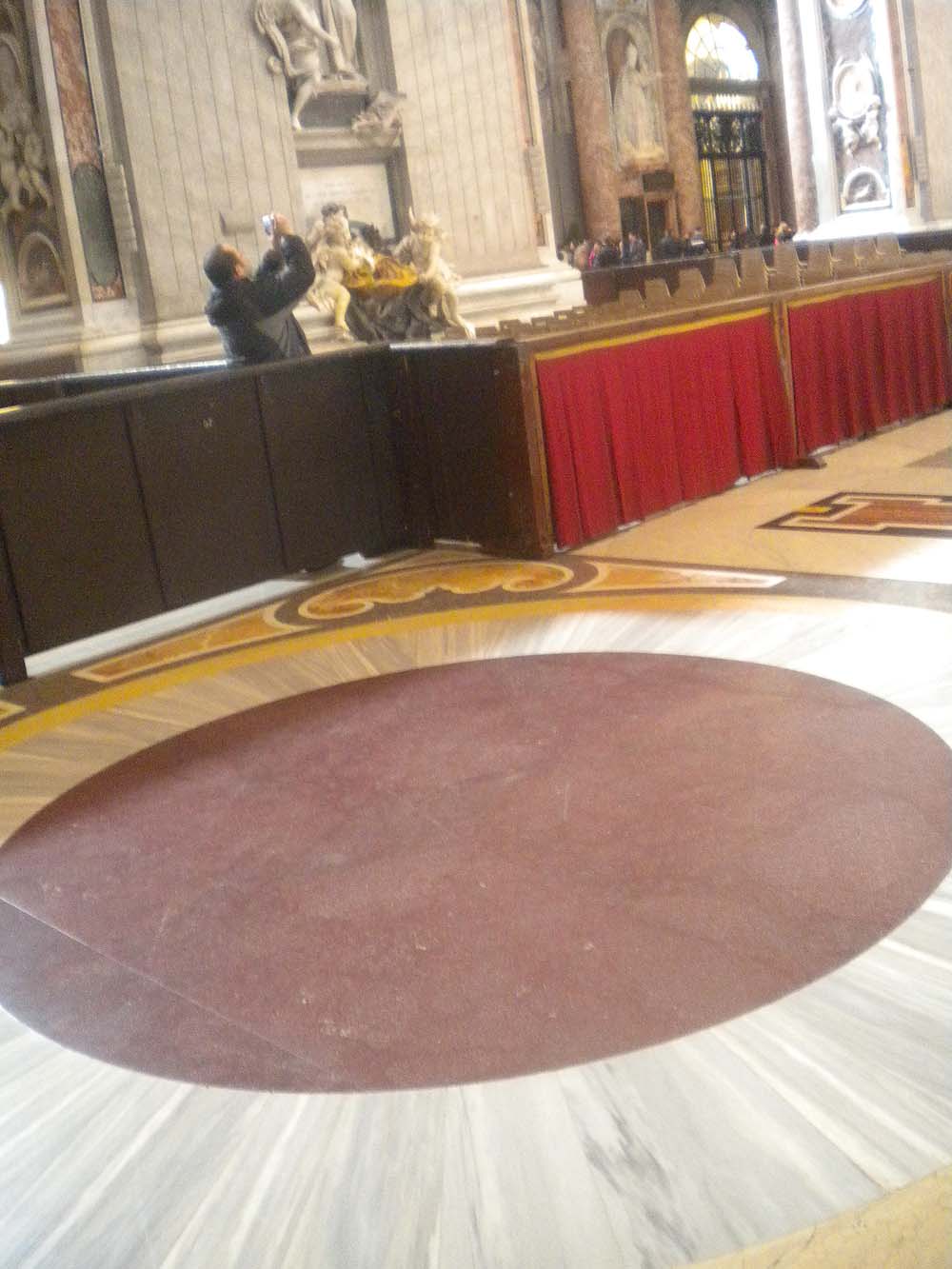
That guy should be taking a photo of the porphyry!

St. Peter’s is just as much a showroom for porphyry, with columns, tiles, tombs.  Every purple object that, from a distance, makes you think “is that porphyry?” turns out to be the genuine article.  And it’s worth keeping in mind that, except for the most modern pieces, they’re all relocated chunks of what were Roman temples scattered around the city from the Caesars’ days.

One large porphyry round in the floor close to the entrance is supposed to be the stone from the original St. Peter’s on which Charlemagne was crowned the first Holy Roman Emperor (and successor to the Caesars) on Easter, 1800 AD.  It’s just inside the entrance in the exact center of the Church, sort of balancing the altar, secular power facing sacred.

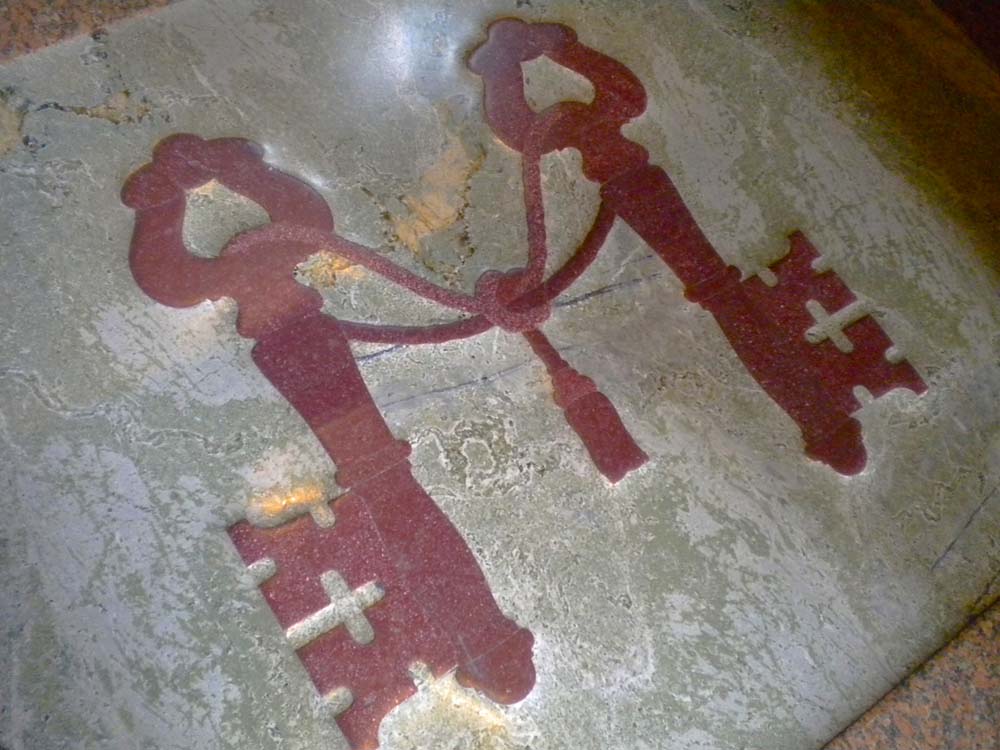
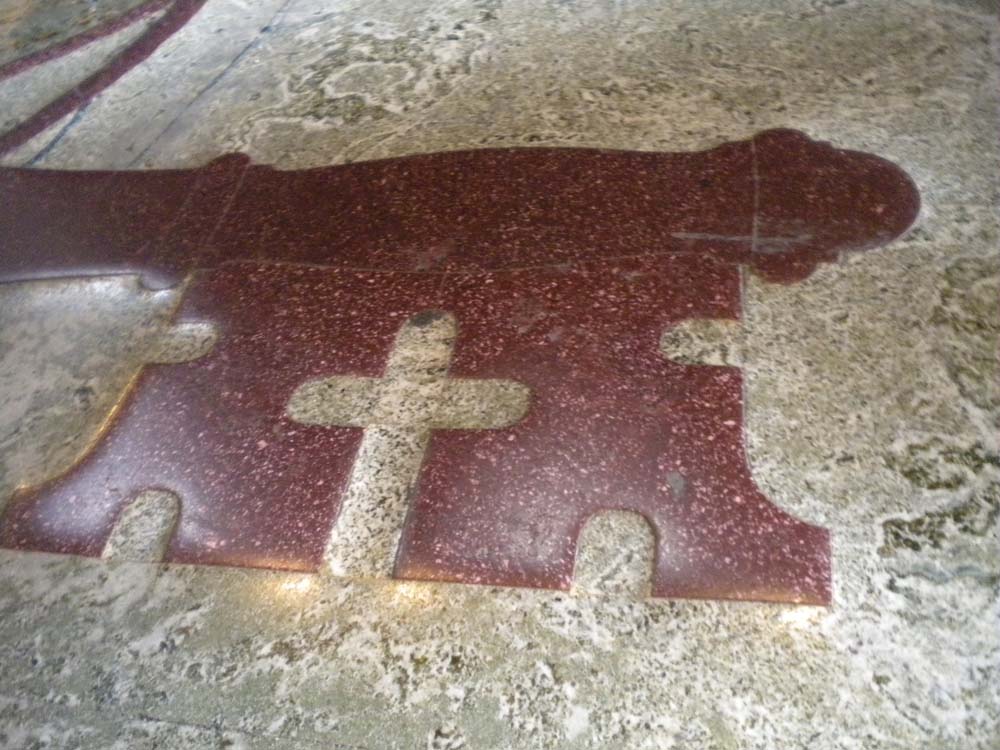
Perhaps my favorite piece of papal porphyry, though, is this set of porphyry keys carved and set into other stonework in the threshold of the Church, so every visitor who enters walks across them.  Most ignore them, but in the pre-modern world one glance at heraldic papal keys in porphyry spells a very special kind of awe: not only does the pope have Porphyry but apparently he has the power to carve it into a Christian shape.  Clearly he is Rome’s successor.  With so many visiting feet for so many centuries, the papal threshold keys are also the best proof I know of the extreme hardness of porphyry, since the stone around them is worn down by more than a centimeter, while the keys stick up, unharmed by the tread of millions.  The Florentine Museum of the History of Science has examples of scientific instruments and grinding stones fashioned from porphyry, chosen for its rigidity and inelasticity as well as for its opulence.

It is not easy stopping traffic long enough to take this detail shot of the threshold of St. Peter's


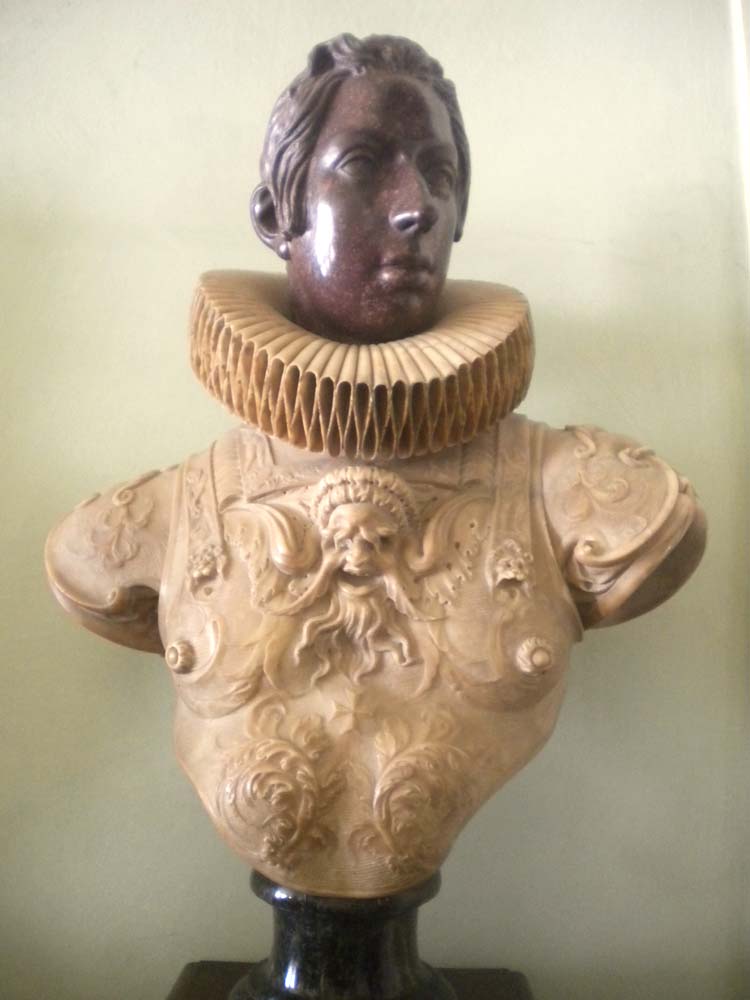
Note how much more detailed the carving on the marble chest is than the porphyry head on this bust of a late Medici.

The ability to carve porphyry was eventually recovered, and in the 18th century Roman relics were transformed into large numbers of sculptures, especially busts, of rather questionable taste and quality.  Porphyry remains hard to work with, so the very subtle curves and scratches necessary to make a really lifelike human portrait are simply impossible in it.  Its products are always a little too smooth and shiny, the edges of the eyes clumsily cut, the wrinkles a little too smooth, like waves rather than folds.  Also, purple with speckles is not the most flattering skin tone.

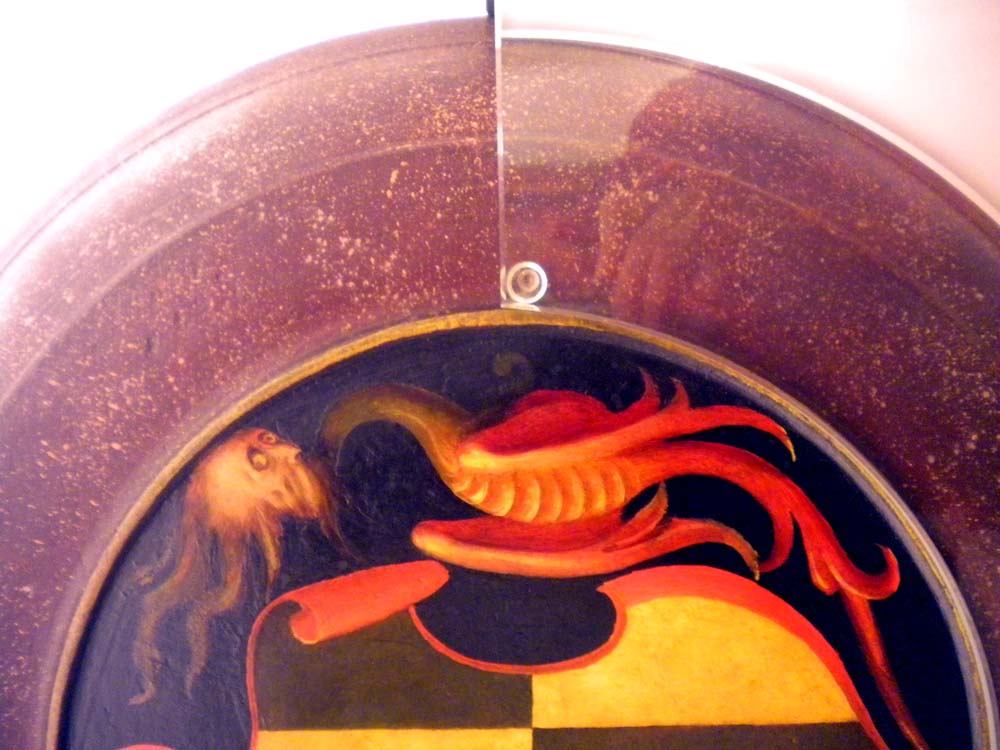
Fake porphyry was, naturally, an industry as well, and many of the most famous buildings in Europe contain not only real porphyry but painted fake porphyry, made of plaster or wood painted with the signature purple and speckles.  This was most often done for bases on which statues sat, or for trim around rooms, but the Villa Borghese in Rome contains whole tabletops of fake porphyry, with real porphyry busts nearby to make them plausible.  Porphyry was also a popular ingredient in painted scenes, especially paintings of imagined palaces, and of places intended to be ancient Rome.  And heaven, of course.  The halls of Heaven, where saints and angels pose for altarpieces, have plenty of porphyry.

Reverse of a decorative wooden platter, painted to look like porphyry

Share