How to Spot Good Gelato from 15 Feet Away
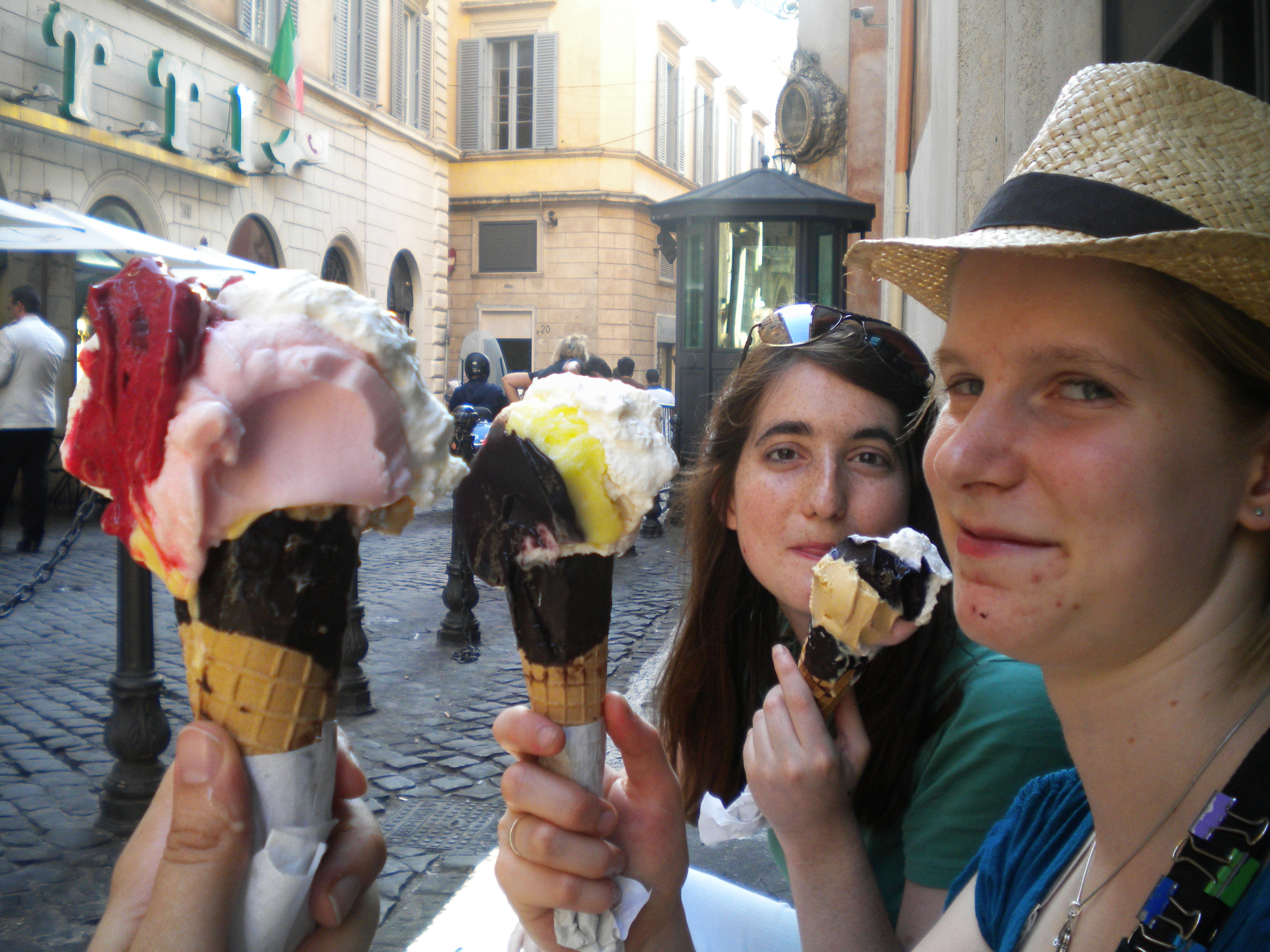
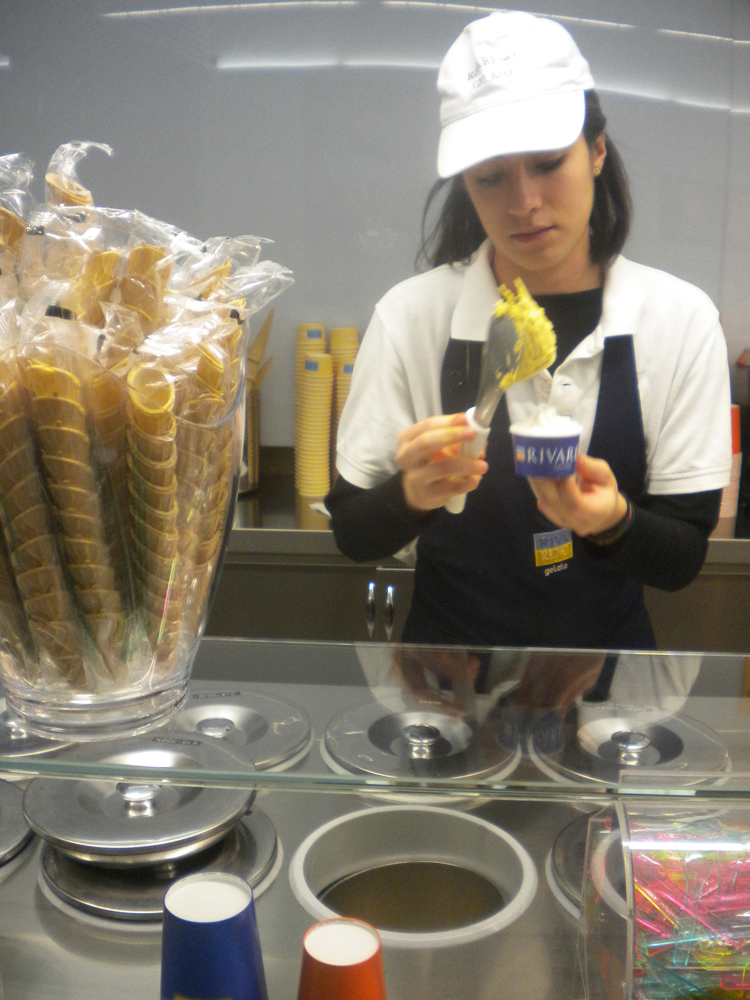
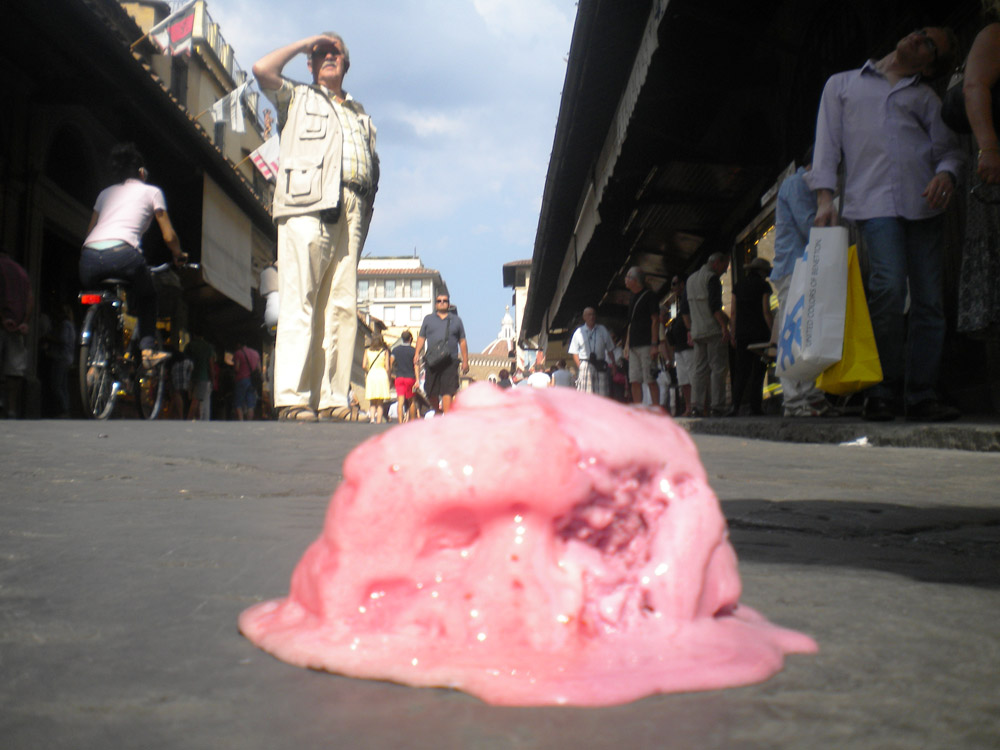
Friends traveling with me are often perplexed to see me stick my head in a gelateria’s door and instantly proclaim it good or bad, despite not having approached close enough to smell, let alone taste, the contents of the brilliant, alluring bins of swirling color. It can be done. There are visible signs of good and bad gelato, so today I am sharing my gelato-assessment method, applicable in Italy and around the world, and hopefully of service to you (especially to several specific friends who are going to Italy soon).
First I want to clarify that pretty much all gelato is delicious, even what I term “bad gelato.” The very humblest kind of gelato is made from pre-packaged powdered mix, consisting of sugar and (usually artificial) flavors and colors, which can be mixed with milk and popped straight into the gelato machine. The sweet, cold, creamy dessert this produces is still quite yummy, the way cheap candies or grocery store cookies are yummy despite their mundane provenance. One is certainly happier eating this gelato than no gelato, but in an area saturated with Great Cuisine, like Florence, or Rome, or Montreal, it is seldom worthwhile to settle for the adequate when the sublime lurks around the next corner.
I also stand by my conviction that the quality of gelato is far more variable than that of ice cream, and far harder to predict from flavor options alone. Ice cream depends on the fat of the cream to help keep it soft, and also on salt as well as sugar, giving it an inherent mix of flavors which are lend well to complex mixes of flavors (triple fudge marshmallow peanut butter banana chocolate chunk blackberry swirl) and are also very effective at concealing it if the ingredients (especially the cream itself) are of middling quality. Gelato is fundamentally just sugar and milk, or sugar and fruit in the case of a sorbetto, and the flavors are usually simple (hazelnut) or extremely simple (fior di late, pure milk). Thus, you can taste it very easily if gelato contains poor milk, poor fruit, or artificial chemicals (many respectable places still use chemicals to help the gelato coagulate and remain the correct degree of softness in the freezer), far more easily than you can taste the same chemicals supplementing the more full-bodied base flavors of ice cream. Thus high quality gelato is (in my opinion) better than the best ice cream because it showcases its excellent ingredients better than the ice cream does, but bad/cheap gelato tends to be worse than bad/cheap ice cream because ice cream’s natural fattyness and saltiness effectively conceals poor ingredients and artificial additives. Notice also that the best grocery store gelato brands (like Talenti) wisely tend to focus on flavors which combine multiple ingredients (salted caramel, cherry and chocolate, mint chocolate) since mixed flavors more effectively conceal the softening additives which grocery store gelato needs to contain to let it last overnight.
Speaking of lasting overnight, another difference between gelato and ice cream is that ice cream keeps better. Both substances are suspensions of tiny ice crystals, which gradually clump to form larger and larger ice crystals, which is why old ice cream has lots of hard bits in it, and sometimes freezes into a solid block. But gelato forms these much faster than ice cream does, since fat and salt slow the clumping process, so gelato without additives can’t even last overnight without freezing into a block, whereas ice cream can. This means the best gelato must be made anew every day in small batches, increasing the labor and meaning anything unsold at the end of the day is a pure loss for the gelateria. In contrast, ice cream can last several days, even a week, so ice cream places have lower labor costs and lower losses on unsold product, a key reason why ice cream parlors can be supported by much smaller communities whereas gelato places require a high population center to ensure that sales move quickly — or else they have to include additives which make the gelato taste funny.
“But I can’t have gelato, I’m vegan and/or lactose intolerant.”
I want to briefly combat this assumption. At its heart gelato is indeed milk-based, but good gelato places also make fruit-based sorbetti, which at their best are pure fruit with sugar, and no dairy at all, while some lower quality ones are mixes of water and fruit extracts, like frozen limeade. These are perfectly safe for vegan and lactose intolerant people, and many dairy-lovers also love, or even prefer, sorbetti to dairy flavors. Occasionally the fruit flavors contain egg whites to help them stay solid, but this is uncommon in my experience. If this is a concern it is usually easy to find out by asking. In addition, more and more serious gelato places have started offering a few flavors based on soy milk or almond milk, to open up gelato more to people who can’t have dairy, and to make use of new exciting flavor possibilities offered by new bases. When I attended the 2012 International Gelato Festival in Florence, I think about a quarter of the competing flavors were dairy-free, possibly more, including both exotic fruits and creamy flavors based on non-dairy milks. And all were delicious.
Now, the test:
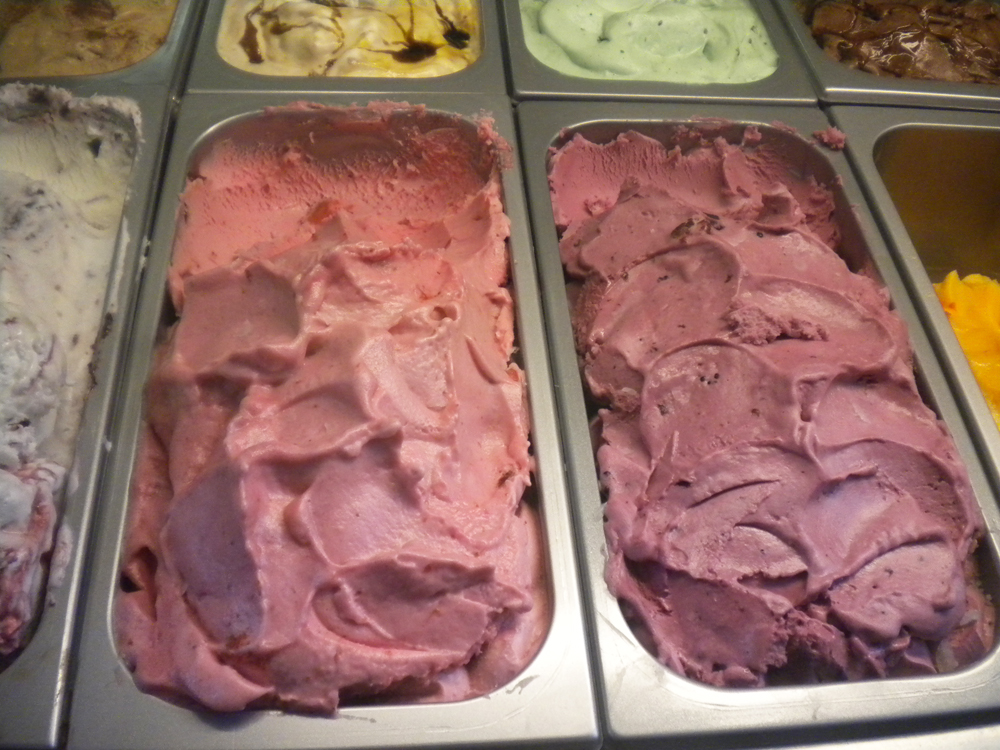
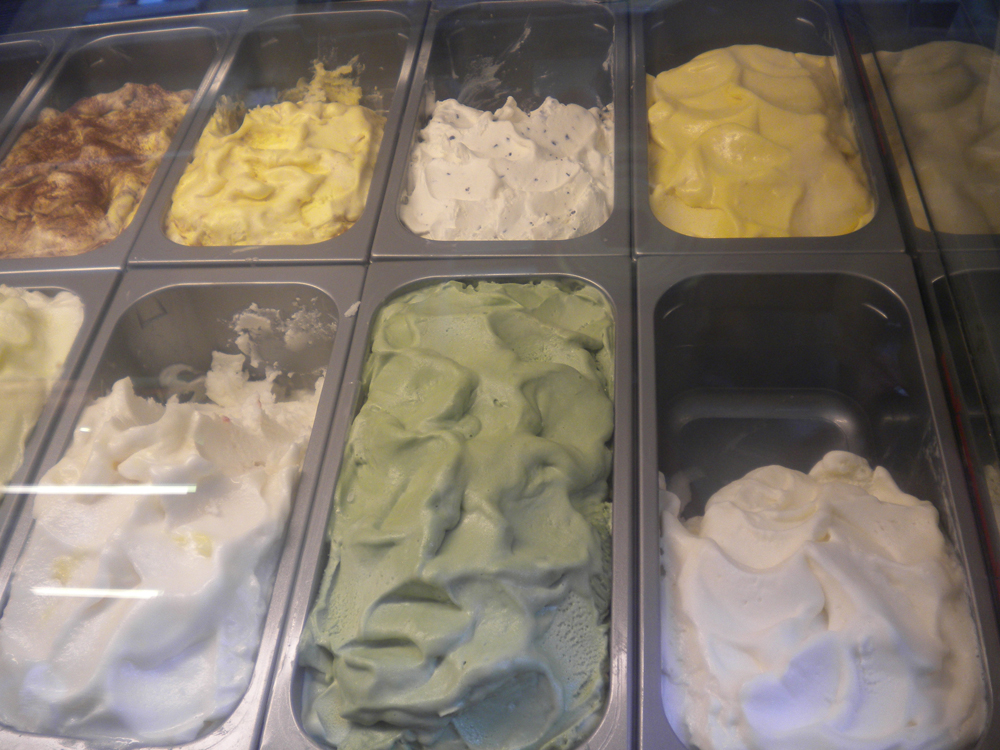
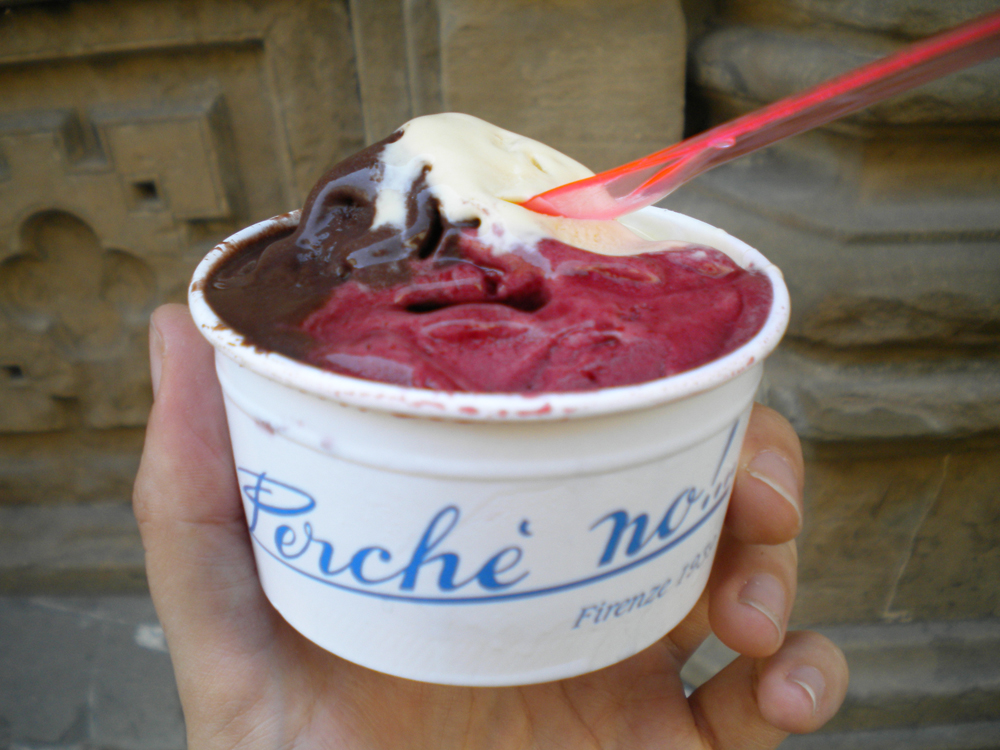
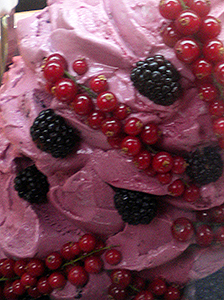
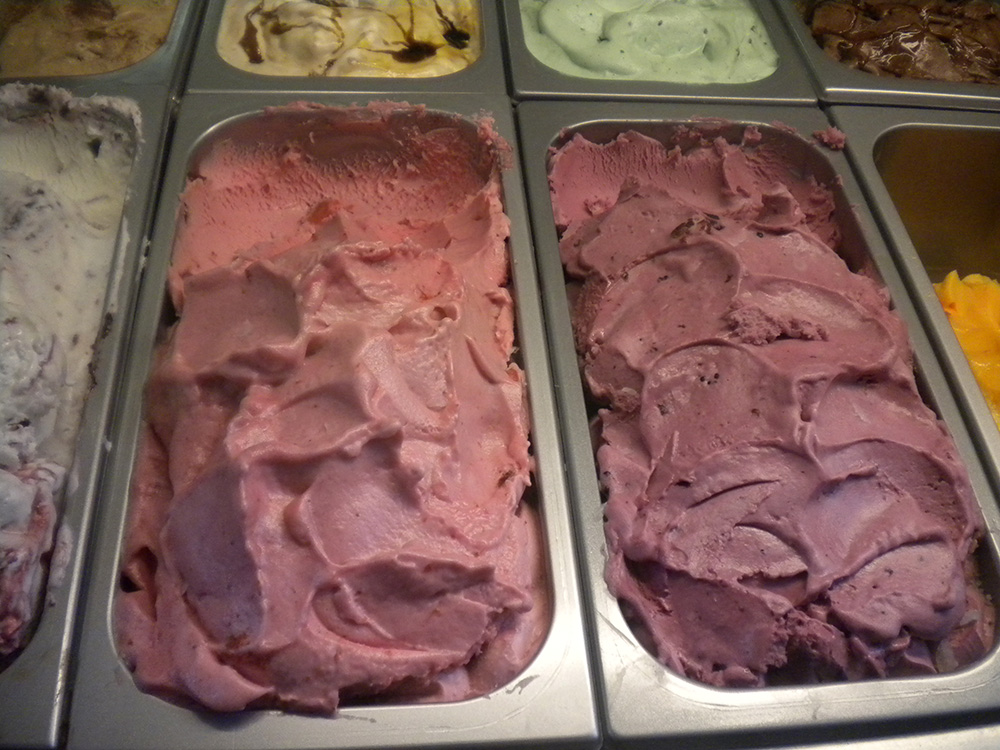
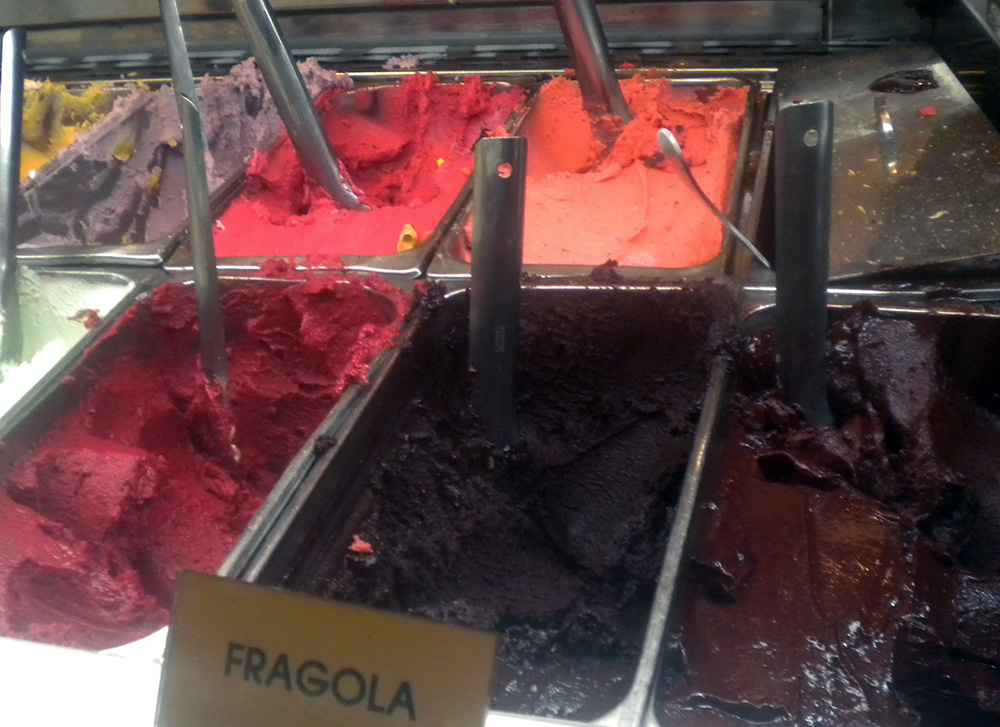
#1) Look at the color of the fruit flavors. Banana, apple/pear, or berry flavors (frutti di bosco) are the easiest tell. If the fruit gelati are made of pure, real fruit then they will be the color that fruit would be if you crushed it: berry flavors a deep dark off-black purple/red, apple white or brownish or yellowish sometimes with flecks of peel, and banana a rather unappealing shade of gray. If, on the other hand, banana is a cheery yellow, apple a perky spring green and berry flavors are the light-ish color of blueberry yogurt, then the gelato before you is a mix of milk with food coloring plus fruit extracts or artificial fruit flavor. Pistachio similarly should be the color of crushed nuts, not bright green. The artificial fruit gelati can still be delicious, but only pure fruit sorbetti will give you the overwhelming flavor of top quality fruit gelato which tastes more like fruit than the fruit does, hyperconcentrating the fruit’s flavors and bringing them out with sugar. This matters even if fruit isn’t your thing: making the gelato out of pure fruit is more laborious and expensive than using flavor extracts, so a gelateria with a brilliant dark frutti di bosco is one that is definitely trying to produce the best, and thus also likely to produce a superior chocolate, crema, etc. Now, sometimes mixes of fruit with dairy can be good, so a blueberry-yogurt-colored frutti di bosco isn’t always a bad thing, but the pure fruit ones are more difficult and more expensive, so they are always a good sign, even if the opposite is not necessarily a bad sign. Looking for fruit colors is generally my first test, and if a place passes that’s often enough to say “Yes!” without worrying about other elements of the test. But if still in doubt:
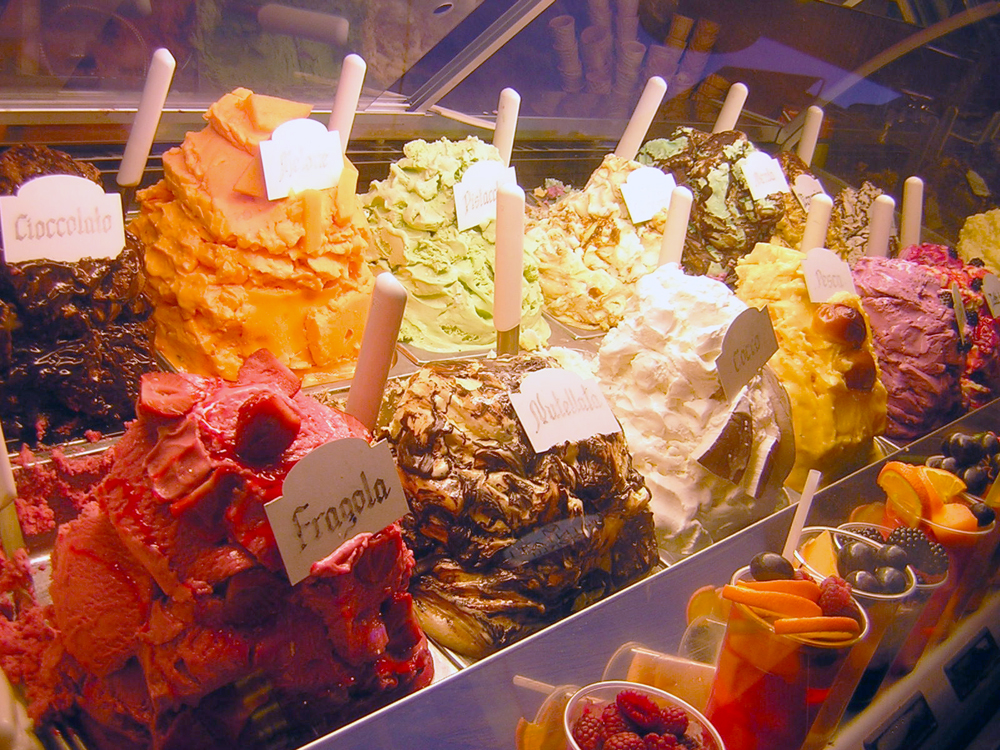
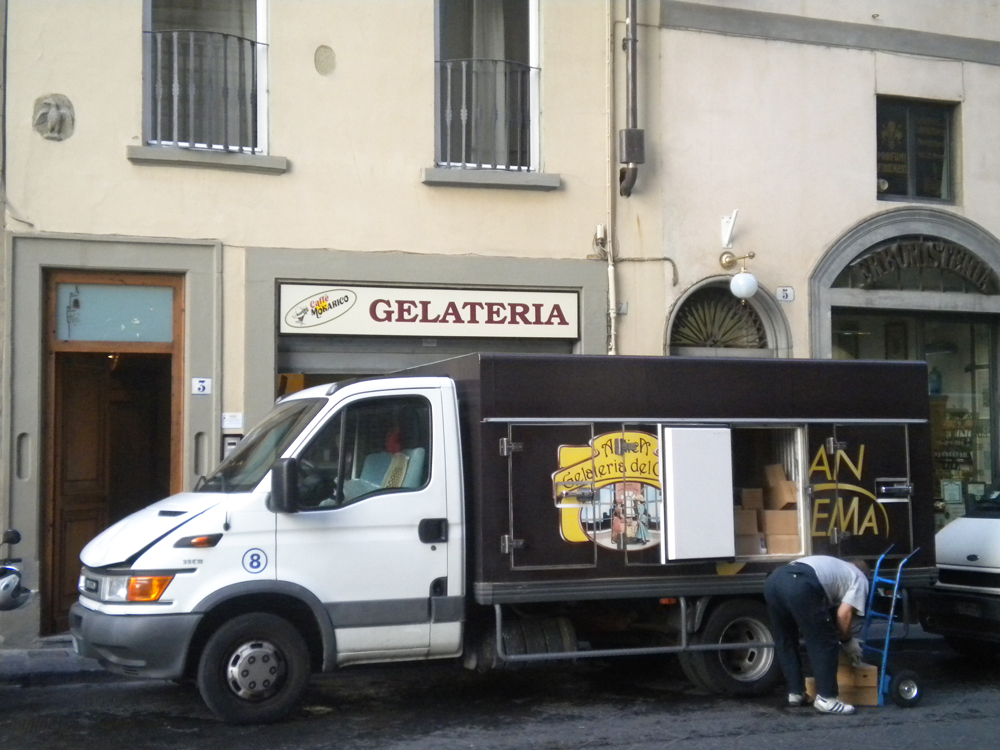
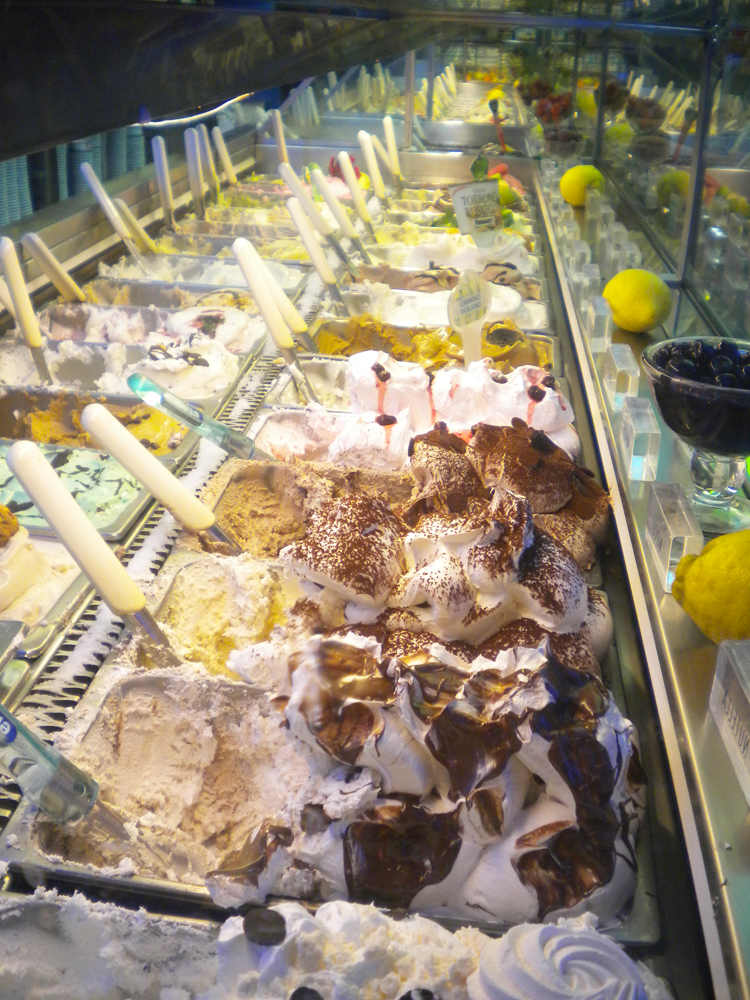
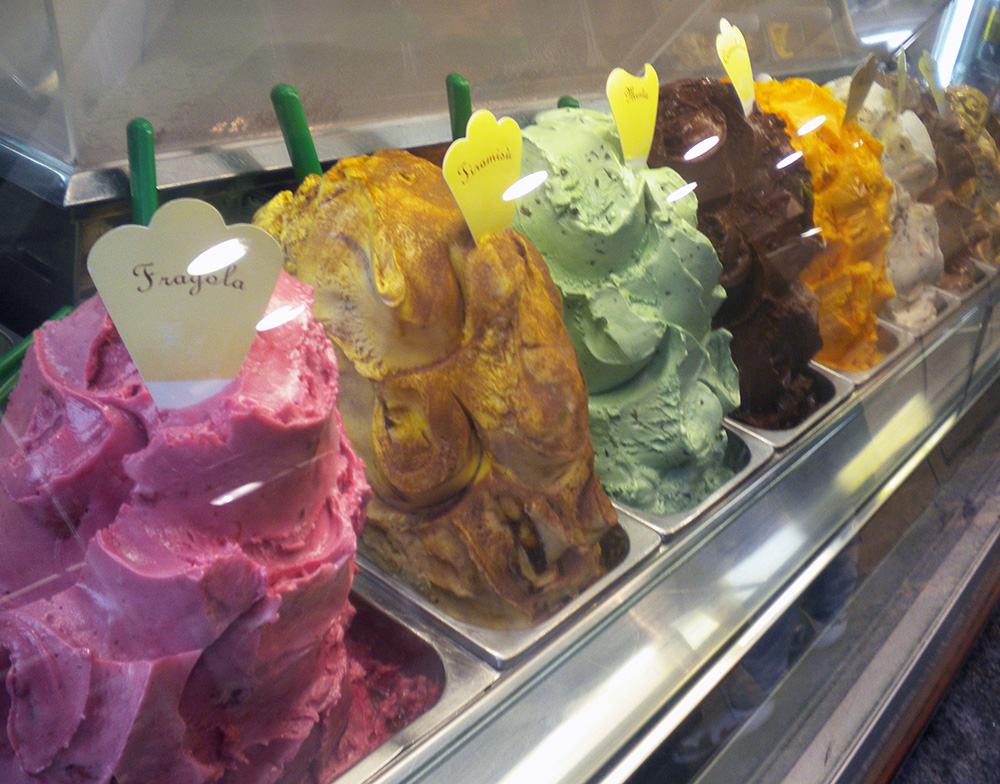
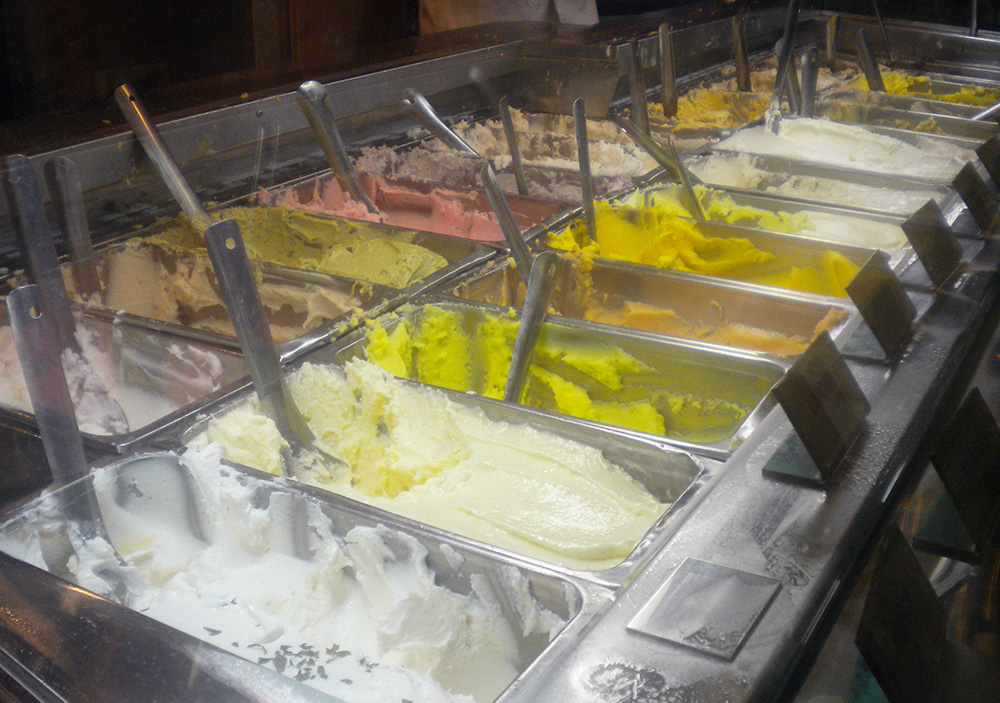
#2) Is the gelato mounded up in huge tall piles? Gelato is soft and fluid, and over time it will naturally flow down, like pudding. The only way to get it to stably stay in a big tall mound is either to freeze it solid (no longer yummy), or to add chemicals that help it remain solid (which can usually be tasted since there is no salt and little fat to conceal them). Thus big, tall, enticing mounds of gelato can be a warning sign. The best gelato will usually not stick above the rim of the bin, unless it has just been brought out. Many very good gelato places don’t even have an open bin, but keep the gelato in round metal containers with lids deep inside the counter. This means you can’t see the color of the gelato, but is generally a good sign, since anywhere that doesn’t show off the visuals of its gelato is usually good enough that it knows it doesn’t have to, and cares more about protecting the gelato than about showing it off. You do need to watch out, though, since some places that serve cheap gelato delivered by vans from warehouses receive it in flat bins with plastic wrap over the top, which is then unwrapped and served. So while tall mounts of gelato are a bad sign, flat bins aren’t a guarantee of quality. Metal lids pretty much always mean good quality.
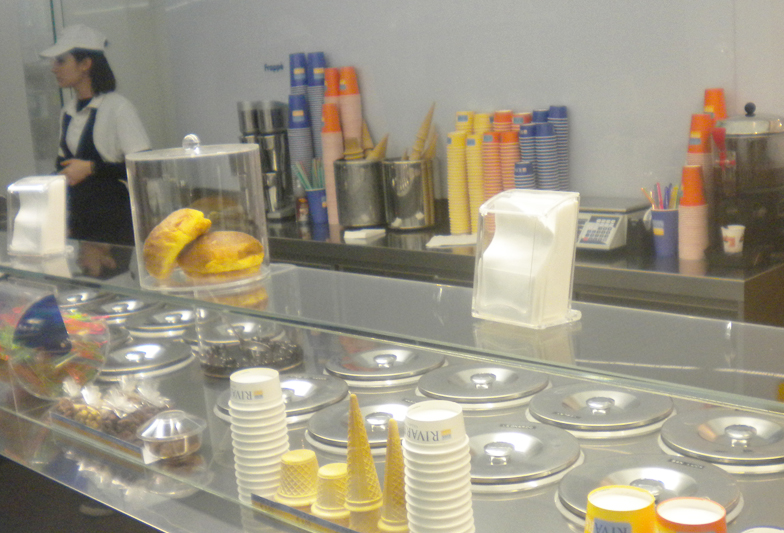
#3) Look at the flavors of fruit offered: are there seasonal fruits? Once again this is a sign relevant to both fruit lovers and those indifferent to fruit. All gelato places will produce lemon, strawberry, and other popular flavors year round, but a gelato place which pays careful attention to the seasons, producing watermelon, apricot, and peach in summer, fig, apple, and pear in autumn, citrus in winter, and diverse berries in spring is another sign that the people in charge care about quality, and are therefore willing to put in extra effort to master a fleeting seasonal fruit which will only be profitable for about a month a year. This too bodes well for the quality of all the flavors. Similarly if you see a bright orange apricot flavor offered in December, safe money says that is a 100% artificial flavor, and many of the others probably are as well.
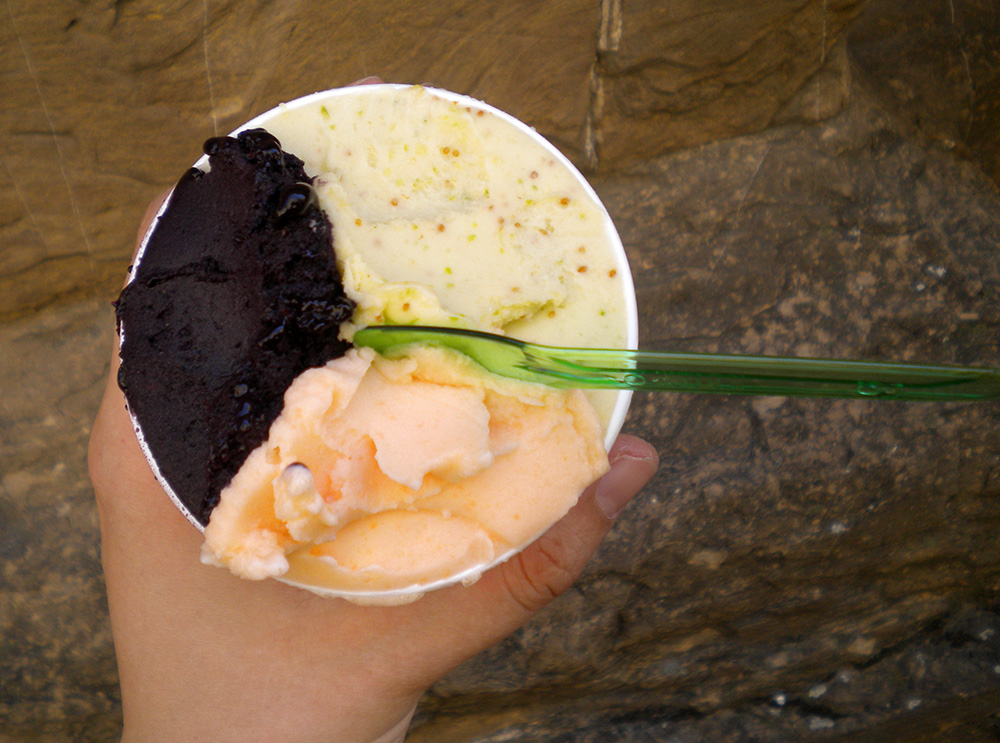
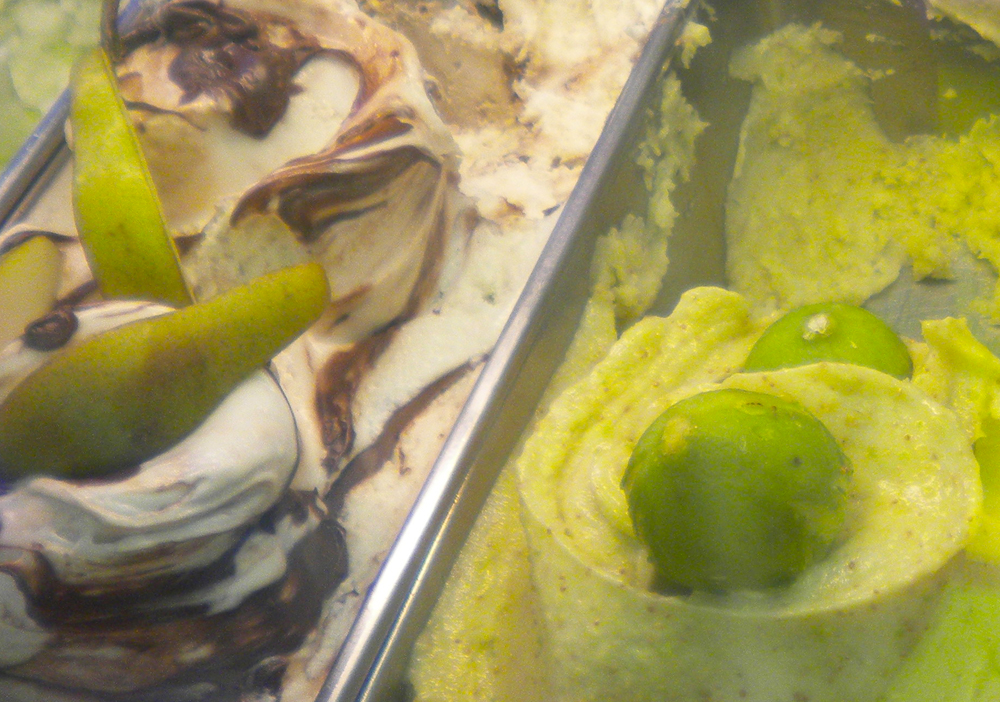
#4) Look at the translucency of the lemon. A small gelato place may not have any of the more telltale fruits, but lemon is pretty much always in stock. Is the lemon an opaque, creamy white that looks rather like the white cream-based flavors? If so, it is milk mixed with lemon extract. If, on the other hand, the lemon is translucent white or subtly yellowish off-white, so the edges of it are almost transparent like the transparent outer edge of an ice cube that’s in the process of melting, then it is just water and fruit extract. This again is a bit more difficult and expensive, because it requires better lemon juice to taste good, and is harder to make stay firm, so again it means the gelato makers have put in more effort.
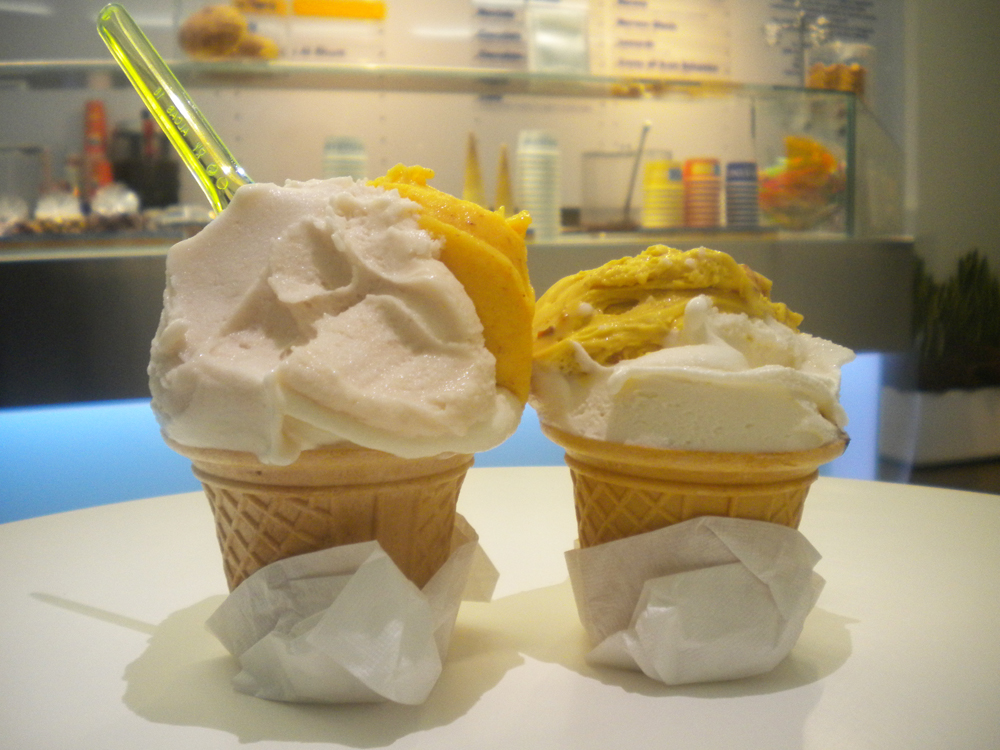
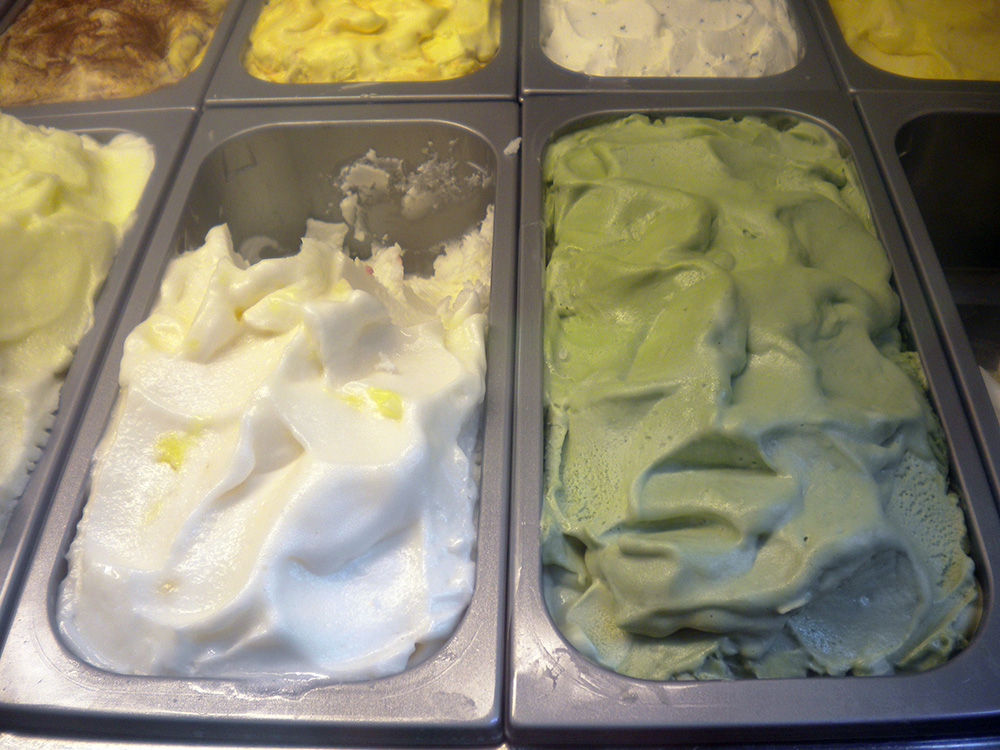
#5) Do they offer fior di latte, or fior di panna? These flavors, made from pure milk and pure cream respectively, are the basic form of gelato. It means they are the flavors that most clearly expose the quality of the milk, and most clearly betray the presence of artificial additives. In Italy, virtually all gelato places will offer fior di latte, and any one that doesn’t is conspicuous. Abroad, especially in the US, it is much more rare, because it exposes inferior ingredients, and few non-Italians know what this flavor is (Americans, for example, always ask for vanilla instead, because we’re not used to the idea that the pure white version of a frozen desert could be so good as to require no flavor, not even vanilla). If a non-Italian gelato place offers fior di latte, it’s often a good sign. If an Italian one offers fior di panna, that is a sign that they have put in extra serious effort into maximizing the flavor of their dairy (and cream is more expensive than milk) so also good. But if they only offer fior di latte with chocolate chips, or with flavored syrup drizzled all over it, they could be showing off their syrups, or they could be covering inferior milk.
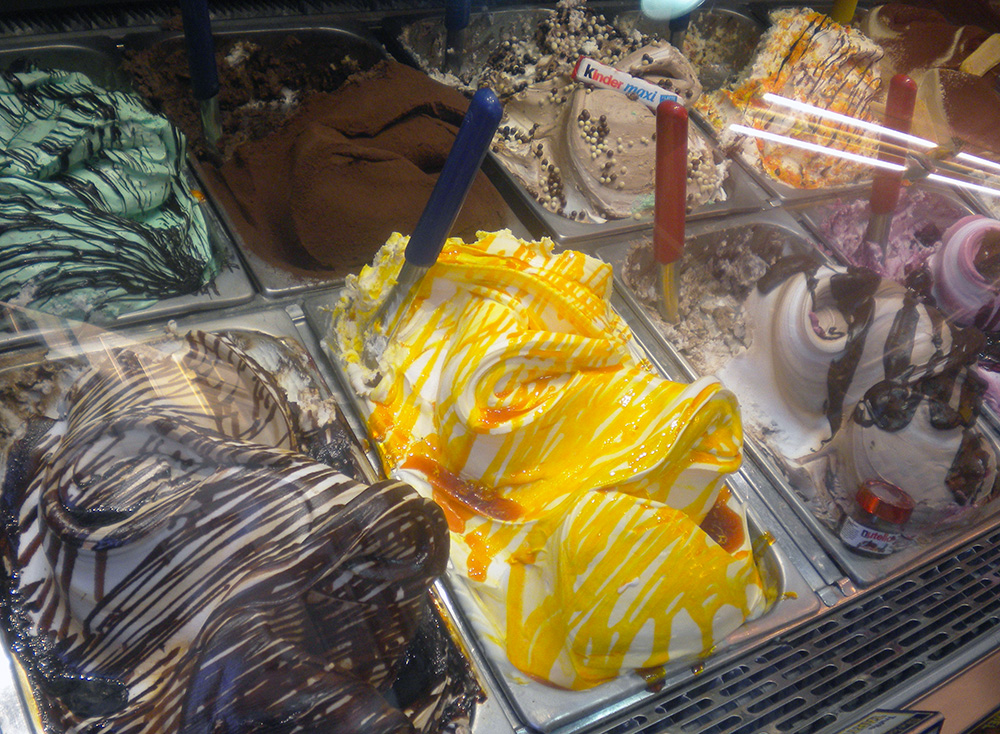
#6) Do they offer hazelnut (nocciola)? This flavor is, gram for gram, usually the most expensive to produce, and to make genuinely powerful. For that reason, many gelato places save funds by offering chocolate-hazelnut flavors, bacio or Nutella, but not pure hazelnut. Others compensate with artificial or weak hazelnut.
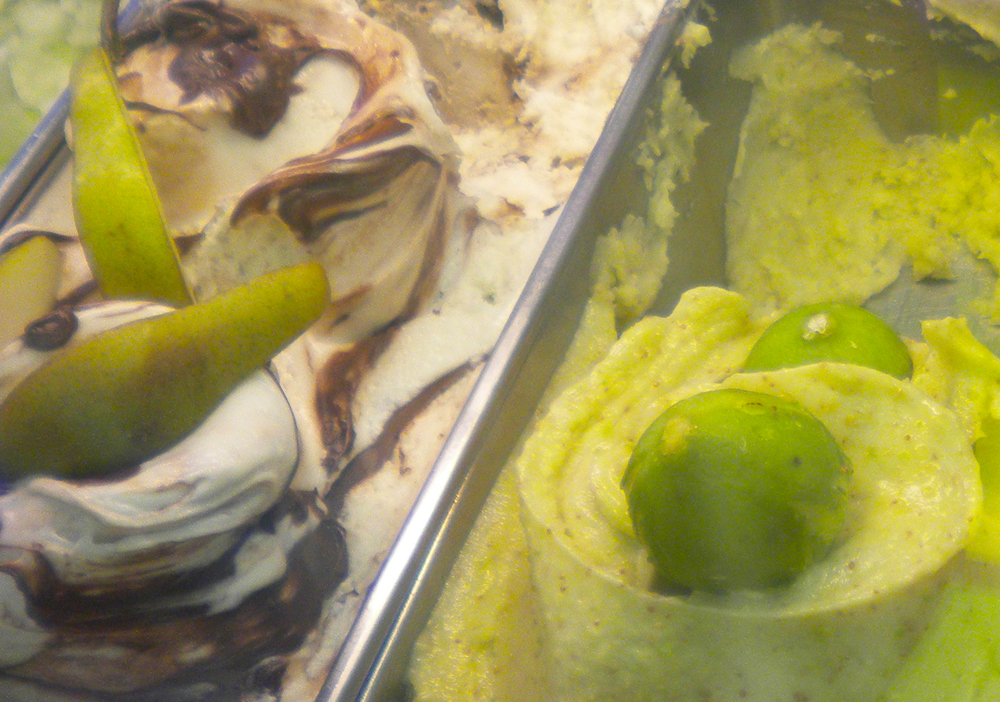
#7) Still in doubt? Now you’re ready to ask to taste something to see if the place is good, but what? Usually you’re going to order two or more flavors, so asking to taste them all in advance is often a bit much. Traditionally people recommend tasting the hazelnut, since if it has a powerful, good flavor it means they are sparing no expense. Tasting fior di latte can also work well, since it is the core of all the other cream-based flavors, so if it is strong and pure the rest will be. Another good choice can be to taste a fruit to see if it’s good quality, or anything unusual or subtle, like basil.
 What do I do if the gelato place is “bad” but it’s the only one around and I want a gelato?
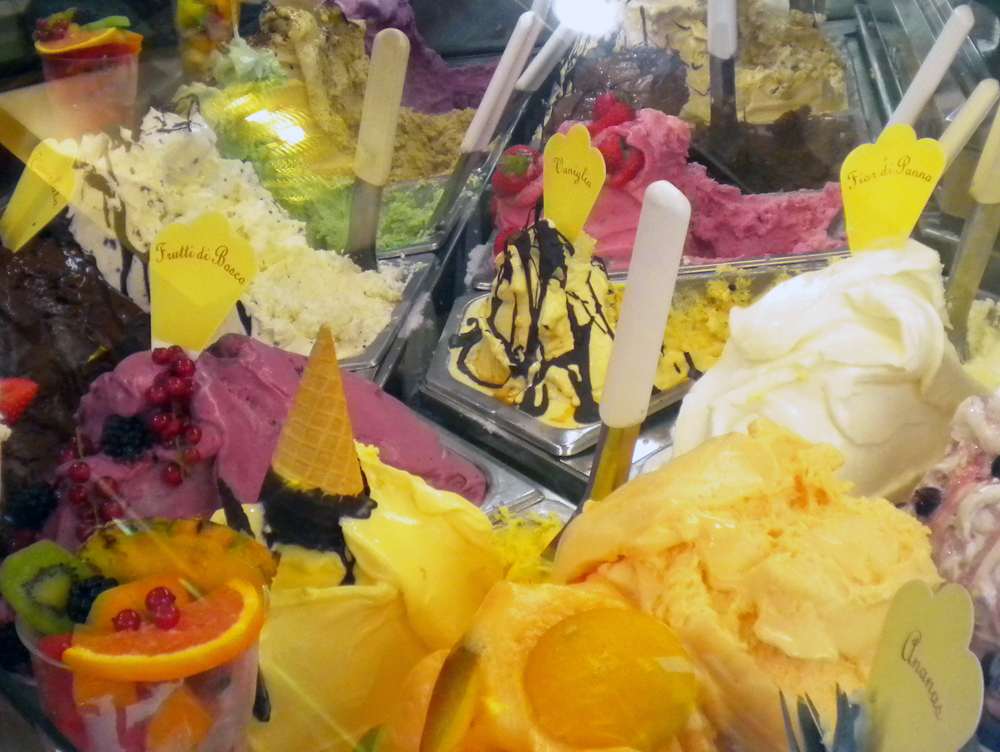
Despair not! You can still have a delicious experience at a mediocre gelato place, you just need to choose your flavors appropriately. Usually if a gelato place is mediocre, it is working with inferior milk, and may have to put additives in the gelato to make it stay soft overnight because they can’t afford to make a new batch every day. These problems can be tasted easily in pure, simple flavors like fior di latte or the fruit sorbets, but you can choose flavors that conceal them, and thus still have a good experience. Chocolate is a reliable fallback in almost all circumstances. Another thing to look out for in mediocre gelato places is a complicated flavor mixing two or more flavors, like tiramisu. A place local to me here has very disappointing sorbets, but respectable chocolate, tiramisu, and pistachio, and remarkably good creative original flavors like root beer or “Elvis” (chocolate, banana, peanut butter) which are well balanced and conceal the mediocre undertones nicely. Lemon is also a good fallback. Whenever I have a rough travel day in Italy, I go to the train station gelato place and get a nice cold lemon, and even the terrible gelato they have in a train station is still miraculously curative after a rough day.
For more on gelato, see also my earlier post: Relax: have a gelato.
My next gelato-related project is to assemble an International Gelato Atlas listing gelato places around the world, to help everyone who has worked up an appetite find good gelato wherever you travel. So far it has lots of listings for the USA and Italy but a few for a whole lot of other countries too. If you know of a good gelato place, please post about it in the comments here, and I will add it to the list. Please specify (A) location, (B) how much of the above test it passes, (C) if its gelato is all natural, (D) recommended flavors, (C) other attributes you consider worth mentioning, and (D) website if there is one. Hopefully together we can make a world wide gelato map capable of combating the symptoms of dreaded gelato withdrawal no matter where we roam!
 , which is the top of the COOLPIX camera line, with very high resolution and an astounding zoom. The 16x zoom is much too powerful to actually be usable unless you set the camera down or use a tripod, but even at half-way-zoomed I could get amazing detail on faraway bits of cathedrals and fortresses. It eats up its batteries, so you need two, but is a great pocket camera.

 . I have been making gelato with it not quite every day for many months now. It is a little loud but whips up a batch in 3o to 45 minutes and many of the best recipes (yogurt gelato, lemon sorbet, chocolate) require practically no preparation. It came with a very good basic recipe book, and for some reason is currently $250 instead of $400+ on Amazon. Also, Amazon allows you to
  , I repeat, subscribe to chocolate, so fresh chocolate powder is delivered to your house for free on a periodic basis to restock your gelato-making needs. There is now no excuse for not having gelato.
 , an astonishingly exciting and even more astonishingly true account of the life and adventures of the Renaissance goldsmith/sculptor/arms-master/duelist/murderer who should’ve been the protagonist of Assassins’ Creed III, and by far the most exciting account of an historical figure’s life I’ve ever read; my manga pick of the year which has to be the long-awaited release of Shigeru Mizuki’s classic
  , a post-WWII collection of classic Japanese oral tradition ghost stories framed around an adorably morbid little zombie boy, packed with folklore and second really only to Astro Boy in its seminal position in mid-20th-century manga (English release finally available for pre-order!); or, the meta-book gift ideal for any bibliophile already weighed down by too many books, Petrarch’s
  , featuring excerpts from his “Remedies against fortune” which advise the reader on how to avoid pride and hubris over owning a lot of books. That’s right, it’s a book about having too many books. Witty, delightful and bilingual, it is a quick and entertaining read, a rich and rewarding reread, and also features dialogues to prevent hubris if you have a graduate degree, multiple graduate degrees, or are a published author.
 , a gorgeous animated film based on the manuscript illuminations of the Book of Kells; the stunning and sadly under-publicized anime film
  , which is as beautiful, wholesome and delight-filled as a Miyazaki movie but with an action plot; and
  , by far the superior (and sadly the more obscure) of the two Borgia TV series that were produced last year. Like all recent over-dramatic historical TV series it makes sex and violence a centerpiece, but they’re the Borgias so it should be nasty, and it does a good job making the sex and violence feel authentically period, while also having the right combination of historical accuracy and storytelling to make it entertaining. We hope someday there will be a season 2.
 are pretty-universally allowed on planes.
 and use it pretty-much every day to turn cloves of garlic into luscious quick-cooking petals of deliciousness.
 like this one, which folds almost as small as a reusable compact shopping bag but is much more practical since it’s a backpack. I usually travel with one and stick it in my pocket when heading out to wander a town, so I can easily carry any shopping. It’s also useful for when one leaves with one bag but inevitably can’t fit new acquisitions into it for the return.
 in your drinks every day, that’s what being a grown-up means! Also, remember those
  shaped like a whale or a dinosaur? Well they’re still just as fun now as they were in the science museum gift shop when you were barely tall enough to peer over the display case.